


 Space and Physics
 PUBLISHED
 1
1


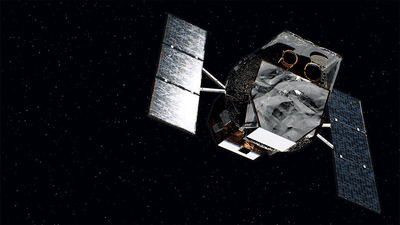


A private spacecraft sent on a mission to rescue NASA's Swift telescope from crashing back down to the Earth has run into its own problems, going into an uncontrollable spin over the weekend.
In 2004, NASA launched the Neil Gehrels Swift Observatory into low-Earth orbit, at the height of around 600 kilometers (372 miles). In the two decades since then it has proved invaluable, rapidly detecting and studying high-energy cosmic events, including gamma-ray bursts and supernovae, as well as identifying these targets swiftly for follow-up by other observatories.
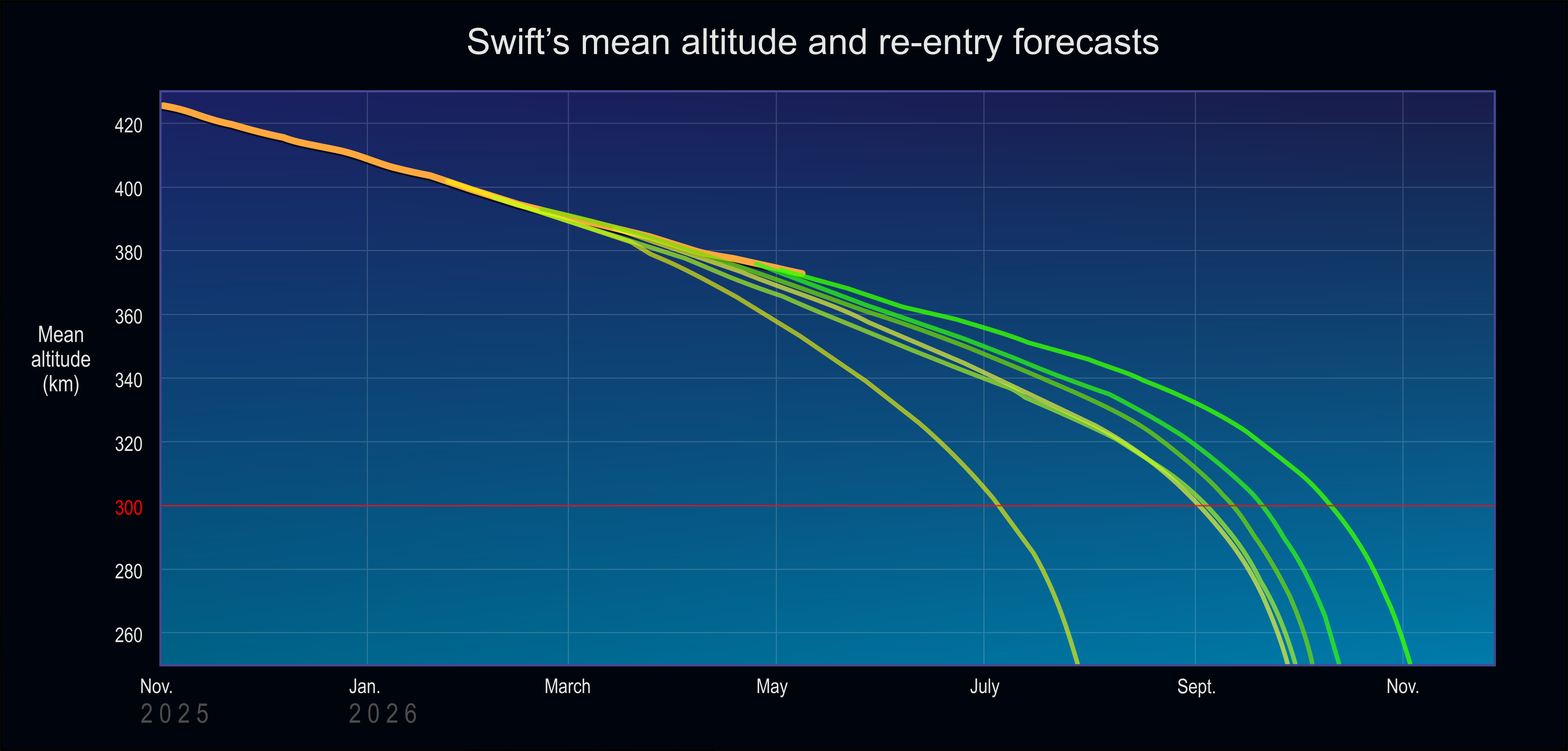
While the observatory began at a reasonable height, its orbit has decayed over time thanks to atmospheric drag. In 2023, it began to look a little hairy for the telescope, with models showing that it could come crashing down to Earth in the 2030s, or within the next few years.
Then 2024 hit the telescope pretty hard.
"In 2024, the Sun reached its solar maximum phase, triggering intense space weather that was more active than expected," NASA explained. "The activity caused Earth’s atmosphere to expand slightly and increased its drag on Swift. By early 2025, almost all the models had Swift re-entering by the summer of 2026."
By the beginning of July 2026, the telescope had descended to 360 kilometers (226 miles) above the Earth, with models now suggesting it has a 90 percent chance of crashing to Earth before 2027.
Rather than allowing the telescope to make its final descent, NASA took the opportunity to test out a private mission to attempt to capture it and deliver it once again to a higher orbit, raising it by 240 kilometers (150 miles).
That mission was awarded to Katalyst Space Technologies, who designed and built the LINK robotic servicing spacecraft on the tight deadline of only a year. LINK launched on July 3, 2026, and initially seemed to be going well, with the spacecraft on track to approach, survey, grab, and boost the falling telescope.
However, over the spacecraft has now gone into a "multi-axis spin" due to technical issues with its altitude control.
"Over the weekend, Katalyst’s LINK servicing spacecraft experienced issues with attitude control, causing the spacecraft to spin and resulting in sporadic communications," NASA explained in an update. "Preliminary investigation shows that two of LINK’s three reaction wheels currently are not operable, and there is some loss of functionality in its cold gas thruster system."
Whilst certainly not ideal, the team is attempting to get the spacecraft under control. With other systems in good health, the team is hopeful that the mission can be rescued, along with an orbiting observatory.
"LINK’s other major subsystems, electric propulsion, robotics, RPO sensing, and power are functioning properly, as well as S-band and L-band communications," Katalyst added in their own mission update.
"Over the coming days, Katalyst will work to reduce the body rates using the gimbaled electric propulsion thrusters and stabilize the spacecraft. We have already begun this series of burns and are seeing the intended effect. "
In the coming days, the team intends to update the control schemes of the spacecraft to reflect its current configuration and available, working thrusters. After that, the team will test out this new configuration, before attempting to move the spacecraft towards its target.
"While these technical issues require a revised approach, our team is working around the clock alongside our NASA partners," Katalyst added. "The mission remains active and we continue to believe that with these changes, LINK has a viable path to rendezvous with Swift."
Should these problems get sorted, LINK still has a tricky task ahead of it, in this first-of-its-kind mission.
"Then LINK will approach Swift and complete a visual survey," NASA explains. "The Katalyst team has identified several potential grab points, but after 20 years of wear and tear in space, those locations need to be verified with the Swift team before moving forward."
More updates on the mission will come as the double rescue attempt unfolds. Fingers crossed, everybody – we do not want to lose this telescope.


