Space and Physics
 PUBLISHED




In the coming months, NASA and private space company Katalyst will attempt something that has never been done before: they will launch a spacecraft to grab a telescope and move it to a safer orbit. This is necessary because the telescope has a really high chance of falling through the atmosphere this year.
That telescope is no other than the Neil Gehrels Swift Observatory. It is a veteran mission, launched on November 20, 2004, which has looked at the most powerful events in the universe: gamma ray bursts. Its abilities are not confined to those, however; recently it studied interstellar comet 3I/ATLAS, making it a very unique and important instrument in orbit. Unfortunately, that very orbit is decaying.
The atmosphere of our planet doesn’t simply stop when we enter space. It is ever more rarefied, but it is still there. Slowly, over time, that extremely tenuous atmosphere slows spacecraft down; lower velocity around the Earth means a lower orbit. On top of that, in periods of intense solar activity, like this current solar cycle, which peaked in October 2024, the atmosphere can swell up, increasing the drag.
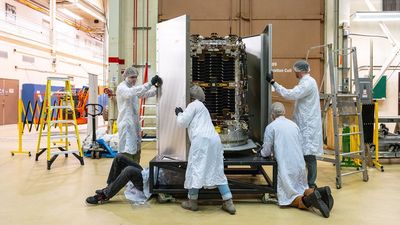
Swift was massively affected. Back in November 2025, there was a 50 percent chance that the telescope would fall back to Earth and burn up in the atmosphere by June 2026 and a 90 percent chance that this would happen before 2027. For this reason, NASA awarded Katalyst $30 million to build a robotic spacecraft that can lift Swift to a more stable orbit. Since April 14, this spacecraft, named LINK, has been undergoing testing at NASA’s Goddard Space Flight Center.
“It’s only been about seven months since NASA awarded Katalyst a contract to attempt to boost Swift with the company’s LINK satellite,” S. Bradley Cenko, Swift’s principal investigator at NASA Goddard, said in a statement. “Combined with our changes to science operations, the teams are creating the best opportunity possible to extend Swift’s lifetime and continue its legacy of cosmic exploration.”
Over the last several months, the Swift team has decided to turn off instruments and modify operations to massively reduce power consumption. This approach meant that they could reposition its solar panels to reduce drag as much as possible, extending the available timeline by several months.
“Swift is still producing valuable scientific data, and we have a way to preserve that while setting a blueprint for how we operate in space,” added Ghonhee Lee, Katalyst’s chief executive officer. “The Swift boost mission is designed to extend the life of an existing spacecraft, one not designed for servicing, quickly and cost effectively. NASA is leading the shift toward more flexible ways of operating in space by working with companies like Katalyst to get more out of its missions and deliver the best return for taxpayers.”
No details are available for exactly when LINK will be launched, though it was originally expected to launch no earlier than June 2026. The craft will travel to space on a Pegasus XL rocket developed by Northrop Grumman and will be launched not from the ground, but from a plane. This particular setup will get LINK to the peculiar orbit of Swift easily; none of the US spaceports have the right setup for reaching Swift on a simple trajectory.