


 Space and Physics
 PUBLISHED
 1
1



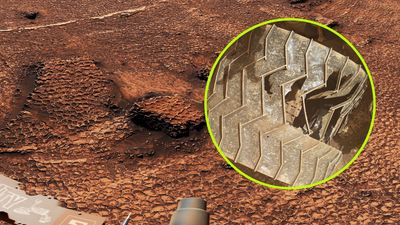


NASA's Curiosity rover has encountered a giant field of honeycomb-like structures in the Valle Grande region of Mars. While it's an awesome discovery, photos beamed back by the rover show extensive damage to one of its wheels.
Let's begin with the positive news. Recently, while investigating the valley, Curiosity was dispatched to an area that appeared lighter in tone from orbit and looked relatively smooth when observed from the rover's earlier vantage points.
Once there, the Curiosity team was rewarded with the discovery of some particularly unusual and intriguing polygonal structures scattered across the Martian surface, they look like Martian honeycomb.
The area beside the polygonal structures was strewn with small, dark-toned rocks. Because Mars has a much thinner atmosphere than Earth, offering far less protection from incoming meteorites, it's quite possible these are remnants launched into the air by an impact that later settled onto the Martian regolith.
"A still-to-be-resolved question is whether these are bits of Mars that 'floated' down from higher in the stratigraphy, were ejected from distant impacts outside of Gale crater, or are meteorites from beyond Mars altogether," the team added in an update.
"Examination of some previous dark 'float' rocks indicated the presence of nickel, common in meteorites but less so in Martian rocks, but are all of the dark-toned pebbles and cobbles meteorites? Further investigations should help in answering this question."
Since then, Curiosity has continued to climb the valley, finding polygonal fractures on the floor stretching as far as the rover can image. While Curiosity has encountered structures like these before, the team said they've not seen anything of this scale.
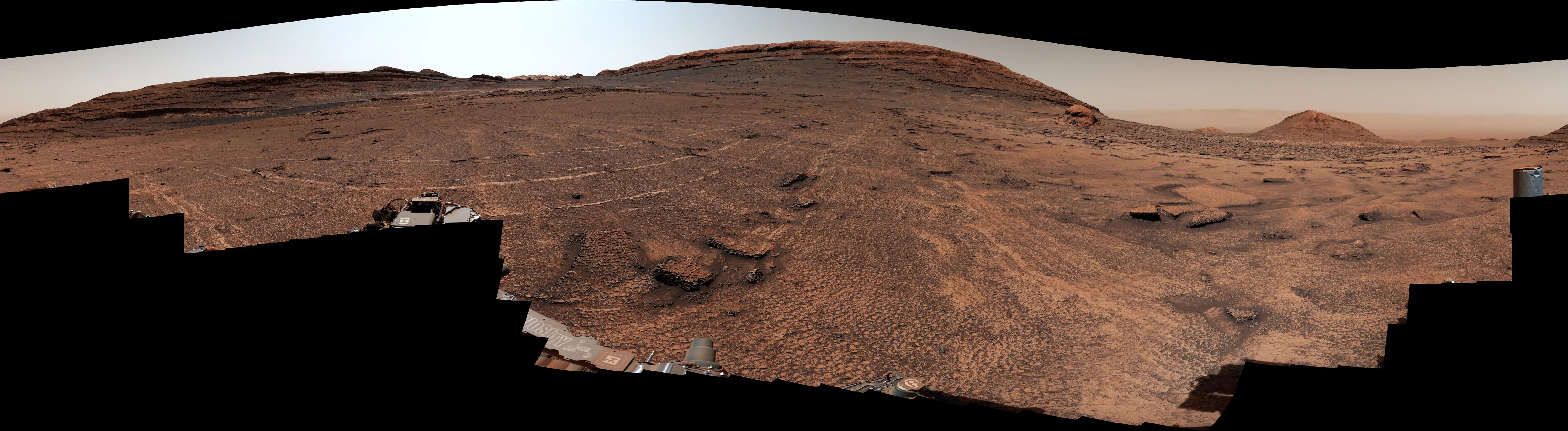
“We’ve seen a lot of fascinating landscapes through Curiosity’s eyes, but this sea of polygons took our breath away,” the mission’s project scientist, Ashwin Vasavada of NASA’s Jet Propulsion Laboratory in Southern California, said in a statement.
“We measured their shapes and chemistry carefully and are hopeful there are clues in the data as to how these features formed.”
According to the team, the structures range from around 4 centimeters to 8 centimeters (1.5 to 3 inches) across. The rover even found them on the sides of a 6-meter (20-foot) butte – an isolated hill with a small flat top – nicknamed “Miraflores".
The researchers are still investigating the structures; however, they note that other, similar structures seen by Curiosity likely formed as mud cracks, and the heating and cooling of Mars's surface, squeezing water out of the sediment, could also explain them.
More worrying news comes from the Curiosity rover turning its cameras on itself, something it does periodically to check for signs of damage.
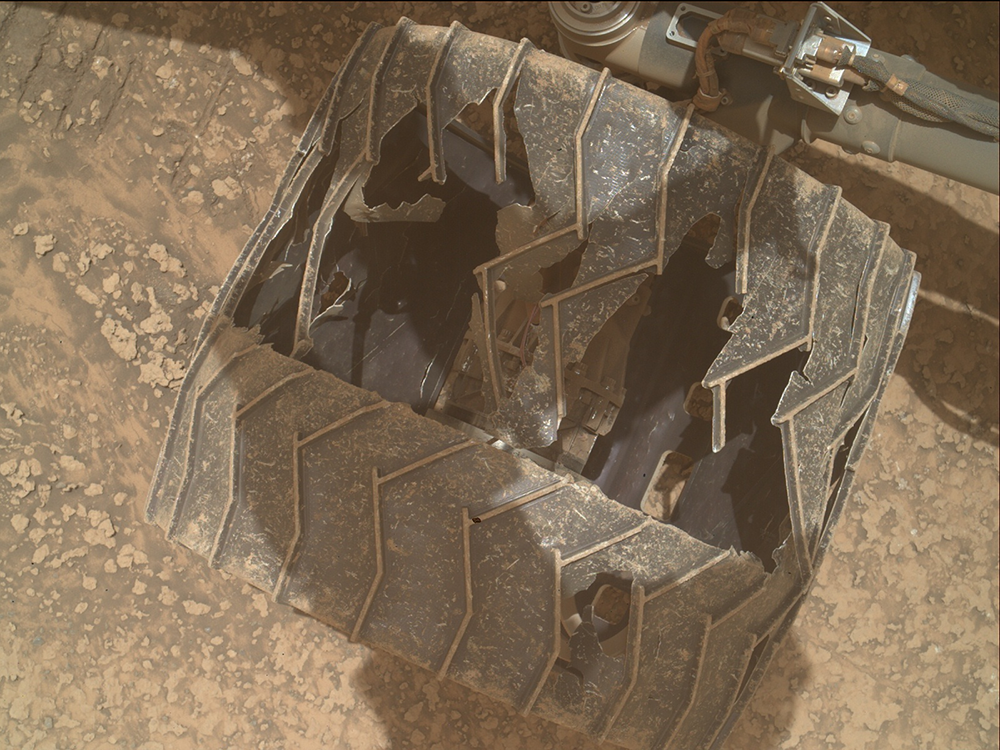
As you can see for yourself, the damage to this wheel is getting pretty extensive, though it doesn't look too much worse than when it was seen in March 2026.
NASA hasn't revealed any imminent plans to deal with the situation, but there are a number of ways to help the plucky little rover continue its work on Mars.
The first of these, which has already been carried out, includes preventing further damage to Curiosity by carefully selecting smoother terrain for it to travel over. Another idea, carried out in 2017, was to update the rover's software.
"The traction control algorithm uses real-time data to adjust each wheel's speed, reducing pressure from the rocks," NASA explained.
"The software measures changes to the suspension system to figure out the contact points of each wheel. Then, it calculates the correct speed to avoid slippage, improving the rover's traction."
When the wheel falls off
Should the wheel get any worse, however, NASA may consider the nuclear option: making Curiosity snap the inner part of the damaged wheel off.
"Although Curiosity’s wheels continue to accumulate damage as the rover continues to drive across mixed Martian terrain, an individual wheel can absorb significant damage before it causes any impact to mobility performance," a NASA paper explains.
"Testing in the JPL Mars Yard on the Scarecrow testbed rover indicates that Curiosity could continue to drive indefinitely on the portion of a wheel that remains when all the grousers on a wheel break, if the unconstrained portion of the wheel can be safely shed."
A grouser is one of the ridges on the wheel that provides traction. The worry is that if all of these break, the inner part of the wheel might start to move around and contact an electrical cable.
According to the team, the best way to avoid this happening is to use the environment around the rover to snap that part of the wheel off.
Trialing two sequential techniques, known as the "Twist and Shout Maneuver" and the "Pigeon Toe Maneuver," the basic idea tested with Scarecrow is that the rover team will find a nice rock to get the broken wheel trapped on, before flooring the remaining three wheels until the damaged part snaps off.
Fingers crossed it won't come to that, but it's nice to have options, especially given the new surprises Curiosity is finding after nearly 14 years on the planet.


