Space and Physics
 PUBLISHED


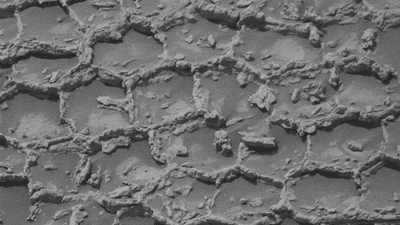


NASA's Curiosity rover has, of late, been getting less attention than the newer and fancier Perseverance rover. That is probably to be expected, given that Perseverance is over exploring the Jezero Crater, where it has found "the only detection of macromolecular carbon on a natural rock surface on Mars", as well as the tantalizing possible biosignature detected in an exciting rock nicknamed Cheyava Falls, while casually completing a marathon.
But, dammit, despite a heavily damaged wheel, which it may one day have to break off, Curiosity is still chugging along and exploring some interesting areas of Mars that are worthy of Earth's attention. Recently, the rover was sent to investigate an area that appeared lighter in tone when viewed from orbit, but smooth from earlier positions of the rover, and the Curiosity team was rewarded with some particularly interesting and strange-looking polygonal structures lying on the Martian floor.
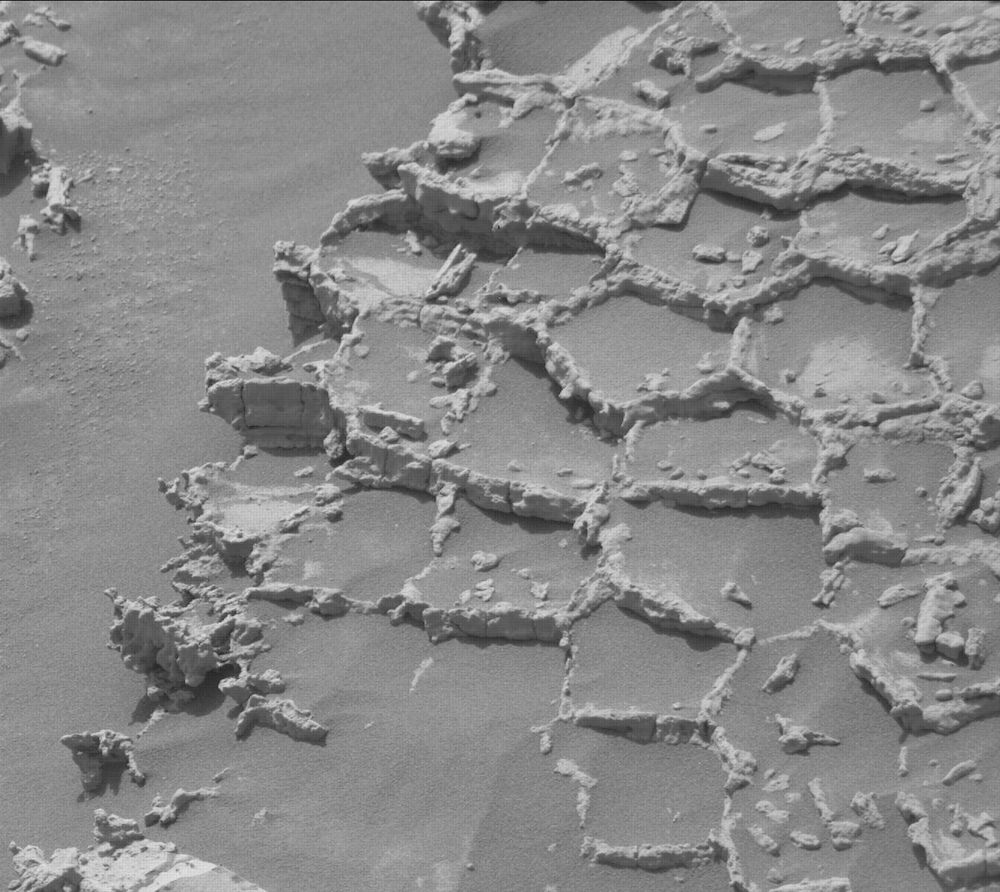
"Reaching this unit, the rover team was surprised to see the unit covered with polygonal structures like the top of a giant Martian honeycomb," NASA explained in an update, adding that the structures' ridges appeared more eroded the further into the area that Curiosity traveled.
So, what has caused this? Are we looking at aliens with a bit of fondness for a mosaic, or some kind of giant Martian floor bees? Of course not. Though the structures appear pretty interesting to our pattern-finding minds, there is no reason to think that these formations are in any way non-natural, just to head off the conspiracy theories at the pass.
Nature does tend to throw up some interesting recognisable patterns here and there, and often far more suspiciously perfect than the rocks seen by Curiosity at Gale Crater. Fascinating examples include the hexagonal storm on Saturn and Northern Ireland's Giant’s Causeway, which has over 40,000 polygonal columns of basalt. Both of these, and plenty of others, are explained through normal, natural processes.
That doesn't mean that the discovery is uninteresting, however. As well as the polygonal structures, which the team investigated further and will no doubt provide an update on, Curiosity found that the area was littered with small, dark-toned rocks. With the Martian atmosphere far thinner than Earth's, making it less protective against meteorites, there is a good chance that these scattered rocks may be due to an impact event.
"A still-to-be-resolved question is whether these are bits of Mars that 'floated' down from higher in the stratigraphy, were ejected from distant impacts outside of Gale crater, or are meteorites from beyond Mars altogether," the team says.
"Examination of some previous dark 'float' rocks indicated the presence of nickel, common in meteorites but less so in Martian rocks, but are all of the dark-toned pebbles and cobbles meteorites? Further investigations should help in answering this question."
The team has so far conducted measurements on the unusual structures and rocks using the ChemCam, with results from these likely on their way in the near future. For now, Curiosity trundles onwards to investigate the formation further, before heading to another polygon ridge and investigating an interesting area of dark-toned rocks spotted from orbit. Who knows what the aging rover will find.