Nature
 PUBLISHED



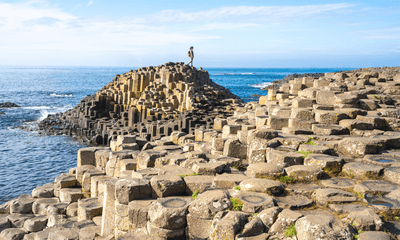


The origin story of Giant's Causeway in Northern Ireland has just been revised, though sadly the ancient battling titans of folklore still don't appear to have been involved. Thanks to cutting-edge technology, researchers at the British Geological Survey (BGS) and the Geological Survey of Northern Ireland (GSNI) have pinpointed its creation to within a far more precise timeframe than ever before.
Located in County Antrim at the northernmost tip of Northern Ireland, Giant's Causeway is a world-famous geological formation of around 40,000 basalt columns, each with a distinctive hexagonal shape.
Legendary origins
Legend has it that the structure was built by an Irish giant named Fionn mac Cumhaill (often anglicized to Finn McCool), who laid a path of rocks across the sea to confront his Scottish rival, Benandonner.
With its peculiar, angular geometry, it's not hard to see why people once believed these columns were crafted by conscious hands rather than natural forces. Science, however, has long had other ideas.
We know now that the causeway's otherworldly appearance is due to massive lava flows spilling up from deep underground that cooled, contracted, and cracked into the remarkable shapes we see today. It’s a process called columnar jointing, and it can be seen elsewhere around the northeastern fringes of the Atlantic Ocean, such as at Stuðlagil in Iceland.
The new study
In the new study, researchers from the BGS and GSNI show that the Giant's Causeway, along with other formations in the region, was created as part of the same globally significant volcanic event that produced many unusual geological structures across modern-day Iceland, Greenland, Scotland, and Ireland.
“Cutting-edge analysis has allowed us, for the first time, to place the volcanic activity that led to the formation of the Giant’s Causeway within a much more precise global context,” Simon Tapster, a geochronologist at the British Geological Survey, said in a statement.
How was Giant's Causeway formed?
Its story begins around 60 million years ago, when a massive blob of superheated rock rose from deep beneath what is now the North Atlantic, like a gloopy bubble drifting upwards in a lava lamp.
As it pushed toward the surface, it triggered enormous volcanic eruptions across the landmasses that would eventually become Iceland, Greenland, Scotland, and Ireland.
While the Giant’s Causeway appeared to fit neatly into this picture, some of its volcanic rocks were thought to be far younger than those elsewhere in the region, making it look like an outlier in the story.
However, through new geochemical analysis and airborne magnetic surveys, the researchers were able to show that previous dating hadn't been totally accurate. Once corrected, the Causeway's volcanic history aligns with the rest of the region, which is known as the North Atlantic Igneous Province.
In turn, this suggests the episode of volcanic activity that gave birth to the causeway unfolded within a window of just 5.5 million years, less than half the 13.5 million previously assumed.
“For decades, it was believed the region’s volcanic activity, responsible for the Giant’s Causeway, stretched over 13.5 million years during a time period we refer to as the Paleogene,” explained Mark Cooper, study author and chief geologist at the GSNI.
“Our research shows that this activity was far more concentrated, with geological processes acting much faster than previously thought. These findings have completely changed how we understand the Northern Ireland’s place in the wider North Atlantic volcanic story,” explained Cooper.
The new study is published in the journal Geology.