Space and Physics
 PUBLISHED


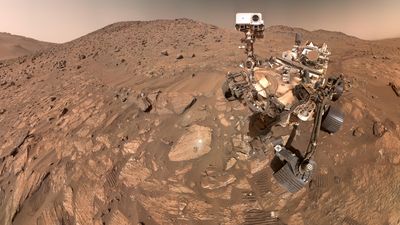


NASA’s Perseverance has reported the detection of macromolecular carbon in Martian mudstones. The detection comes from the same outcrop, nicknamed Bright Angel, where the now-famous Cheyava Falls rock formation is. The Cheyava Falls sample is currently the only known Mars sample we've found with a "possible biosignature".
While a possible biosignature does not mean life, the sample is certainly puzzling. The new findings will actually strengthen the case for why this whole area is incredibly exciting. The team analyzed some areas of two mudstones and reported the detection of hundreds of organic compounds.
According to the team, writing in a new paper, the observations are “the most robust organic detection in Jezero Crater thus far, and, to our knowledge, the only detection of macromolecular carbon on a natural rock surface on Mars.”
After Cheyava Falls and the previously reported Apollo Temple samples, the team analyzed rocks that have been given the names Walhalla Glades, Steamboat Mountain, and Beaver Falls. While the names of the samples are a bit peculiar, the tantalizing possibility of what they mean for life on Mars makes them worth remembering.
A very interesting finding is that the carbon in the mudstones is hardly weathered. It is possible that the rocks have only been recently exposed to the Martian surface or, alternatively, the substances in question are more resistant to the effects of radiation and oxidation.
One mudstone contained carbon within a primary silicate-dominated matrix, while the second one had organic molecules mixed with sulfate and carbonate minerals. While in chemistry we use the word "organic", it is possible that these molecules formed without the presence of life at all.
In fact, even the Cheyava Falls rock with its puzzling and exciting "leopard spots" is just on the first rung of NASA’s Confidence of Life Detection (CoLD) scale. The CoLD Scale is made of seven steps, and when it comes to the possibility of life beyond Earth, we don’t want to skip any of them.
.png "A diverse group of scientists in labcoats including one in a wheel chairs build up brick by brick a starcase. On the right most end, there are the names of the seven steps: The first one is detect a possible signal. Followed by ruling out contamination, making sure that the biology is possible, and ruling out a non-biological explanation. The final threes is the discovery of an additional independent signal, ruling out other hypotheses, and finally an independent confirmation.")
Cheyava Falls is on number one: the detection of a possible signal. Number 2 is ruling out contamination, and number 3 is making sure that the biology is possible. Fourth is a big one: ruling out a non-biological explanation.
The final three are the discovery of an additional independent signal, ruling out other hypotheses, and, finally, an independent confirmation.
The discovery of complex carbon-based molecules does not shift the classification for the Cheyava Falls sample but provides intriguing context for future analysis.
The study is published in the journal Science Advances.

 1
1