Space and Physics
 PUBLISHED
 1
1


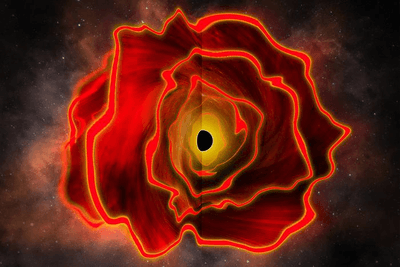


A survey using the space telescope JWST has found evidence of a peculiar star-like quality in a black hole from the early universe, leading researchers to suspect they are looking at a brand-new type of astrophysical object: a black hole encased in a ball of hydrogen that makes it appear like a giant star, or "black hole star".
While seeking galaxies in the early universe, JWST has spotted a plethora of objects since dubbed “little red dots." These existed soon after the Big Bang and must be tremendously bright for us to see them at this distance, leading to almost a thousand peer-reviewed papers in four years exploring their nature.
The dots are of particular interest because they seem to contain inexplicably large black holes. The presence of these monsters so early in the universe's history is a bit of a mystery, as they shouldn't have had enough time to form by the mechanisms we are familiar with in modern galaxies.
Dr Rohan Naidu at MIT and his colleagues were actually on an entirely separate quest, trying to weed out objects in JWST images called "mirages," because they are much closer than they appear. In the process, they found an object that isn't quite as distant as other little red dots but is stupendously bright and red.
“When we see something very red in the universe, we often assume that it is surrounded by dust, like soot or ash,” said MIT Professor Robert Simcoe in a statement.
“The same way that the wildfire smoke from Canada recently made the sky in Boston look bright red, astronomical objects can also appear redder than their intrinsic color when you see them through a veil of dust.”
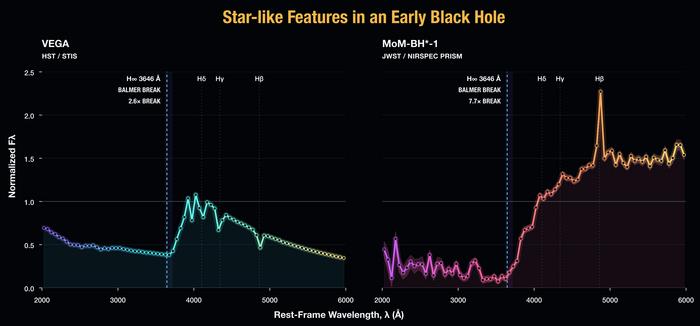
However, the object in question’s brightness cuts out suddenly at short wavelengths, a phenomenon known as a “Balmer break.” Dust doesn’t cause Balmer breaks, but some young stars do when gas in their atmospheres captures light shorter than specific wavelengths.
“The break we observed in this object is the deepest break we have ever observed in any object, ruling out ‘ordinary’ stars as the source,” Naidu said. “But it made us wonder if we were seeing a new kind of ‘stellar atmosphere,’ but on a spectacular scale.”
Metal-free
The new object’s spectrum indicates an almost complete absence of elements heavier than helium (which astronomers confusingly refer to as metals), indicating it predates any supernovae nearby.
The team sought to model what it would take to produce such a red color with hydrogen alone, and they were surprised to discover it could happen “if you have an extremely dense screen of hydrogen, so dense that it looks more like the surface of an enormous star than a wispy interstellar nebula,” Simcoe said.
However, while the hydrogen cocoon explains the color, the sheer brightness requires a special power source.
The brightest objects in the universe are quasars, brilliant bursts of energy powered by black holes, but this doesn’t look like one of them.
Instead: “You have something that looks a bit like a star but is 100 billion times brighter,” Naidu said. “That means you can’t be powering this by nuclear fusion, which is the energy source that sits at the heart of all the stars we have.”
How could the brightness of a black hole’s accretion disk and the spectrum of a star be combined? The most likely explanation the team can find is that we are looking at a black hole about 100,000 times as massive as the Sun – small by the standards of supermassive black holes – that is surrounded by dense hydrogen with a radius five times as wide as the distance to Voyager 1.
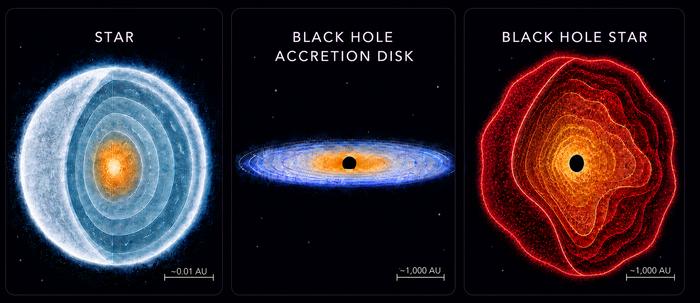
The team has called the object MoM-BH*-1, the * being used to designate black holes and the initial acronym coming from their project “Miracle or Mirage."
MoM-BH*-1 is considerably brighter than JWST’s typical little red dots, but that may just be because they are smaller versions of the same thing. If they are, this object may have helped explain how they came to be, because its configuration is consistent with a scenario called super-Eddington feeding, which is one proposed mechanism for getting big black holes early on in the universe.
“Every little red dot is consistent with being a black hole star, embedded in a generic early galaxy,” Naidu said. “But what is special about MoM-BH*-1 is the black hole star is essentially completely outshining its surrounding host galaxy, such that we’re seeing pure black hole star light.”
That may not be the case forever, though. There is a bright galaxy near MoM-BH*-1 and the two are expected to merge in about 100 million years. At that point it could match the appearance of other little red dots.
“Astronomers have never lacked imagination”
Little red dots might not be the only mystery MoM-BH*-1 can shed light on, as the unusual object could potentially help explain "problematic quasars," a group of objects that appear to be quasars but are far too massive compared with what we'd expect for their age.
“Astronomers have never lacked imagination: since the discovery of quasars, there has been no dearth of theories to explain how these black holes grew so massive so fast,” said Naidu.
“Something spectacular must have happened in the early universe. Now with JWST, we can directly observe this era and see for ourselves which scenarios actually occur.”
Once encased in a galaxy, there is a possibility that MoM-BH*-1 may transform into a problematic quasar.
MoM-BH*-1 is not entirely unique, however. At the time astronomers first announced their finding on Arxiv.org, they also reported an object dubbed The Cliff for a similarly extreme Balmer break. We are seeing the Cliff about 2 billion years after MoM-BH*-1, around the time star formation in the universe peaked.
A further black hole star candidate of similar age to The Cliff has also been found, but it is likely these were late stragglers. Being so much closer to Earth, we can see them far more easily than those from MoM-BH*-1’s time, which struggle to stand out unless they happen to be fantastically bright.
Proving Naidu’s point about imagination, three years ago a paper drew attention for proposing apparently ordinary stars might have small black holes at their cores.
Inspired by Soundgarden’s song Black Hole Sun, Dr Earl Bellinger modeled whether we could tell if stars had black holes inside them and concluded that a black hole the mass of an asteroid would be impossible to detect.
Planetary mass black holes would change the timing of the star’s conversion to a red giant, however, so a class of stars known as red stragglers might be powered this way.
MoM-BH*-1 clearly operates on an entirely different scale, and arguably shouldn’t really be considered a star. Nevertheless, its existence might cause second looks at Bellinger’s work.
The study is published in Nature.