Space and Physics
 PUBLISHED
 3
3


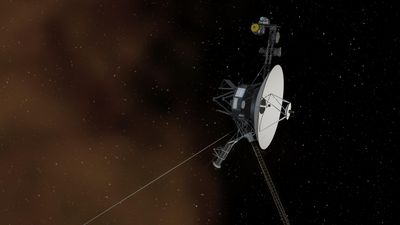


Voyager 1 is the most distant human-made object we have ever sent into space, and in just a few months, it will cross a pretty incredible threshold: it will be 1 light-day away from Earth, the first human-made spacecraft to reach this distance. Now, the Voyager mission team has just confirmed to IFLScience the exact date it will meet this milestone. Voyager 1 will be a record-breaking 1 light-day away on November 18, 2026.
Voyager 1 and 2 are the only human-made spacecraft that have reached interstellar space, which means beyond the heliosphere at the edge of the Solar System. One light-day away means it will take the spacecraft 24 hours or more to send a signal to Earth.
NASA did note that due to the motions of both the spacecraft and our planet, the exact moment when the signals between us and Voyager 1 will take 24 hours might be slightly different, but currently, it looks like the precise time will be 2:16:07 am PST (10:16:07 am UTC) on Wednesday, November 18, 2026.
A date to remember
November 18 is going to be a date to remember! We at IFLScience have been excited about this date for a while. Last year, I did some very simple calculations based on publicly available data to work out when this might happen and managed to calculate an estimated November 13 (pretty close!). But we knew to confirm it we had to hear directly from the Voyager team.
It took some time, and more calculations are ongoing (NASA might be quite tired of all of my emails checking in). It's not like the Voyager team is simply waiting around with nothing to do, though. Very much the opposite!
Just a few months ago, the team had to regretfully turn off an instrument to save power. They are now planning a radical and exciting intervention to extend the longevity of Voyager 1 and its twin Voyager 2.
I won't pretend that the Voyagers are not among our favorite missions. They have been in space for all my life. It is simply extraordinary that we got to see a human-made object cross the threshold of 1 light-day, an incredibly cosmic record.
Voyager 1 & Voyager 2—what an extraordinary journey, so far!
The Voyager probes were launched in 1977, and after just shy of 50 years in space, they continue to give us a glimpse into the cosmos. On their way to the outer Solar System, Voyager 1 visited Jupiter and Saturn, while its twin took a deviation and got the only close-up look we have ever had of Uranus and Neptune. Voyager 1 was also the first human-made object to enter interstellar space in 2012, followed by Voyager 2 in December 2018.
Everything about these two spacecraft is truly unbelievable, particularly that they continue to send data back to Earth, providing insights into an unexplored region of space. However, most of their instruments had to be turned off to save battery, cameras included. The last-ever image taken by Voyager 1 was the Pale Blue Dot, snapped 36 years ago on Valentine’s Day, 1990.
Soon, Voyager 1 will be more than 1 light-day away. This enormous distance makes it challenging to communicate with the spacecraft. There have been several problems with the Voyager probes, and yet, the mission team has been nothing short of incredible, troubleshooting and fixing a half-century-old machine in interstellar space.
In about 40,000 years or so, each Voyager will pass relatively close to another star. We don't know for sure if those stars have planets, much less inhabited planets, but it's a chance for us to send our message in a bottle out into the cosmos.
Dr Linda Spilker
On November 15, Voyager 1 will reach 25.9 billion kilometers (15 billion miles) away from Earth, a distance that takes light more than 24 hours to cover. The spacecraft has been beyond the influence of the Sun for a while, but it will take a very long time for it to be close to a star other than our own.
“It took 35 years to reach interstellar space, but it will take 40,000 years for Voyager 1 to be closer to the star AC +79 3888 than our Sun,” NASA explains. “Alpha Centauri is the closest star to our own right now, but because stars are moving, Voyager 1 will actually get within 1.7 light-years of AC +79 3888 (aka Gliese 445) in 40,000 years.”
Long before that date, there is another milestone expected in the near future – a much sadder one. At some point, Voyager 1 will stop communicating with Earth. However, Dr Linda Spilker, Voyager Project Scientist, reminded us that even when the spacecraft stops talking, it will still be carrying a message.
“The Voyager mission is truly iconic. What I really like about both Voyagers is that they each carry a golden record. That golden record has the sights and sounds of Earth, about a hundred pictures, and hello in different languages,” Dr Spilker told IFLScience in an exclusive interview.
“Those records, once the Voyagers can no longer communicate with Earth, then they become our silent ambassadors. In about 40,000 years or so, each Voyager will pass relatively close to another star. We don't know for sure if those stars have planets, much less inhabited planets, but it's a chance for us to send our message in a bottle out into the cosmos.”
Voyager 1 is a testament to what we can achieve. We are far, far from perfect as a species, but it is incredible that this group of apes from ancient Africa is about to have sent a spacecraft almost a whole light-day away from home.
This article has been updated to include the precise time Voyager 1 will reach the point where messages will take 24 hours to arrive at Earth.