Space and Physics
 PUBLISHED




Humans have a lot of challenges ahead of us if we want to become a truly long-term species, capable of surviving for a long time into the future.
Should we, or whatever creature comes after us, manage to cling on to life for a billion years, the problems will get much grander in scale. In a new paper, author Gabriel Harry attempts to look at what engineering projects Earth's inhabitants could undertake in order to escape the death of our Sun.
The Sun is currently in its main sequence, fusing hydrogen into helium at its core. This phase, we have learned through studying stars like it, will not last forever. In around 5 billion years, our host star will expand and potentially engulf Earth (though that might not be so clear cut after all, according to a recent study).
Unfortunately, Earth is likely to become uninhabitable long before that, with a recent study giving us the optimistic outlook of 1.8 billion years.
While we may dream of one day leaving the Solar System, and escaping the death of our planet, that might be unfeasible. In short, even if we found a planet that was as suitable for Earth life as Earth, interstellar distances are large, before we even get into the problems of generational ships.
According to the new paper, we may choose to stay in our home Solar System as the Sun slowly makes the Earth less habitable. If we do, the paper suggests, we may have a few engineering projects available to us that will significantly slow our demise.
One idea explored is to slow down the Sun's evolution itself, removing mass from its surface in order to reduce the pressure at the core and slow the fusion taking place within. Of course, this would involve us making a megastructure in space.
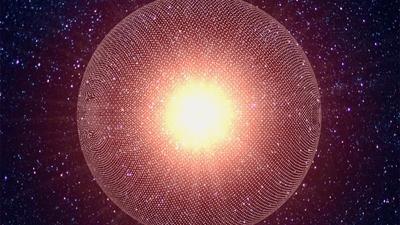
"This could be done by using a Dyson swarm, an orbiting fleet of space-based mirrors or collectors, which captures a portion of the Sun’s power output and directs it onto a small region of the solar surface," the paper explains. "Photospheric particles would gain kinetic energy until they move faster than the Sun’s gravitational escape velocity."
While an option, there are a few problems with this idea, including that Dyson swarms (note: Dyson spheres were initially proposed as a joke) are thought to be pretty unstable over time.
Another is getting material for the project, though the paper points out that a more advanced civilization with robotic drones and the appetite for destroying Mercury will not have too much trouble, with the robots collecting material to make more robots as well as a Dyson swarm as they go.
Assuming that this can be achieved, the paper estimates that it would only keep the Sun in its main sequence for an extra 400 million years. However, it would keep us in the habitable zone for an extra 7.5 billion years.
An alternative strategy gets much more Mr Burns. This is the idea to block out the Sun using giant sunshades placed at strategic Lagrange points.
"Lagrange Points are positions in space where the gravitational forces of a two-body system like the Sun and Earth produce enhanced regions of attraction and repulsion," NASA explains. "These can be used by spacecraft as 'parking spots' in space to remain in a fixed position with minimal fuel consumption."
This idea comes with the same problems as Dyson swarms – they may be unstable, given the radiative pressure coming from the Sun, and gravitational influences. The paper suggests that these can be accounted for by attaching a sunshade with a tether to a counterweight, though this will require quite a lot of advancements in materials science to achieve.
"While appearing risky at first glance, any civilisation pursuing this strategy would have aeons in which to refine and test it during the Sun’s main sequence," Harry writes. "As long as near-Earth objects were adequately cleared and enough cable redundancy constructed, there would be no natural risks to the structure."
This tactic, however, would also require us to come up with our own alternative source of energy. For this, the paper suggests we could use fusion, mining the gas giants of our Solar System and performing fusion within Jupiter/Saturn's atmosphere, before sending energy to the home planet via microwaves to a generator.
Another, perhaps more desperate tactic would be to move the Earth out to the Solar System's new habitable zone. The paper outlines two other works that have looked into this idea, with one sounding much safer than the other.
The truly desperate tactic would be to adjust Earth's orbit using a gigantic Kuiper belt object. The basic idea with this one is to pass it close enough to Earth on a regular basis (every 6,000 years), slowly imparting orbital energy into the Earth, and lifting it out to 1.5 astronomical units (AU), with 1 AU being the average Earth-Sun distance.
While fun, one problem is that the object would impart around 10 times the Moon's tidal force, potentially altering the Earth's rotation, as well as causing flooding.
As an alternative, the paper suggests we could fire a particle beam constantly into space, slowly shifting our orbit over the course of 100 million years. Unfortunately, this idea would require us mining the gas giants once more for material, while we may also need another source of energy in our farther-out orbit.
These ideas are fun, and reasonably realistic if we are talking huge, far-off space projects for a species that has learned how to do longevity right.
But the paper points out that these are not the end of our (or whoever takes over from us) challenges, including the end of plate tectonics and water loss to space, as well as more traditional challenges like space rocks hurtling in our direction. In short: it's possible Earth life can survive, but it sounds like a lot of work.
"If the safeguards were implemented and maintained, life on Earth would be able to continue as normal, enjoying comfortable security, geology and climate, and for 100 trillion years be able to look up at the night sky and see the stars – after which, natural star formation in the visible universe would end and the last stars would wink out," the paper concludes.
"However, on Earth the Sun would still rise the next morning – with 9.0 million billion years of artificial sunlight remaining, the Earth’s biosphere would still be very much in its infancy."
The paper has been accepted for publication in the Journal of the British Interplanetary Society and is available via preprint server arXiv.