Space and Physics
 PUBLISHED





Two new studies published over the last month have attempted to tackle the weighty questions of the fate of the Earth and all life upon it. There's good news and bad news on that front.
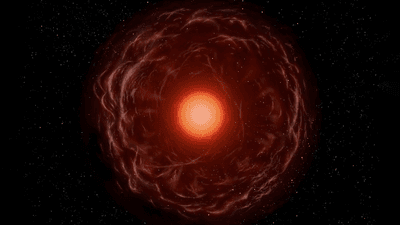
Let's start with the good news. The Sun will not last forever, having been formed with a finite amount of hydrogen available to it. Once it has run out of hydrogen to fuse at its core, our star – currently a yellow dwarf – will begin to expand into a red giant.
"When it starts to die, the Sun will expand into a red giant star, becoming so large that it will engulf Mercury and Venus, and possibly Earth as well," NASA explains. "Scientists predict the Sun is a little less than halfway through its lifetime and will last another 5 billion years or so before it becomes a white dwarf."
We'll admit that doesn't sound great, but bear with us. There are two factors that astronomers look at when determining the fate of the planets: the amount of mass lost by the Sun, which makes its gravitational pull weaker, and the tidal forces created that pull the planets closer as the Sun expands.
For a long time, the prevailing idea has been that the Earth will not escape the expansion of the Sun, with tidal forces winning out and our planet being pulled in.
But a new study published in Astronomy & Astrophysics that looks at the red giant L2 Puppis suggests that the Earth may in fact survive the red giant branch (RGB) and asymptotic giant branch (AGB) phases of the Sun's long and slow demise.
"The observed properties of L2 Pup, which we used as a proxy for the future Sun, suggest that Earth will likely survive the AGB phase," the team wrote in their paper, though they add that further study of similar stars found in the coming years will help to refine this.
"Future observational constraints, combining spatially resolved interferometric data with the most recent hydrochemical simulations, are needed to better constrain AGB mass-loss rates and hence the fate of the inner Solar System."
So that's the good news. The bad news, of course, is that we'll all be long dead.
While nobody really expects life to survive the red giant phase, a new team has attempted to model just how long we can expect life on Earth to actually continue for. The team combined climate models, CO2 models, and models of the Sun's mass loss to figure out the fate of Earth's vegetation.
The Sun is gradually brightening as it ages. You might think this would be a good thing for plants, but it has its limits.
"Earth's long-term carbon cycle may respond by drawing carbon dioxide out of the atmosphere and into carbonate rocks, thereby reducing the greenhouse effect and offsetting the increased sunlight," the team explains in their paper. "Most prior studies have argued that this would eventually make carbon dioxide levels too low to sustain photosynthesis, thus marking the end of the biosphere as we know it."
Combining several models and including our understanding of plants able to photosynthesize under low CO2 conditions, the team suggests that the biosphere should survive for nearly two billion years.
"In this study, we have used 3-D climate calculations to show that the maximum lifetime of Earth's vegetative biosphere is ∼1.86 Gyr [1.86 billion years] from now," the team concluded. "If silicate weathering is weakly dependent on temperature, then this lifetime is based on a 338K [64.8°C, 148.7°F] thermal limit for complex life."
"If this thermal limit is instead taken at 323K [49.8°C, 121.7°F], then the maximum lifetime under weak weathering is 1.68 Gyr [1.68 billion years]."
So while all life will eventually end, at least 1.86 billion years is longer than previous estimates. In a more positive light, the team also acknowledges that nature may well come up with clever ways of pushing that survival further.
"As an example, we can imagine a scenario in which plants evolve the ability to regulate their temperature and pressure, perhaps in response to changing climates," they write. "As the sun brightens, plants may favor an aerial environment and adapt accordingly, spreading to high-altitude terrain and into the stratosphere and beyond."
So the future may be filled with plants and life for a good amount of time yet, even if humans are not around to witness it. And at least the planet won't be consumed by a red giant, so there's that too.
The first study is published in Astronomy & Astrophysics, and the second is published in JGR Atmospheres.