Space and Physics
 PUBLISHED


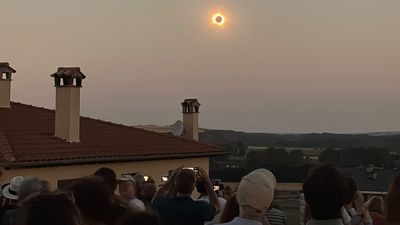


This week, many millions of people enjoyed the phenomenal total solar eclipse, with many hundreds of millions more seeing the partial eclipse across Europe and parts of Africa, Asia, and North America.
IFLScience was on the ground to see it happen in its totality in Spain and as a partial eclipse in the UK. It was an extraordinary event to watch, and with so many eyes on the sky, so many beautiful videos and photos already shared (and many more to come), you may have forgotten that we Earthlings can also watch the opposite effect from space.
Weather satellites from Europe and the US have recorded the shadow of the Moon eclipsing the Sun as it moves across the Earth before being interrupted by the terminator, the line between day and night.
One of the time-lapses was captured by the Meteosat-12 satellite EUMETSAT in cooperation with the European Space Agency (ESA). The other comes from GOES-19, which is operated by the National Oceanic and Atmospheric Administration (NOAA).
Both are located in geostationary orbit, 36,000 kilometers (22,370 miles) above the Earth. That’s a special orbit: satellites placed there appear to stay stationary with respect to certain places on the Earth’s surface – the perfect place to put a weather satellite.
With one focusing on North America and the other on Europe, we got two great views of the shadow crossing the Northern Hemisphere.
A first for the books
The August 12 eclipse was an exciting one. While totality only touched Iceland (where it was unfortunately cloudy) and crossed Spain, partiality was seen across Europe. It was the best eclipse across the continent since 1999, and the best for decades to come.
“Eclipses aren't particularly unusual when you consider the entirety of the Earth, but for an individual country there can be decades between each occurrence, as they can only be viewed from specific locations on the globe for short amounts of time,” Jess Lee, astronomer at the Royal Observatory Greenwich, told IFLScience.
Spain will be a bit of an exception, as it will have another total solar eclipse next year – the longest this century – and a ring of fire eclipse in 2028.
Still, this was pretty special, as it was the first one in recorded scientific history to have happened on the same day as the peak of the Perseids meteor shower. In fact, in Spain we saw a few bolides as we travelled away from our eclipse-viewing location.
We at IFLScience knew these two celestial events colliding was rare, but when we started investigating if or when this had happened before, we soon realized this might actually be the first recorded instance of a total solar eclipse and the peak of a major meteor shower.
We looked at the data of 5,000 years’ worth of solar eclipses and five major consistent meteor showers and concluded that this had not happened before.