Space and Physics
 PUBLISHED



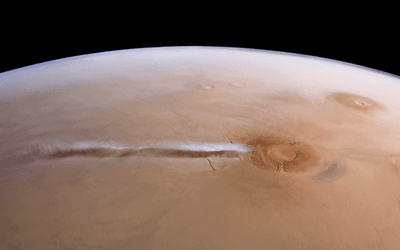


Every morning, across the spring and summer months of the Martian southern hemisphere, a lonely cloud forms and stretches from the 20-kilometer- (12-mile-) tall Arsia Mons volcano out across the Red-tinged landscape. A recent attempt to understand it found physics that surprised researchers.
The Arsia Mons Elongated Cloud can stretch for up to 1,800 kilometers (1,120 miles). Each day, it forms, grows to span the length of one-and-a-half Californias (or twice the length of Britain), then evaporates.
The AMEC was discovered in 2018 by the European Space Agency mission Mars Express. The feature is a veritable staple of the Martian sky, one we at IFLScience have covered multiple times through the years. It is an orogenic cloud, a cloud that forms due to the presence of a volcano or mountain.
Like nothing on Earth
Previous attempts at simulating just how the cloud forms and how it can extend so far have failed to reproduce what we see. Now new work has introduced some physics not commonly associated with clouds on Earth – the fact this massively improved the simulation suggests the researchers might be onto something.
“To create the AMEC in our modelling, we found that we needed to include some exotic physics… physics that, while included in textbooks, is treated as theoretical and usually thought not to happen in nature. It certainly hasn’t been seen in action before,” lead author Jorge Hernández-Bernal at Sorbonne University in Paris said in a statement.
“Once we included this physics in our simulations, the AMEC emerged just as we hoped.”
According to the simulation, the AMEC is formed in this way: wind blowing through the atmosphere encounters the mighty extinct volcano, producing waves that lift moist air several kilometers high into the atmosphere.
The sudden lift causes the air to cool down massively in a very short amount of time; we're talking a drop of around 30°C (54°F) in just 10 minutes. The water vapor turns directly into ice particles that then stretch out to form the AMEC.
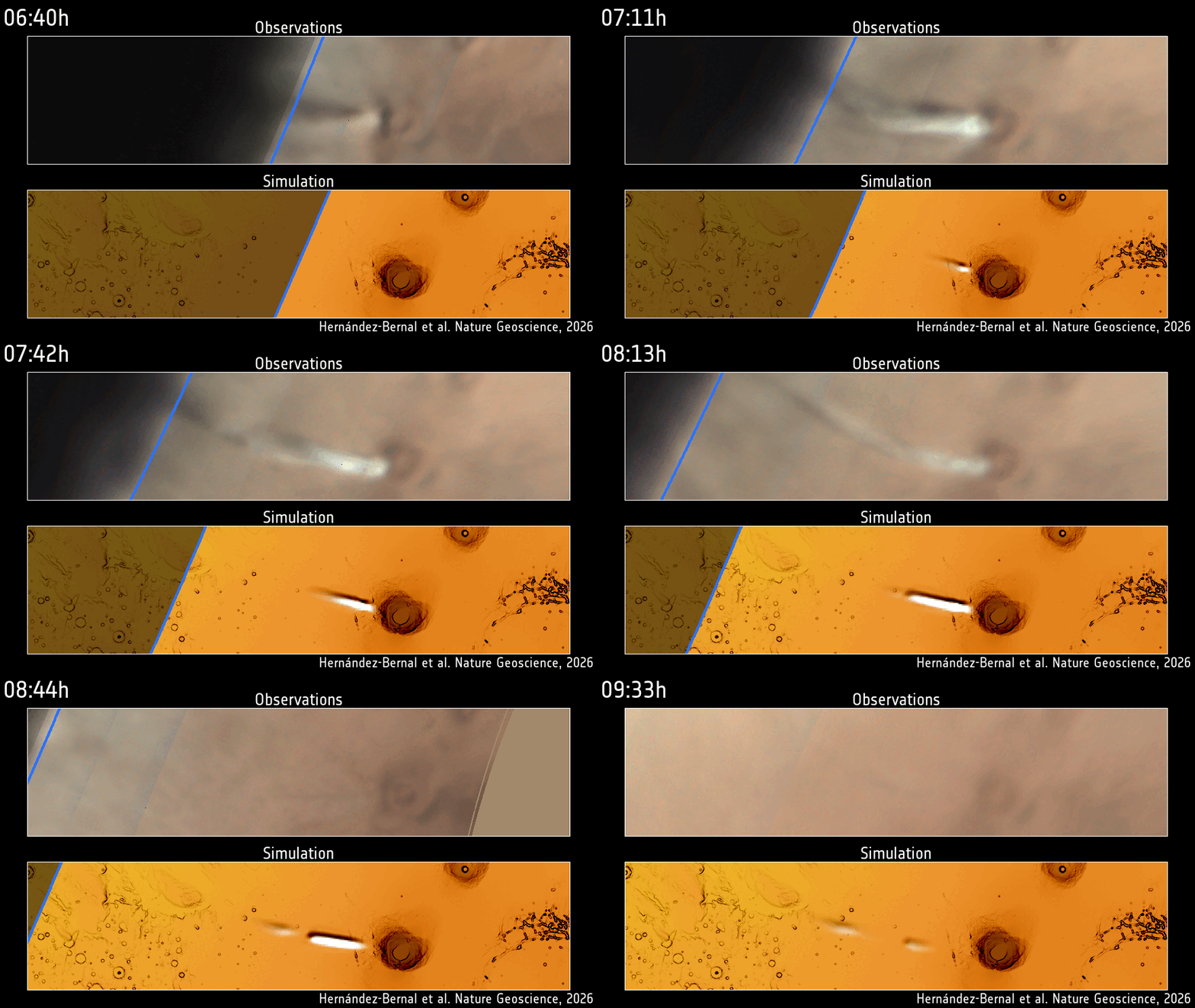
Unlike the classic heterogeneous nucleation of clouds on Earth, where dust is necessary to condense water into liquid droplets, in this case the dramatic change of conditions is all that's required to form the icy cloud particles.
“We call this homogeneous nucleation, and we’ve never seen it before in a planetary atmosphere. It’s wholly unexpected,” Hernández-Bernal continued.
It has been suggested that Earth and Venus might have conditions where these events take place, possibly in the very high atmosphere. it would require extreme relative humidity, which can’t happen on the ground but might happen where there is a lot less air.
The level of relative humidity expected is more than 100,000 times what we experience down on the surface of Earth. “We’ve not seen these conditions on Mars before, but our finding now strongly suggests that the planet’s humidity can indeed reach these extreme levels,” said Jorge.
Eyes on the Red Planet
The work is a testament to what can be done with spacecraft around other worlds. And despite several orbiters currently circling the Red Planet, there is still much more to discover about the Martian atmosphere.
“Mars Express can also track how the cloud is changing on timescales of mere hours, which gives us an unrivalled view of short-lived phenomena on the planet,” added ESA Mars Express project scientist Colin Wilson.
“Overall, this finding is a true accomplishment for the mission and its scientists: Mars Express discovered the AMEC, has followed up and monitored it for years, and is now helping reveal the secrets of its formation.”
Clouds are found everywhere in the universe, from a few hundred meters overhead to the skies of distant worlds. Understanding the physics, exotic or not so exotic, that governs them is very important.
A paper describing the results was published in the journal Nature Geoscience.