


 Space and Physics
 PUBLISHED


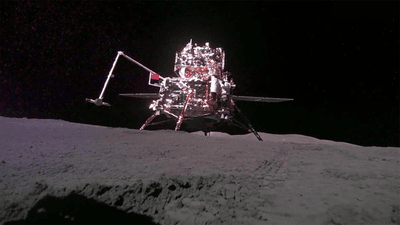


In 2024, China's Chang'e-6 mission landed in the South Pole-Aitken Basin on the far side of the Moon, and began collecting samples to return to Earth.
When it returned, it brought with it a little under 2 kilograms (4.4 pounds) of material, the only spacecraft to have delivered us samples from the Moon's far side. Since then, with scientists in China going first, the samples have been analyzed thoroughly, with researchers discovering – among other things – that volcanoes persisted on the far side for 1.4 billion years.
In new research from an international collaboration of scientists, the samples have been found to contain cubic iron, the first time this iron phase has been seen in lunar material. The discovery came with a bit of a puzzle, with this form of iron usually only stable at higher temperatures.
What is cubic iron when it's at home?
The iron you are likely used to, unless you're into rapid compression experiments, for example, is the alpha (α) phase of iron (Fe). This is because it is the crystal structure that is stable at temperatures below 910°C (1,670 degrees Fahrenheit).
But other allotropic phases of iron are possible under different conditions. Gamma iron (γ-Fe) has a different structure, with its atoms forming a face-centered cube.
"On the lunar surface α-Fe and Fe-Ni alloys are widespread and the dominant carriers of the lunar remanent magnetization," the team explains in their paper.
"Metallic γ-Fe, however, is stable only at high temperatures and has not been documented in lunar samples."
How weird is that?
Usually, this particular form of iron is only stable at temperatures between 912 and 1,394 degrees Celsius (1,674 to 2,541 degrees Fahrenheit), before becoming a more familiar and comfortingly arranged form of iron as it cools.
The team believes that the gamma phase of iron was likely stabilized by unique conditions involved in lunar impacts and their rapid cooling, as well as small amounts of carbon.
“Given its widespread occurrence in diverse impactor types, especially in materials analogous to iron meteorites and carbonaceous chondrites," the team explains in their supplementary information, "even minor incorporation of carbon from such sources could effectively facilitate the stabilization of γ‑Fe."
The team found that larger particles of gamma iron formed stable magnetic vortices, and had a stable response to an external magnetic field. The Moon does not have a global magnetic field today, but, excitingly, this discovery could be used to investigate the magnetic field of the past, with this type of iron potentially being a "record" of ancient magnetism.
As well as this, the discovery of this phase of iron could help scientists to study different stages of impacts on the lunar surface, really hammering home how useful and worthwhile the Chang'e-6 mission was.
The study is published in PNAS.


 1
1