


 Space and Physics
 PUBLISHED


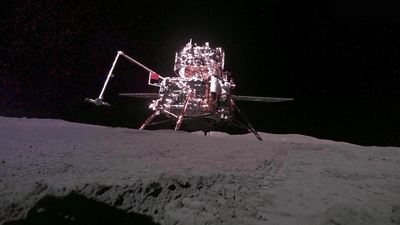


Chinese scientists have opened up the first ever samples taken from the far side of the Moon.
On June 1, Chang'e 6 touched down softly on the far side of the moon. This was the second time China achieved this feat, and they remain the only nation to have done so.
While there, the lander delivered a payload for the European Space Agency (ESA): a negative ion detector, which has already detected negative ions as they're kicked up as secondary particles from the lunar surface.
"These observations on the Moon will help us better understand the surface environment and act as a pathfinder to explore negative ion populations in other airless bodies in the Solar System," Negative Ions at the Lunar Surface principal investigator Martin Wieser said in a statement, "from planets to asteroids and other moons."
But the main purpose of the mission is to return the first samples from the far side of the Moon, and that's what the China National Space Administration (CNSA) achieved on Tuesday, landing in the Inner Mongolia desert. The capsule was airlifted to Beijing on Wednesday, where it was opened at the China Academy of Space Technology.
The samples will be sorted, before being studied by researchers across China who have applied for access. After two years this access could be opened up to international scientists, per Space.com.
Zongyu Yue, a geologist at the Chinese Academy of Sciences, told Chinese media outlet the South China Morning Post that the samples are hoped to answer “one of the most fundamental questions in lunar research – what geologic activity is responsible for the differences between the two sides [of the Moon]."
Often referred to as the "dark side" of the Moon, the far side actually receives about the same amount of sunlight. However, there are notable differences between the two sides, which we realized after the onset of space travel.
Though heavily cratered, the far side of the Moon does not have the deep basins and "lunar seas" seen on the near side, and its crust was measured to be thicker by the Gravity Recovery and Interior Laboratory mission in 2012. It also, weirdly, appears to be more conductive.
There are a number of theories as to why the sides came to be so different, including that there were originally two Moons orbiting Earth which collided early in the Earth's history, and that a dwarf planet collided with a smaller Earth moon later on.
Though the far side of the Moon has been studied from orbit, there is nothing like getting your hands on samples. Hopefully, they will answer questions about how the Moon formed, while scientists also hope that the samples could contain water, oxygen, and hydrogen, which could be harvested during further exploration.

 1
1