Space and Physics
 PUBLISHED




What you'll discover in this article
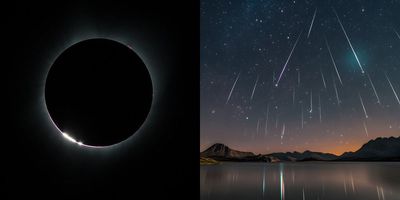
- On August 12, the total solar eclipse will coincide with the peak of the Perseids, the known best meteor shower of the year.
- IFLScience looked through 5,000 years' worth of eclipse data to investigate if a total solar eclipse has ever occurred on the same day as the Perseids peak, and found no record of this happening.
- In fact, since the first records of meteor shower peaks' Zenithal Hourly Rate began, there have been no total solar eclipses on the same day, making this the first.
This week, some lucky people across the Arctic, Iceland, and Spain might be about to witness a double whammy of celestial events: a total solar eclipse and the peak of the Perseids meteor shower. We at IFLScience knew this was rare but when we started investigating if or when this has happened before, we soon realized this might actually be the first recorded instance of a total solar eclipse and the peak of a major meteor shower.
We looked at the data of 5,000 years’ worth of solar eclipses and five major consistent meteor showers, and concluded we think this is the case.
A problem of calendars and celestial mechanics
Meteor showers are produced by Earth passing through the debris left over by comets and asteroids on the same orbit. Tiny fragments fall through the atmosphere, briefly bursting into flame, and leaving behind a streak of light, which we also call "shooting stars". The biggest fragment might become a fireball.
Since each meteor shower comes from a specific parent body on a specific orbit around the Sun, Earth always encounters these clouds of debris in the same spot in its orbit, so at the same time of year, each year. Does this mean that the showers always peak on the same night? Almost.
The peak of meteor showers can change slightly year over year due to gravitational forces and the uneven density of the debris cloud. And of course, every four years, to keep everything in check, we need to have a leap year, shifting the calendar a bit.
This year, the Perseids will peak on the night between August 12 and 13, right after the total solar eclipse on August 12.
Why is this eclipse so exciting?
The August 12 eclipse is exciting because for those not on the path of totality, it will still be visible as a partial eclipse (with many getting 80-90 percent coverage) across the northernmost part of North America (and a good chunk of the East Coast), across the Arctic, and from most of Western Europe. It is going to be the best eclipse across Europe since 1999 and for decades to come.
“Eclipses aren't particularly unusual when you consider the entirety of the Earth, but for an individual country there can be decades between each occurrence, as they can only be viewed from specific locations on the globe for short amounts of time,” Jess Lee, astronomer at the Royal Observatory Greenwich, told IFLScience.
“The last total Solar eclipse for the UK was 1999, and the next total eclipse will be 2090. In this partial eclipse, around 90 percent of the Sun will be covered, which is exciting because the next eclipse of a similar magnitude for us won't be until 2081!”
With that in mind, the excitement is palpable. The Royal Observatory has organized a live stream of the partial eclipse for those who may not be able to watch it in person. Many will also be trying to capture the event from the path of totality (yours truly included, from Spain).
Is this the first time we have this coincidental event?
Total eclipses can happen any day of the year – there have even been a few on February 29 – but the dates change because of the way the Earth, Moon, and Sun’s alignment changes over time. Eclipses tend to happen in a period called "eclipse seasons".
“The Moon's orbit around the Earth is tilted slightly – if it wasn't, we would have a solar and lunar eclipse every single month. Eclipse season occurs when the Moon's and Earth's orbits are aligned,” Lee told IFLScience.
“As the Moon continues to orbit the Earth, and the Earth orbits the Sun, these orbits go in and out of alignment in this repeating cycle, which means we have a period of around a month every 173 days when solar and lunar eclipses can occur, which we call 'eclipse season'.”
NASA has collated data about every solar eclipse from 1999 BCE up to 3000 CE. During this period, Earth will have experienced 11,898 solar eclipses, with 3,173 of them being total solar eclipses. We have gone through the data to see if any of these have or will coincide with the Perseids peak, like it will this Wednesday.
So, we know the Perseids peak between August 11 and August 13 every year. The last total solar eclipse on August 11 was also across Europe back in 1999, but the peak of the shower that year was on August 12, so it missed it by one day.
The last time a total solar eclipse was on August 12 was in 1692, but the Perseids peaked on August 10-11 that year, so it also just missed it. The next time a total solar eclipse will occur on August 12 will be in just a few decades: first in 2045 and then in 2064.
The fault is in your (shooting) stars
The difficulty with assessing this record is the variability of the peak of the meteor showers and that we have only been measuring them in a consistent way since the 1950s.
That measurement is the Zenithal Hourly Rate (ZHR), the theoretical maximum meteors that one would see in an hour. While showers last for weeks, it is only at the peak that you get a possible number of meteors approaching the ZHR. The slowest showers have 2-3 meteors an hour at their peak. The Perseids, at around 100-150, are a powerhouse among showers.
Whilst even a single meteor can be a beautiful and awe-inspiring sight, in my opinion the more the merrier!
Jess Lee
“Whilst even a single meteor can be a beautiful and awe-inspiring sight, in my opinion the more the merrier!” Lee told IFLScience.
“The Perseids have one of the highest hourly rates of 100-150 per hour, which would mean you don't have to wait around long before another shooting star streaks overhead. It's also known for bright meteors and occasionally fireballs, making it even more exciting to watch."
We looked at the five consistently prolific meteor showers: the Geminids, Perseids, Quadrantids, Eta Aquarids, and daytime Arietids. They all have a ZHR over 30. None of them had an eclipse in the same period as their peak since the ZHR measurements began in the 1950s, with one exception.
The Arietids are difficult to observe because they are a daytime meteor shower and appear to spread out from very close to the Sun. They were only discovered via radio waves by the Jodrell Bank Observatory in 1947. They peak between June 7 and 8, and in 1956, there was a solar eclipse on June 8.
However, there is no data on whether the shower peaked on the 7th or 8th, but the potential of seeing an eclipse and a meteor shower at the same time would have been incredible. Unfortunately, there are no reports of meteors during the totality.
So, Wednesday, August 12, 2026 will be the first time that we know a total solar eclipse and the peak of a major meteor shower will occur on the same date, resulting in a spectacular day and night for skywatchers.
Better luck to our descendants on June 8, 2290.