Space and Physics
 PUBLISHED






What you'll discover in this article
- Astronomers have tracked stellar wind as it falls onto a powerful pulsar from its giant companion.
- It will allow for a deeper understanding of these puzzling stellar objects.
- “This is the first time we're seeing material from a stellar wind as it is falling onto a neutron star,” Roi Rahin, the lead author, told IFLScience.
The binary system BP Crucis is fascinating. It features an enormous star tens of times the Sun and an extremely compact object, a pulsar: the end product of a supernova.
This pulsar is packing in a few times the mass of our star into a city-size sphere. Now, new research has tracked how the stellar wind from the massive star is being snatched up by the pulsar.
An extreme binary system
The primary star in this system is called Wray 977, and is what is known as a blue hypergiant star. It weighs 40 times the Sun and is 60 times its size.
Its companion star in this system is the neutron star GX 301-2. This is about 20 kilometers (12 miles) across and spins on its axis every 11 minutes, sending pulses towards Earth. Because of this, the neutron star is also classified as a pulsar.
But this latest study has documented how the solar wind from the primary star is accreting onto the neutron star.
“This is the first time we're seeing material from a stellar wind as it is falling onto a neutron star,” Roi Rahin, a researcher at the University of Maryland, Baltimore County, and NASA’s Goddard Space Flight Center, told IFLScience.
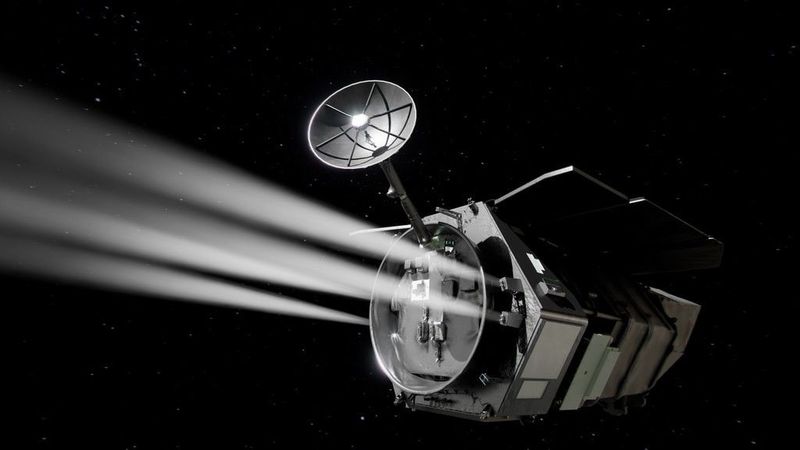
The observations were possible thanks to the XRISM observatory, a collaboration between NASA and JAXA, its Japanese counterpart.
How to measure falling wind
The team used a spectrograph - an instrument that extracts the spectrum or “rainbow” of light - to see its constituent colors. These “colors” are in X-rays and reveal the elements falling onto the pulsar as hydrogen and helium, while also showing how fast they are being captured.
The team could tell that at the closest and farthest point of its 41.5-day orbit around Wray 977, the pulsar was encountering dense plasma from the stellar winds released by its blue hypergiant companion.
The material is falling on the pulsar at a speed of 540,000 kilometers (335,000 miles) per hour.
The team used the observations to model what might be happening in the system. They could document how the pulsar encounters the stellar wind, then uses it to form an accretion disk, before losing the disk as material simply falls into the pulsar.
Understanding how it flows into the neutron star is required if we want a complete picture of the processes we're seeing.
Roi Rahin
The disk eventually returns towards the end of the interaction, and the process starts again.
Previous observations had focused on what’s happening either really close to the pulsar or really far away. This work provides insight into the crucial middle distance.
“We can detect accretion in other ways at different stages of the accretion process, but up until now we had a sort of a gap,” explains Rahin. “We saw wind material in the vicinity of neutron stars, and we saw accreted material caught in the magnetic field (using synchrotron features).”
“The gap between the two spans around 5-6 orders of magnitude (tens of millions of km vs tens of km or less from the neutron star). The material we saw in this work sits in the middle of that gap (1 million km to a hundred thousand km from the neutron star).”
More yet to come
There are so many open questions about pulsars. The process of feeding from a companion could be a flashlight on some of these unknowns.
“We want to understand how pulsars work. How they emit the radiation they emit,” Rahin told IFLScience.
“In a wind-fed pulsar like GX 301-2, the wind is supplying the material powering the emission we see. Understanding how it flows into the neutron star is required if we want a complete picture of the processes we're seeing.”
“A spectroscopic view is the only way to truly “see” the material as it falls in since we're seeing it obstructing our view of the star and we can measure the flow properties.”
Back in December last year, the team conducted some follow-up observations, and we've been teased that they are even “more surprising and interesting”. So stay tuned for more.
A paper describing the results was published in the journal Science Advances.