Space and Physics
 PUBLISHED


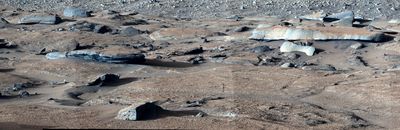


NASA’s Perseverance has performed some deep analysis on a particular rocky outcrop at the edge of Jezero Crater on Mars. It has discovered that area experienced wildly different water events several billion years ago.
Perseverance has been sent to Jezero Crater because it is clear from orbital observations that it was a place rich in water. We can see the effects of an ancient lake and a river delta; orbital chemical analysis suggested the existence of minerals formed in the presence of water, such as carbonates.
One intriguing spot is the so-called “Margin Unit,” located where the shoreline of the ancient lake was. They expected to find sedimentary rock, similar to what has been found elsewhere both by Perseverance and its distant companion Curiosity in Gale Crater, another ancient lake.
It turns out that the Margin Unit is not made of ancient clay and silt, but igneous rock, a rock that formed from either deep magma or surface lava. One of the mountains nearby might be an extinct volcano in disguise!
The rock is mostly made of olivine, a mineral that is an excellent record-keeper. It retains evidence of when it was affected by water – and it turns out it was not just once.
“Before we arrived at the Margin Unit, the main hypothesis – derived from orbital observations — was that the carbonate seen from orbit formed from interaction with the lake that existed in Jezero Crater,” lead author Candice Bedford, from Purdue University, said in a statement.
“But now we know that this location became a sort of crossroads for aqueous systems. The Margin Unit findings are important because Jezero Crater sits inside one of the largest exposures of carbonate on Mars, so what we learn here reaches well beyond this crater.”
Perseverance used its SuperCam instrument to shoot a laser at interesting rocks. A bit of the rock is vaporized, and the camera can analyze the plasma to work out the target’s chemistry. Back in 2023, the rover shot this outcrop 185 times.
The top of the outcrop shows no signs of being altered by water, and it has the hallmarks of deep magma being pushed out from the interior of the planet. Lower down, there is evidence of carbon dioxide-rich groundwater, creating veins of carbonate mineral within the olivine.
The rock has also been altered lower down, but in a different way. Researchers report the presence of minerals associated with being soaked in the ancient lake.
“Some of the Margin Unit rocks also contain silica,” said Eleni Ravanis, a planetary scientist at the University of Hawaii at Manoa and a coauthor of the study. “Turning olivine into carbonate can leave silica behind, and we see more of that silica in rocks that sat below the water line.”
On the eastern part of the Margin Unit, there are mineral veins unlike the rest. They show calcium sulfate and fluorite, minerals typical of hot water moving through volcanic rocks.
“If there is one thing I have learned after 10 years working with Mars rovers, it is that Mars constantly throws surprises at you,” said Bedford. “It is very rare that things are as we expect them to be from orbital data. I hope this work helps reshape how scientists view the history of water in Jezero Crater and across Mars. Ultimately, I hope it helps planetary scientists reconstruct the changing climate and habitability of early Mars.”
The team could see the different alterations from the different water events, but they can't put a date to them.
The study is published in the journal Communications Earth & Environment.