Space and Physics
 PUBLISHED





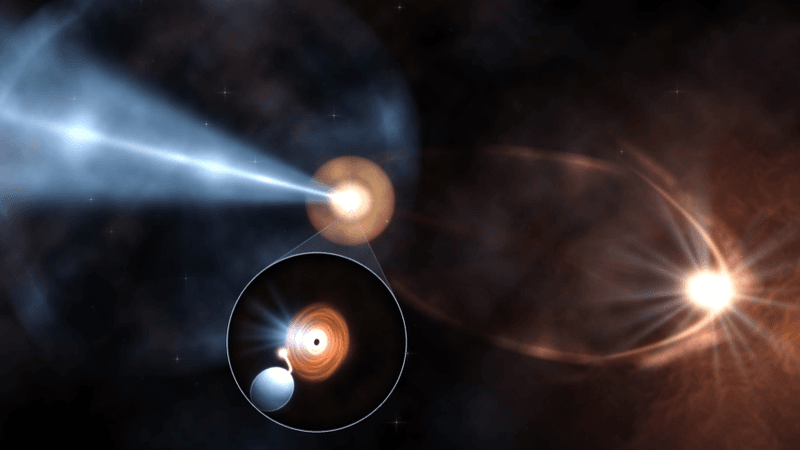
Astronomers are reporting the discovery of a retrograde planet around an M-dwarf star. This is a type of star smaller and cooler than our Sun, and the planet is about the size of Neptune. Individually, neither are very special in the universe – but somehow, this planet goes the wrong way round.
Planets form from a disk of material that goes around the star. The star and the disk rotate in the same direction, so planets tend to go in the same direction as their stars. All the planets in the Solar System are like that.
We have found retrograde planets before, among larger stars with multiple planets and in a binary star system, so it is not the only one in the cosmos. This star, though, is tiny and seems to have only one planet, GJ 3090 b, making the whole situation puzzling.
Thanks to deep observations of this system, the team reconstructed the planet’s orbit in three dimensions. The world is orbiting with a 136-degree tilt compared to the star – so backwards, and at quite the steep angle compared to the equator of the star. In the Solar System, all eight planets are just a handful of degrees from it.
“This is a remarkable planetary system because the planet is not simply tilted relative to its star – it is orbiting in the opposite direction. That immediately raises the question of how such an unusual orbit could have formed,” Dr Andrew Winter, a lead author from Queen Mary University of London, said in a statement.
The presence of companion stars or massive planets could push a world onto a dramatic orbit. Basically, you usually need a significant gravitational interaction. This system has no other star nor a hidden planet.
“We looked for the kind of massive companion that could have forced the planet into such an extreme orbit, but we don't find evidence for one. That suggests we may need to think differently about how this system acquired its unusual architecture,” added co-author and PhD student Yann Carteret from the University of Geneva.
One proposed mechanism is that the planet formed from a secondary protoplanetary disk, collected from dust and gas that existed where this star formed.
That material would have assembled in the peculiarly oriented disk, and the planet would have simply inherited those properties without the need for any violent gravitational encounter.
“The idea that a planetary system could be rebuilt from a second, differently oriented disk is particularly exciting. It suggests that the environment around a young star can play a much bigger role in determining the architecture of its planets than we might have expected,” added Assistant Professor Vincent Bourrier from the University of Geneva.
This is the smallest planet around an M dwarf for which astronomers have been able to work out its 3D orbit.
The study is published in the journal Astronomy and Astrophysics.