Space and Physics
 PUBLISHED



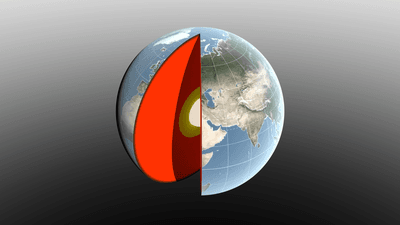


A team of astronomers have pinpointed Earth's shifting center of mass to within less than a millimeter's accuracy and tracked how that mass shifts with the seasons, revealing a few surprises about our planet in the process.
If we asked you where the center of mass of the Earth is, you would likely say somewhere near the center, and you'd be right. Even the common center of mass of the Earth-Moon system (known as the barycenter) is well within the Earth's body at around 1,000 miles (1,600 km) under its surface.
So you'd be right, but you wouldn't be altogether that accurate. Which is a shame, as that information is actually pretty useful for all sorts of scientific purposes.
"Knowing the location of the center of mass, determined using measurements from sites on Earth's surface, is important because it provides the reference frame through which scientists determine the relative motions of positions on Earth's surface, in its atmosphere and in space," NASA explains.
"This information is vital to the study of global sea level change, earthquakes, volcanoes and Earth’s response to the retreat of ice sheets after the last ice age."
So, how do you go about finding the center of mass of the Earth?
The Earth is not a perfect sphere (here's why), and scientists have already made some reasonable efforts to pin down Earth's center of mass. The best method that they have come up with so far is to use satellites, and then measure the gravitational influence of our planet on them as they are affected by the mass below.
The first attempt using this method came in 1976 with NASA's Laser Geodynamics Satellite (LAGEOS I).
"The two-foot diameter, 900-pound satellite orbited the Earth from pole to pole and measured the movements of the Earth’s surface relative to earthquakes, continental drift, and other geophysical phenomena," NASA explains.
"The mirrored surface of the satellite precisely reflected laser beams from ground stations for accurate ranging measurements."
Using ground stations placed in 20 countries around the world, LAGEOS 1 and LAGEOS 2 allowed scientists to accurately measure distance from the satellites, which could then be used to figure out the center of mass of the Earth.
But, as accurate as these measurements were, they weren't quite satisfactory in that regard, and ignored a few key factors.
"By its very nature, Earth's reference frame is moderately uncertain no matter how it is defined," Donald Argus of NASA's Jet Propulsion Laboratory said in a statement following a previous study.
"The problem is very much akin to measuring the center of mass of a glob of Jell-O, because Earth is constantly changing shape due to tectonic and climatic forces."
Why is it shifting around?
In the new paper, a team, including members of NASA's Jet Propulsion Laboratory (JPL), and staff at the University of Nevada, the University of Montana, and the Helmholtz Centre for Geosciences in Germany, set out to improve upon those previous measurements and take into account factors such as how the weight of water deforms the Earth's crust, moving the ground stations themselves around.
Adding in precise GPS tracking to the work, as well as using the orbital data from several extra satellites in low-Earth orbit, the team was able to track the movement of the Earth's center of mass, also known as the geocenter, as it moved through the year.
This movement is not due to Earth's mass simply wandering around, but due to shifts in the oceans, atmosphere, and continental water throughout the seasons.
While this has been tracked previously, the team was able to do so with more accuracy than ever before.
Over the year, the Earth's center of mass appears to shift around in teeny tiny amounts. As snow accumulation peaks in North America and Eurasia around March, the team found that the geocenter shifted around 3 millimeters toward the North Pole. As rainwater accumulated in the Amazon basin in April, Earth’s center of mass swooped 2.2 millimeters towards South America.
Monsoon season also does its part, shifting the center slightly with the accumulation of rainwater.
As meltwater swells the oceans between August and October, our center of mass shifts towards the Pacific Ocean, drowning out changes seen in other, punier oceans of the planet. The atmosphere too played its part in moving the Earth's geocenter around just a little.
"The European Centre for Medium-Range Weather Forecasts model predicts that variations in atmosphere mass contribute significantly to the interhemispheric transfer, and that maximum atmosphere mass occurs in July, three months after and before, respectively, maximum continental water and ocean mass," the team explains in their paper.
"From an independent test, we found that estimates of [center of mass] from satellite orbit determination are to a high degree consistent with variations in the atmosphere, ocean and continental water in the geophysical models."
The team were even able to visualize the movement in the Earth's center of mass, showing it dancing about in response to the changes in water on the surface.
Smaller shifts than expected
The biggest surprise was how small these changes were, suggesting our mass isn't shifting around as much as we used to think.
“We’re now estimating the size of the movement of Earth’s mass center back and forth each year to be about half of what we believed it to be eight years ago,” Argus said in a new statement.
“Our findings suggest that the mass of Earth’s water and air moving between the hemisphere is smaller than previously thought.”
Small as these changes are, knowing about them to such high accuracy is useful.
“While these movements might appear tiny, our modern world relies on extremely accurate positioning measurements," Felix Landerer of JPL, one of the study’s coauthors, added.
"By unraveling and understanding the mechanisms that change reference systems, we can build better reference systems that ultimately benefit mapping and navigation — from global shipping logistics to precision agriculture.”
But it's also nice to know the center of Earth's mass, to within millimeter accuracy.
The study is published in Geophysical Journal International.