Space and Physics
 PUBLISHED


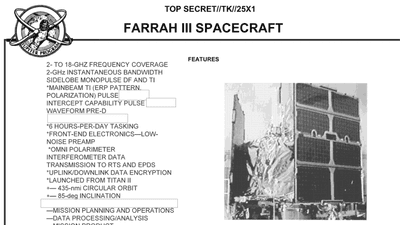


A Cold War-era spy satellite, launched in 1988, has broken up in low-Earth orbit (LEO), turning into a debris cloud around 775 kilometers (481 miles) above the Earth. So far, a cause has not been identified.
Space, though a fine place to escape from capitalism, is not free from Earth's military. Whilst the US has now confirmed that it has weapons in Earth's orbit, it has certainly had spy satellites since at least June 22, 1960, with the launch of SOLRAD 1, a satellite primarily used to intercept radar signals of the Soviet Union and analyze their radar network.
In 1988, the US was still interested in monitoring the radar of the Soviet Union, and concealing that same fact from them. On September 5, it launched the generically named satellite USA 32 on board a Titan II rocket, though it also came with a secret codename: FARRAH III. Bizarrely, this name was inspired by American actor Farrah Fawcett, though there aren't any clear links between the star of Logan's Run and clandestine military projects.
Only declassified this year, the satellite's purpose was to monitor radar signals, process some of the data on board, and transmit it back down to Earth, including to military units on the ground. Despite this, it wasn't much to look at.
Described as a "tuna can", the low-altitude satellite used spin to stabilize itself as it observed the Earth's radar signals. It is unclear how long the satellite was operational, but it and one of its successors, FARRAH 5, have been observed spinning away in LEO as recently as 2021.
In current times, as you may have inferred after simply looking up for a while on a nice clear night, Earth's orbit is getting fairly full, and that's just the satellites which are still functional. There are several efforts underway to try and deal with the problem of space debris through debris-collecting spacecraft, but a lot more effort is also going into stopping newer satellites from becoming debris in the first place.
For example, missions are planned so that the satellites end their time by being pushed down safely to break up in Earth's atmosphere (and preferably over an ocean) or pushed up into a safe altitude. Another factor is making sure that at the end of their mission all the propellant is spent, as well as anything else that could cause explosions (which is also great at propelling stuff), known as "passivation".
"Both launch vehicles and payload satellites typically have several types of stored energy sources on board, any of which might result in energetic breakups and the creation of debris after their mission has ended," a NASA document explains.
"NASA, ESA, JAXA and other space-faring organizations have requirements in place to limit the growth of the orbital debris population by passivating space vehicles that remain in orbit after their missions have ended."
It is unclear whether FARRAH III was passivated at the end of its mission, but the US Space Force has just confirmed that on September 13 2026 it unexpectedly broke apart.
"U.S. Space Forces–Space (S4S) confirms the fragmentation of USA 32 (#19460) in LEO on 13 Sep 2026 (JDay 256) at approximately 2113 UTC," Space Force said.
"All tracked debris are being incorporated into routine conjunction assessment screenings to support spaceflight safety. No immediate threats have been identified; further analysis is ongoing."
Spaceweather.com suggests that a leading suspicion in the cause is a pressurized tank or battery finally ruptured after 38 years of heating and cooling. However, a collision with another piece of debris or a meteorite could be possible as well. The region of space it was occupying was already quite cluttered, making the risk of further collisions with other satellites a real concern.
Astronomers are closely monitoring the situation for potential further collisions with these new pieces of debris, assessing the size of each piece and the risk it poses to other spacecraft. As well as this, by looking at the objects' paths they may hope to reconstruct the fragmentation event itself, and find out how a Cold War-era satellite came to be destroyed decades later.