Space and Physics
 PUBLISHED




What you'll discover in this article
- The United States has announced it has deployed weapons in space, the first country to openly admit this.
- Experts in space law and security spoke to IFLScience about what this means in terms of international relations in space.
- Dr Jessica West told us this "changes the game a little bit when it comes to arms control and efforts to keep peace in outer space."
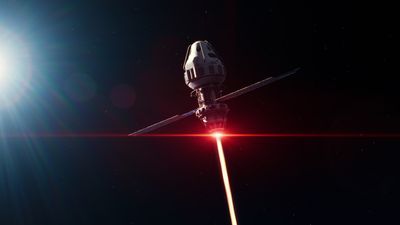
Speaking at the Air, Space, and Cyber Conference on Monday, September 14, US Secretary of the Air Force Dr Troy Meink confirmed that the United States had deployed a space weapon in Earth’s orbit. The admission is a gamechanger when it comes to the militarization of outer space.
Most experts believe that there have been weapons deployed in space, even though for decades the global community has been working to prevent an arms race in outer space. No country, though, was ready to go on record saying, "Yes, it is happening," until the USA under the Trump Administration.
“Today, we continue to ensure we remain ready to meet the challenges of evolving threats, wherever they exist. This is why the United States now has on-orbit space control weapons capable of defending the joint force against hostile adversary action,” Meink said in his keynote.
AFP reported that a spokesperson for the Chinese foreign ministry has stated: “We urge the US side to stop expanding its military capabilities and preparing for war in outer space.”
The Venn diagram between space companies and the military-industrial complex is very close to being a circle. Even some peaceful uses of space pass through military applications. Still, up to this point space has not been a theater of war. That might change.
Space has changed
Speculation around whether a country, be it China, Russia, or the US, has weapons in orbit has found its confirmation.
For me, the key change is really this effort to normalize the idea of weapons in space.
Dr Jessica West
“The announcement this week ended the speculation and has forthright said, 'No, we're in an era where there are orbital weapons,'" said Dr Jessica West, a senior researcher at Project Ploughshares working on preventing an arms race in outer space.
“To me, that changes the game a little bit when it comes to arms control and efforts to keep peace in outer space.”
Ultimately, the announcement has not changed anything in orbit. China and Russia might have already developed and deployed orbital weapons and might be more upfront with that they plan to place.
“For me, the key change is really this effort to normalize the idea of weapons in space,” Dr West continued.
Weapons in space or affecting space have a long tradition. In January 1975, the Soviet Union decided to test out attaching a weapon to the side of spacecraft and firing it. In November 2021, Russia used a ground missile to blow up one of their old satellites, forcing astronauts to shelter in case the debris were to hit the International Space Station. China did a similar test in 2007.
This is not a case of the United States suddenly introducing military competition into an otherwise demilitarized domain.
Professor Michelle Hanlon
Back in 2024, officials in the Biden administration accused Russia of deploying anti-satellite weapons in space, and Rep. Mike Turner (R-Ohio), the former chair of the House Intelligence Committee, discussed Russia developing a nuclear weapon in space.
There are scientific approaches to check if such a weapon has been deployed, and they might have to become standard. A nuclear weapon detonation in low-Earth orbit might destroy most satellites in that region of space.
Space is fundamental to our society. From weather to global positioning, from banking to telecommunications, almost every one of us accesses space directly dozens of times a day, and indirectly thousands. The loss of low-Earth orbit would be devastating for our way of living.
An announcement as deterrence
The deployment of weapons in space is seen as part of Donald Trump’s "Golden Dome" defense system, which hopes to protect the US from missile and airborne threats. That includes space.
The capabilities of these weapons have not been advertised. They could have radio-jamming capabilities, kinetic impactors that can damage other satellites, or other approaches that can be used for offensive or defensive purposes.
The key word appears to be that the deployment will serve as a deterrent.
Meink reportedly continued at a press roundtable, "Me talking about the details of what we’re doing would actually not benefit deterrence, so we’re not going to talk about the specifics of what we’re doing, whether we’ve tested it, not tested it, or anything else.”
We’ll have to wait and see if this approach will work. While an escalation is possible, it is equally possible that this announcement will lead to countries discussing clearer rules about what activities should and should not be allowed in outer space.
The Outer Space Treaty does not prohibit conventional weapons in Earth orbit.
Professor Michelle Hanlon
“I see the disclosure as a significant and, in many ways, welcome development,” Professor Michelle Hanlon, co-director of the Air and Space Law Program at the University of Mississippi School of Law, told IFLScience.
“This is not a case of the United States suddenly introducing military competition into an otherwise demilitarized domain. What is new is the United States publicly acknowledging that it has on-orbit space-control weapons.”
Does the ambiguity strengthen the deterrence effect, or does it increase the risk of misperceptions that could lead to escalation?
Squaring the circle of the Outer Space Treaty
We have talked in the past about the complexity of the fundamental law that regulates space: the Outer Space Treaty. On one hand, a short treaty with ample limitations; on the other, a valuable international accord that has kept the peace in outer space since 1967.
“The Outer Space Treaty does not prohibit conventional weapons in Earth orbit. Article IV draws a very specific line: it prohibits placing nuclear weapons or other weapons of mass destruction in orbit or otherwise stationing them in outer space,” Hanlon continued.
Article III makes clear that activities in outer space remain subject to international law, including the UN Charter.
Professor Michelle Hanlon
“It also prohibits weapons testing, military installations, and military maneuvers on the Moon and other celestial bodies. It does not impose that same prohibition on conventional weapons in Earth orbit.”
The fact that the deployment of weapons is not strictly forbidden does not mean that any nation can just start shooting down other people’s satellites with no consequences.
Article IX pushes against harmful contamination, and the destruction of a satellite and the harmful debris that it would cause could fit in that category. And that’s not all.
“Of course, that does not mean their use is legally unconstrained. Article III makes clear that activities in outer space remain subject to international law, including the UN Charter,” Hanlon continued.
September 2026 has certainly been a big month of US announcements about space. First, President Trump announced that the Moon belongs to the US (it really does not), and now this. And there are two more weeks to go!