Space and Physics
 PUBLISHED
 1
1



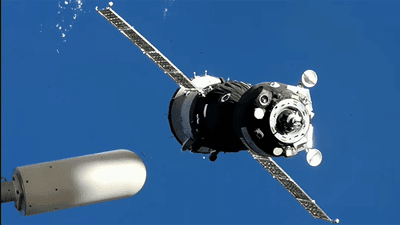


On July 15, 1975, we got a brief glimpse of how collaborative space missions could look. The crews of a US Apollo spacecraft and a Soviet Soyuz met and docked, before the famous "handshake in space". It wasn't exactly the end of the Cold War, but it was a nice little preview of what can be achieved with international co-operation.
Whilst nice, to place it in proper context and not leave you with a false impression of the Cold War, it also took place the same year that the Soviets tested a space cannon.
During the Cold War, the US and the Soviet Union were both pretty terrified of the possibility of the other side using nuclear weapons. Both were also a little worried about the other side interfering with their space activities.
Given that both sides were looking into space wars there was probably good reason to believe the enemy was also thinking about disrupting satellite operations. But enough justifying the actions of a now-gone Soviet government.
The long and short of it is that in January 1975, the Soviet Union decided to test out attaching a weapon to the side of spacecraft and firing it.
The world wouldn't hear about this test for decades, though rumors that the Salyut space stations were weaponized swirled around during this time. When the truth did come out, it turned out that the weapon was a 23-millimeter cannon originally designed for the Tupolev Tu-22 Blinder supersonic bomber, which they attached to Salyut 3.
It was on January 24 1975, following the departure of the crew onboard Salyut 3, that the Soviets fired the cannon as a test. It's likely the weapon would have been pretty useless in any actual military operation.
But it's thought that rather than targeting satellites, the Soviets were instead trying to protect against any unwanted boarding attempts.
"Soviet lore proclaimed that this gun had been mounted on the exterior of the station as a defensive measure," a paper on the topic explains. "Having inflated and vague target ranges from 500-3000 meters, the gun was clearly not an effective antisatellite weapon, but one that would ward off a direct physical boarding or capturing attack against the station."
Either way, it probably wasn't really needed as rocking on up and taking over a space ship pirate-style isn't exactly easy, as both sides would later learn during their collaborative attempt to dock with each other. NASA had to build a docking module to connect the two spacecraft without even knowing the exact design of the Soviet craft.
The Soviets faced quite a few challenges when adapting the weapon to be fitted and fired in space.
The first was that the gun had to be fixed in place to fire at a target. This meant that the entire space station needed to be rotated in order to fix its sight on the target, making the weapon quite slow and not altogether dynamic.
A second problem was the recoil. The energy from firing a cannon in space could seriously alter the spacecraft's trajectory, or else send it into a spin. To counteract this, ground controllers fired the station's thrusters, but even then the cannon was able to destabilize even this 20-ton spacecraft.
The weapon was fired, and apparently successfully.
Since then, as far as we're aware, no other weapon has been fired in space. It may be that humanity heads in that horrific direction again, but if we do the basic concept will probably need plenty of improvement.
"The Salyut cannon was a weapon that could not be targeted in real time and could not be used while there was a crew inside the station to defend. It could provide no practical, tactical support in space and its shrouded identity prevented it from being of any use for deterrence," the paper continues, adding that targets such as satellites were well out of its range.
"Nonetheless, the rumor of its existence prevailed for decades before the Ministry of Defense unveiled it, thus fueling the internal mythology of the defensive military space station deterring capture and boarding."
All in all, the cannon was pretty useless. Here's hoping it fired the first and final shots in space.