Space and Physics
 PUBLISHED
 1
1


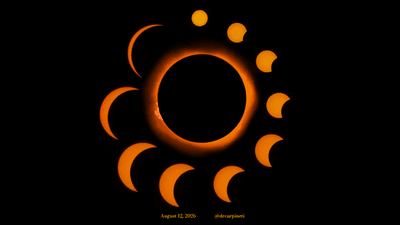


The August 12 eclipse was an extraordinary celestial event for the millions who saw it in totality and the hundreds of millions who saw it in its partial phase across Europe. Africa, the Middle East, and Europe will also see the next total solar eclipse, and it is one for the history books.
So, don't tell us that we didn't warn you in time!
What’s going on?
On August 2, 2027, the Moon will obscure the Sun in a strip that goes from Morocco and Spain all the way to the Arabian Peninsula and the Horn of Africa.
The path of totality is thin compared to the surface of the Earth. At its widest, it will stretch to 258 kilometers (160 miles).
Still, the path will touch upon some extremely significant places for both ancient and modern history: from Cádiz in Spain and Tangier in Morocco, moving to Benghazi in Libya, hitting its duration peak in Luxor, before reaching the tip of the Horn of Africa via Mecca.
Beyond the millions that will be on the path of totality, billions will see the partial eclipse. In Africa, it will be visible as far south as Mozambique and Madagascar; it will be seen as far east as Thailand in its partial phases and cover most of Southern and Central Europe, and a chunk of Northern Europe.
Astronomers will use it to test Einstein’s theory of relativity and plenty of other science, similar to the eclipse last week. An Italian team used the Spanish eclipse to look for Vulcanoids, a population of asteroids believed to orbit the Sun within the orbit of Mercury.
For astrophiles, the spectacle is special in itself, but the last eclipse was doubly special, as it was the first in recorded scientific history to happen on the day of a major meteor shower peak!
Why is this eclipse special?
The August 2, 2027 eclipse is going to be the longest for the next century or more. It will be just shy of the record set by the July 22, 2009 one, with its 6 minutes 39.5 seconds, though that one happened mostly over the Pacific Ocean.
This one instead will cover large swathes of land, making it the longest total solar eclipse over accessible land, with its 6 minutes and 23 seconds at its maximum over Luxor. That will be a very long period of totality.
To compare, the Great American Eclipse of 2017 was 2 minutes 40 seconds; the second Great American Eclipse of April 8, 2024, was 4 minutes 28 seconds. The eclipse last week had a maximum of 2 minutes 18 seconds.
The duration is not the same everywhere. The closer you are to the center of the path of totality, the longer it is, and in the case of next year’s one the peak is a while after it starts.
The theoretical possible maximum for a total solar eclipse is 7 minutes 32 seconds. Unless some longevity breakthrough happens, nobody alive will be around to see the next closest one to that record: On July 16, 2186, the sun will be eclipsed for a maximum of 7 minutes and 29 seconds.
The second longest this century is also a while away, 70 years, but there will be kids who could theoretically see both; the eclipse of May 22, 2096, will last 6 minutes and 7 seconds.
How to prepare for it?
If you want to see totality, there are plenty of places to go to, including major tourist destinations. Certain places, such as Luxor, appear to be already sold out or asking exorbitant prices, so you better move quickly.
As we said, plenty of people will get partiality without having to leave their house. Let’s stress again how important it is to have proper solar glasses. After an eclipse, there’s always a spike in internet searches related to eye problems.
Do not look at the Sun without proper protection. If you do not want to get glasses, you can easily make a pinhole projector or use a colander.
You do not have to photograph or immortalize the solar eclipse; it is completely fine to be living in the moment. If you want to though, we have asked advice from one of the best astrophotographers out there, Andrew McCarthy.
There is time, so you can make sure you have the right equipment and the right date – or you might end up in the hilarious situation that one of the IFLScience writers, James Felton, found himself in last week.
I don't want to wait that long!
Well, IFLScience does not control the motion of the celestial spheres, but if you want more celestial events featuring the Moon and shadows, you are in luck.
On August 28 this year, there will be a partial lunar eclipse visible across western Asia, Europe, Africa, the Americas, and part of Oceania, including New Zealand.
If you only care about solar eclipses, there will be an annular eclipse on February 6, 2027. An annular eclipse is also known as the Ring of Fire, because the Moon is at its furthest in the orbit around the Sun, so it doesn't cover the full solar disk.
This will be visible across portions of Chile, Argentina, Uruguay, Ivory Coast, Ghana, Benin, Togo, and Nigeria.