Space and Physics
 PUBLISHED




There is a supermassive black hole at the center of every galaxy, but they are not cosmic plugholes, waiting for everything to fall inward. Most stuff will go around them, undisturbed for billions and billions of years.
If they become active, though, they can disrupt galaxies, heating up their gas and snuffing out star formation. Now, researchers show evidence of the contrary too!
The power of an active black hole is such that a huge amount of energy spreads out into the surrounding gas. This can be shot out in the form of a powerful jet moving close to the speed of light and galaxy-wide winds that warm up the interstellar medium. To form stars, you want this gas to be cold so it can condense and then collapse.
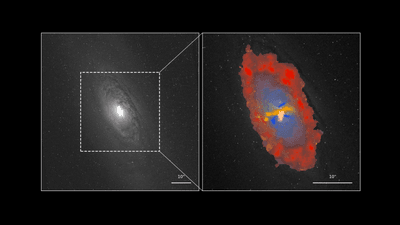
The new study, using the European Southern Observatory’s Very Large Telescope, looked at nine nearby galaxies that have an AGN, an active galactic nucleus. The astronomers found that the feedback mechanism might be more complex than previously assumed and that AGNs can, in fact, contribute to star formation.
In these nine galaxies, the team shows cones of radiation extending away from the galactic planes. Perpendicular to these cones, into the galaxy, the team observed shock fronts – some from jets and, in weaker AGNs, possibly winds.
Around these phenomena, the team spotted rings or arcs of new stars forming. They extended from 2,600 light-years to 19,600 light-years. Black holes could be helping make new stars too.
“Once we resolved them, we could see that they not only accrete things, but they also eject things,” lead author Peixin Zhu, a graduate student and astronomer at the Center for Astrophysics, said in a statement. “The injection and accretion are linked with each other.”
“The most interesting phenomena about shocks is that they always go perpendicular to where the black hole’s injected outflows go. It is very common, and we see it consistently appearing across the whole nine galaxies.”
The team also used the Chandra X-ray telescope to independently confirm the activity, showing that there is a complex cycle of accretion of material on the black hole, outflows of the same material back into the galaxy, and what that does to the whole galaxy.
“We’re seeing that black holes are not just consuming material at the centers of galaxies, but they’re actively reshaping their surroundings,” said Lisa Kewley, an astrophysicist at the Center for Astrophysics | Harvard & Smithsonian, director of the Center, and Zhu’s advisor.
“This work helps us understand a complex feedback cycle that plays an important role in galaxy evolution.”
The study is published in The Astrophysical Journal.

 1
1