Space and Physics
 PUBLISHED




The awesome thing about science is that the more you learn, the more you question even the most basic facts. Before we go to school, we know that steam is hot and ice is cold. Well, turns out there exists in the Solar System a form of water ice that is a lot hotter than we might consider suitable for human proximity.
There are a large number of phases of matter, but we mostly stick to the three we commonly experience: solid, liquid, and gas. We are used to thinking that to change a substance from one to the other, it simply requires temperature changes. There is another variable, though, that we can easily ignore on Earth: pressure.
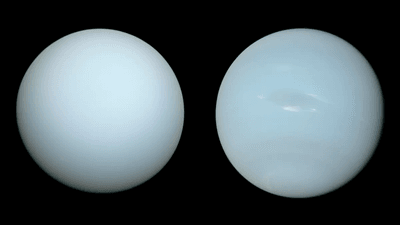
The "ice" inside the ice giants, Neptune and Uranus, is hot, dense, and subjected to crushing pressures. It might also explain why they have such unusual magnetic fields. However, visiting and taking a sample is impossible, so scientists did the next best thing: they recreated the conditions in a lab.
Under pressure, pressing down on me
On Earth, pressure is more or less constant. We can notice a little difference in the temperature it takes to boil water at sea level or up a mountain, but who’s making coffee or pasta with a thermometer?
Lower pressures lead to lower boiling points, and the opposite is true as well. Under huge pressures, freezing temperatures are higher, allowing the creation of ices that are extremely hot.
Scientists at the French Alternative Energies and Atomic Energy Commission (CEA), led by Alexis Forestier, have created an exciting phase of ice under intense temperature and pressure, similar to the conditions inside the ice giants. Water is a molecule made of two hydrogen atoms and one oxygen atom. Under these conditions, something truly peculiar happens to it.
Ice, ice baby
Under extreme pressures, ice becomes "superionic." This means that the oxygen atoms form a lattice crystal, while the hydrogen atoms, stripped of their electrons – so just the single protons – are free to flow about.
A tiny sample of ultrapure water was compressed into a space of just 12 microns. It experienced pressures from about 800,000 times normal atmospheric pressure to over 2.25 million times. The temperature ranged from room temperature to 2,087°C (3,788.3°F).
A superionic phase of ice was produced in the lab years ago, where the oxygen is in a cubic lattice, known as face-centered cubic (fcc). In the new work, the researchers showed that at a temperature over 1,527°C (2,780.3°F) – enough to melt steel – and at a pressure of 1.6 million atmospheres, the superionic ice transitions to a hexagonal-close-packed (hcp).
Inside the ice giants
On Earth, we need to put a tiny sample between two diamond anvils while shooting lasers at it. In space, these ices are believed to be found in the interiors of ice giant planets like Uranus and Neptune and in exoplanets of a similar size.
We have suspected that there are odd things going on inside them due to the peculiarities of their magnetic fields, which are tilted and off-center, as seen by Voyager 2 when it flew by the two planets in the late 1980s.
One idea is that this is caused by charge flowing through superionic ice close under the planets' surfaces, rather than the geodynamo thought to be the source of Earth's magnetic field, as well as Mercury and even Jupiter.
The exact details remain sketchy, so recreating these ices in the lab is crucial for future models and to prepare for future exploration.
The study is published in the journal Physical Review Letters.