Space and Physics
 PUBLISHED


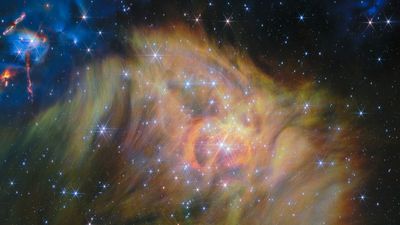


Stars and planets are notably different. Stars fuse elements at their cores, while planets don’t. Stars form from the collapse of gas clouds, and planets form from the accretion of little pebbles into large objects.
There is a class in between these two: brown dwarfs. They formed like stars, but they are too small to fuse hydrogen in their cores.
In the past, an arbitrary limit was placed to divide brown dwarfs from gas giant planets like Jupiter. Anything more than 13 times the mass of Jupiter was a brown dwarf. JWST has now pushed that limit way down.
In one of its largest-ever images, JWST mapped the star-forming cloud IC 348. This is a stellar nursery just 1,000 light-years from Earth. The team found some brown dwarfs that have a mass of just twice that of Jupiter, making the separation between gas giants and stellar objects a lot more uncertain.
This object's mass is just 0.19 percent that of the Sun; to be a star and fuse hydrogen, it ought to be at least 8 percent, so this should be firmly in the brown dwarf category. Yet, the object is just too small, even for a brown dwarf. Smaller than was believed possible!
The object is not just impossible according to our models; it even has peculiar hydrocarbon emissions from its atmosphere. Hydrocarbons are molecules like methane, made of just hydrogen and carbon. The one in the object's atmosphere has not been identified.
The cherry on top is that this exceptional object appears to be surrounded by a disk of material. Is the smallest known brown dwarf forming its own planets?
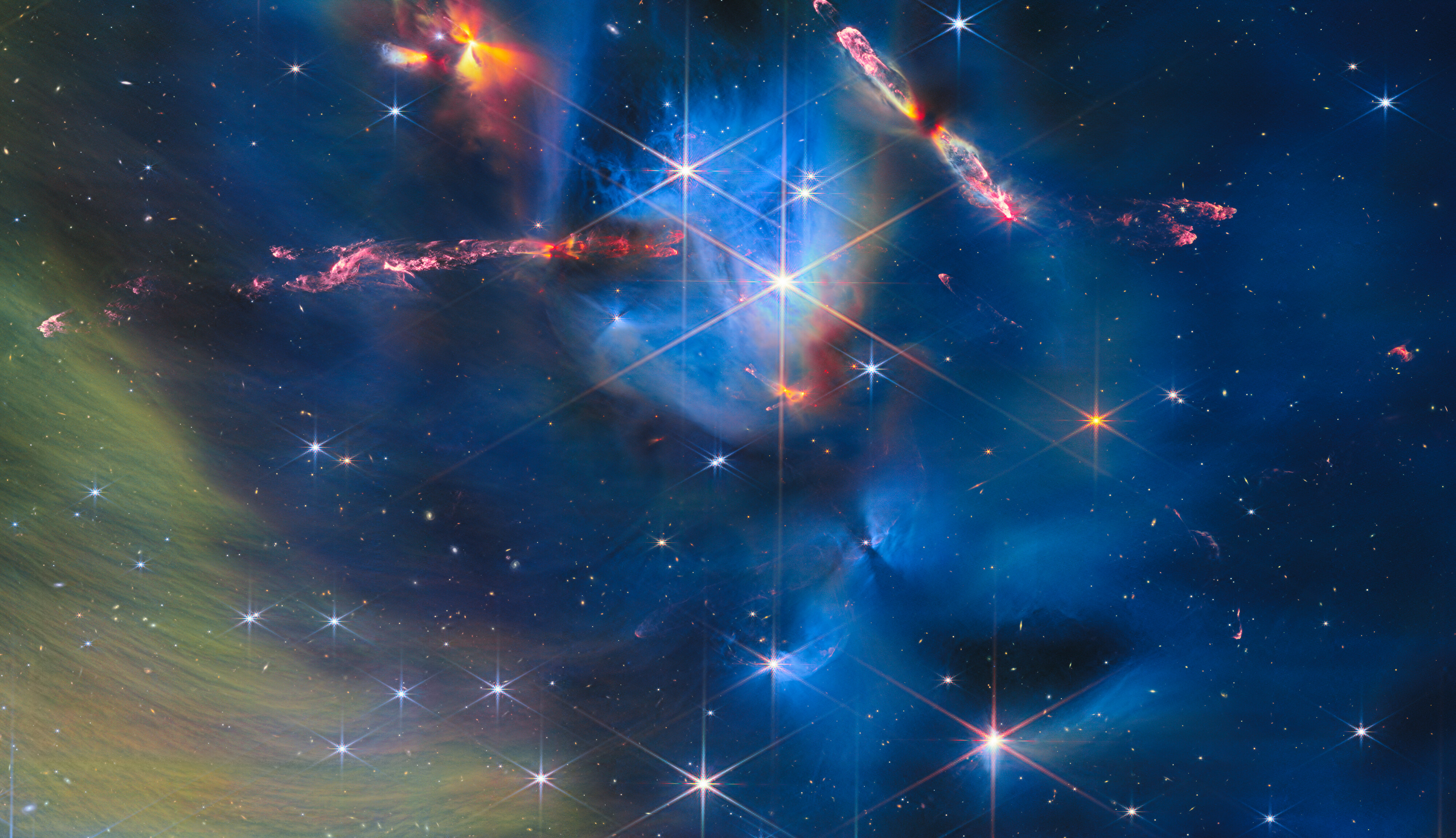
Researchers will continue to study this object and the rich tapestry that is IC 348. This has already been an interesting target for JWST. Several protostars in this region are accompanied by Herbig-Haro objects, the peculiar and luminous interaction between protostar jets and the gas around these fledgling stars.
Among them, there is the famous Herbig-Haro 211, which is very regular and so associated with lower-mass stars. Bigger stars tend to have more chaotic outflows like BN-KL in Orion. For the intermediate-mass stars, there is the exceptional Dragon Jet, which IFLScience had as an exclusive earlier this year.
JWST will continue to observe where baby stars form; its sophisticated infrared camera can peer through the gas and dust of the stellar nursery, and maybe there are even smaller brown dwarfs out there to be found!
The study is published in The Astrophysical Journal Letters.

 1
1