Space and Physics
 PUBLISHED
 1
1



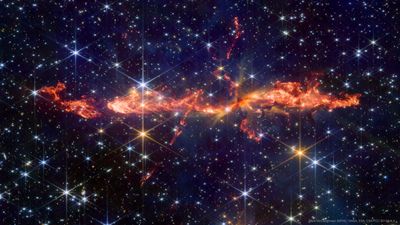


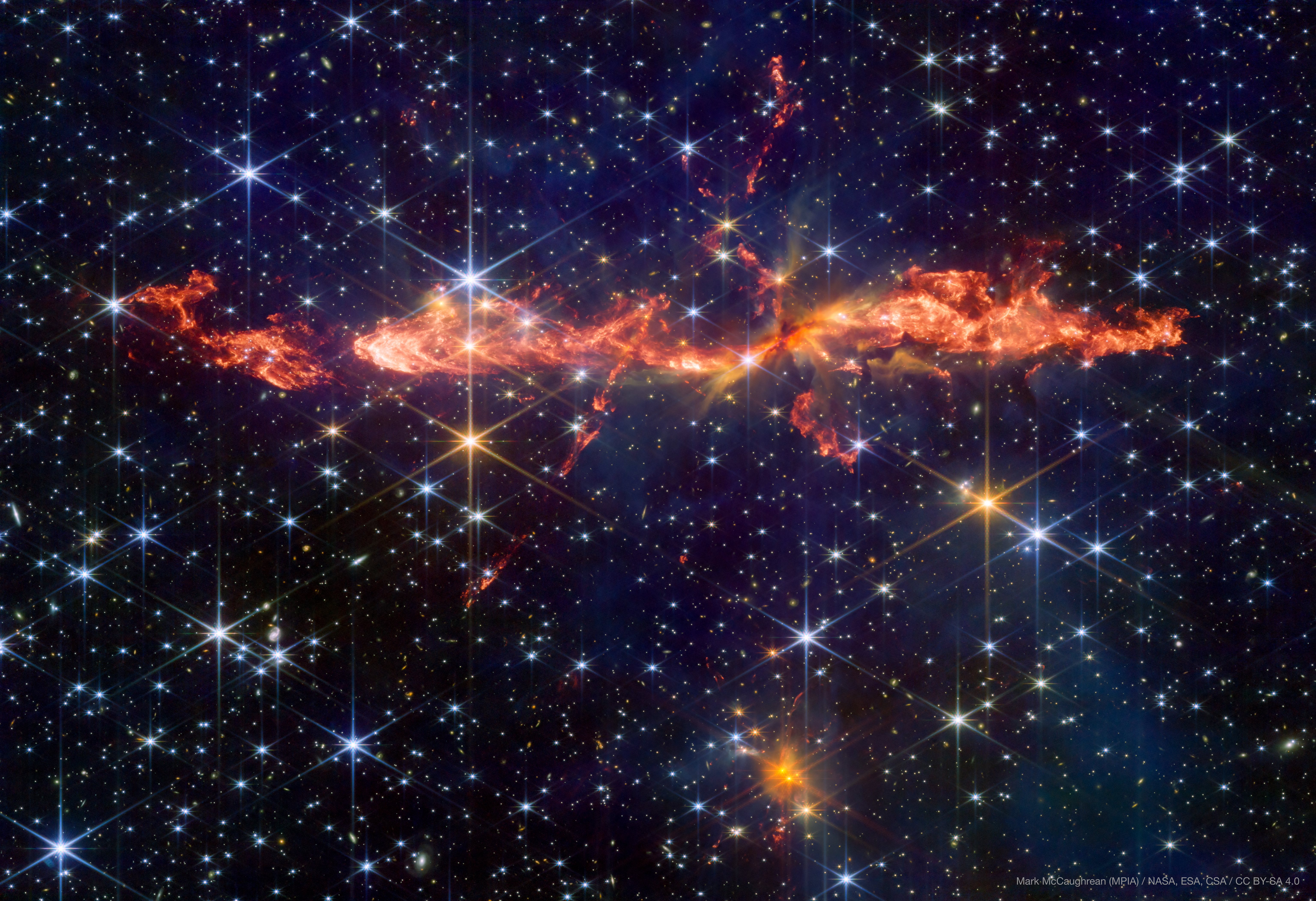
IFLScience has been given an exclusive look at some truly stunning observations from JWST. A team of astronomers led by Mark McCaughrean has looked at a region in the constellation of Cassiopeia where baby stars are being born. It is utter but beautiful chaos. It is the Dragon Jet.
The actual name of the jet is protostellar outflow complex HH288, but since its discovery in the 1990s, the team has seen its resemblance to a mythical dragon. The different structures of the dragons are jets of material released by protostars, and in particular, the red emission comes from molecular hydrogen being shocked in these outflows.
“One of the things we know about the way that stars form is they're a little bit like babies. You put food in them so they can grow, but then some of that stuff comes back out again,” Dr Mark McCaughrean, adjunct scientist at the Max-Planck-Institute for Astronomy in Heidelberg, told IFLScience. He added, laughing, “And a bit like babies, it comes out of both ends.”
A star is not born at full size. During the protostar phase, it pulls in more material from the gas cloud from which it is born. Some of the material will flatten out into a disk from which planets might form. Due to the conservation of angular momentum, when something shrinks, it needs to spin faster. Simple calculations would show that stars should not form, as they should be spinning so fast they would pull themselves apart. That’s where the outflows come in.
The outflows get rid of the angular momentum, making them a crucial component of star formation. They are also a spectacular-looking one. In the case of the Dragon Jet, we are seeing material moving away from the protostars at around 100-200 kilometers (60-120 miles) per second.
In the original observations, scientists could see two almost perpendicular outflows. This previously unreleased near-infrared JWST image has revealed that beyond those two, there are five or more flows, which suggests a dense cluster of young, intermediate-mass protostars in the core of the region.
“The Dragon is actually quite chaotic. We think that there's at least five different protostars all popping off simultaneously in the Dragon. There's the big flow, the main dragon body, the tail on one side, the head, and the flames. But if you look, there are bright lines of red in multiple directions,” McCaughrean, who is also the former Senior Advisor for Science & Exploration at the European Space Agency, told IFLScience. “We think there's probably at least five or maybe six individual places, so therefore individual protostars in a cluster all bursting off at once.”
All of this is fascinating, but an extra interesting fact is that the mass of these protostars is in the intermediate range, a few times the mass of the Sun. The outflows sit between the very regular jets seen in low-mass stars, such as Herbig-Haro 211, and the very chaotic, associated with high-mass stars like BN-KL in Orion. In large star-forming regions, the effects of these intermediate stars’ jets might play a major role in self-regulating star formation.
“I think we've already learned quite a lot of new things just by looking at the data. The story about how intermediate mass protostars affect their environment and blow all this material away is the thing which is kind of most compelling,” McCaughrean explained.
The team is currently writing a paper with all the data and has scheduled follow-up observations in millimeter and radio waves to better characterize this fascinating system.
A high-resolution image can be seen on McCaughrean's Flickr.