Space and Physics
 PUBLISHED


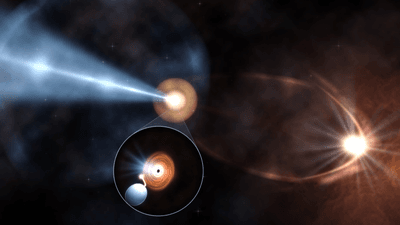


Astronomers have found, for the first time, a microblazar in our own galaxy. The object is a miniature version of what happens when a supermassive black hole produces an energetic jet and shoots right towards Earth.
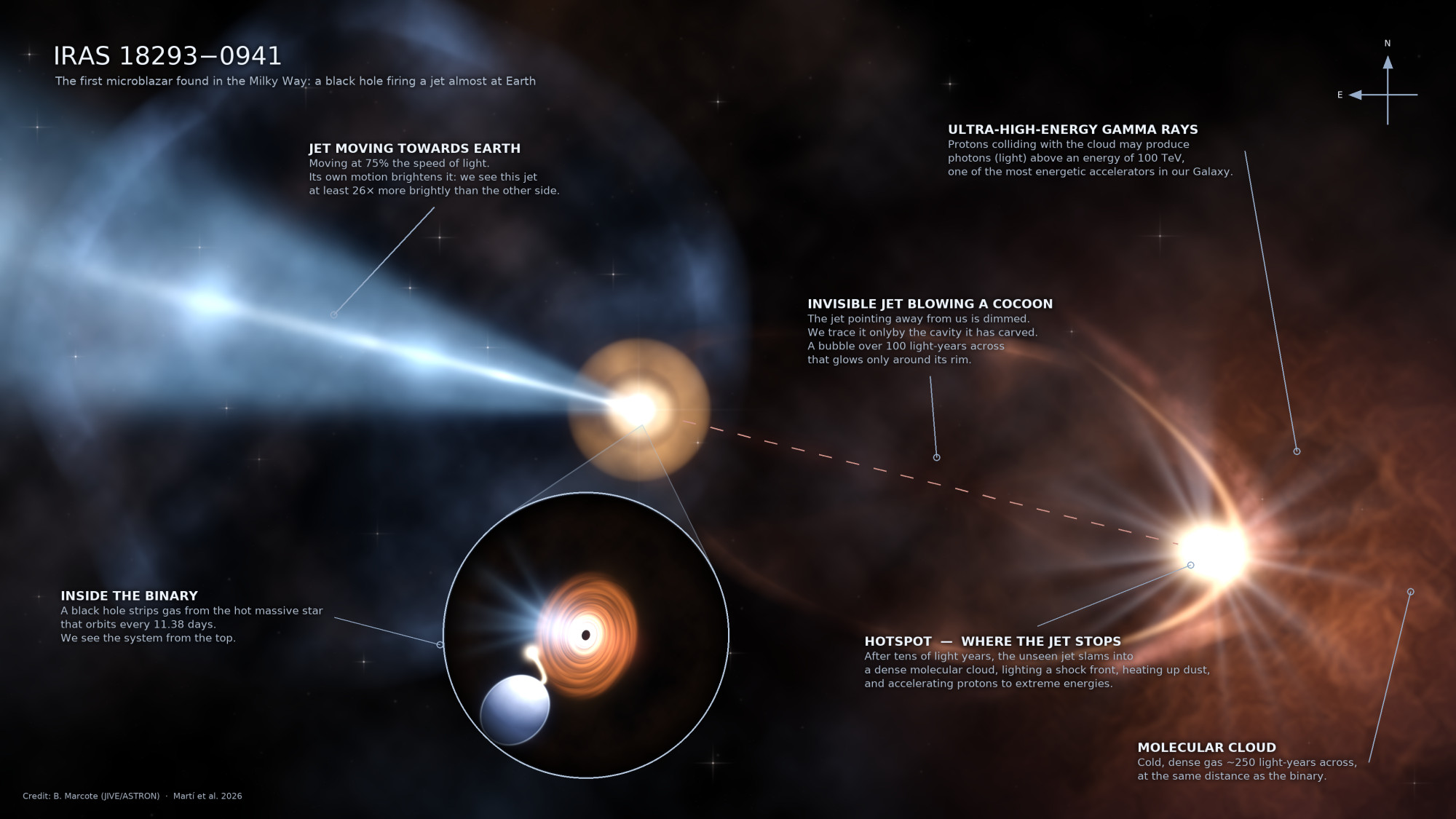
The object, called IRAS 18293−0941, also has a black hole, but a stellar-mass one. It weighs about 10 times the mass of our Sun, and it has a stellar companion that goes around it every 11 days.
The black hole steals material from the companion, which first ends up in an accretion disk and eventually in the black hole. Part of that material is shot out into the galaxy as two jets shooting in in opposite directions. As luck would have it, one points almost right at us.
Radio observations have shown that the jet on the other side has cleared 100 light-years of interstellar medium. The ones from regular blazars can extend for millions of light-years, but they are also at an enormous distance away. This one is roughly 12,000 light-years from Earth.
“This discovery allows us to study remote blazars, created by distant supermassive black holes,” co-author Benito Marcote, senior support scientist of ASTRON and JIVE, said in a statement. “Those blazars are too remote to be resolved in our images. Having an analogue object in our galaxy allows for detailed study of blazar physics.”
The jet was seen slamming into a dense cloud of interstellar material. The effect of this interaction is remarkable. Particles are accelerated to energies 100 times higher than what we can achieve in the Large Hadron Collider, the most powerful particle accelerator on Earth.
This microblazar is not the most powerful particle accelerator in the universe, but it might be one of the most powerful in our galaxy, since there is no blazar at the center of the Milky Way.
The particles are moving just a tiny fraction slower than the speed of light, and they might well be the fastest particles in the galaxy.
It is only the microblazar nature of IRAS 18293−0941 that is newly discovered. The object itself was spotted in 1983 by the now many-decades-defunct IRAS satellite, an early infrared space telescope.
To reveal what this black hole gets up to, researchers used optical light, X-rays, gamma rays, and the aforementioned radio observations. All of this was key to fully capturing its behavior and its environment.
“This was a genuinely multi-wavelength observational campaign,” Marcote explained.
“This discovery highlights the power of studying the Universe with different kind of telescopes at the same time, because none of the individual telescopes could have told the entire story,” added coauthor Jakob van den Eijnden, from the University of Amsterdam.
“It is a great showcase of the international team efforts that are at the core of modern astronomy.”
The study has been accepted for publication in Astronomy & Astrophysics and a preprint is available on the arXiv.