Space and Physics
 PUBLISHED




The Large Hadron Collider, the world’s foremost particle accelerator, is CERN’s pride and joy. This instrument has pushed the envelope on particle physics, delivering the long-sought evidence of the existence of the Higgs boson in 2012. From June 29, the LHC will be turned off for its third long shutdown. Things are about to change dramatically.
Long Shutdown 3 will last four years, and it will feature some major works. This includes dismantling a small portion of the 27-kilometer (16.7-mile)-long ring that makes up the LHC. The goal is simple: to massively increase the number of collisions happening in the particle accelerator.
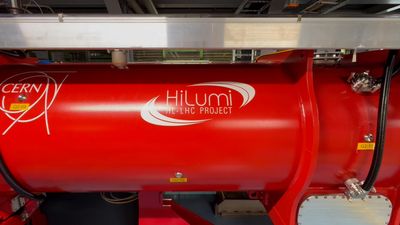
The High Luminosity Large Hadron Collider, or simply HiLumi, is going to be this new exciting phase of the LHC. Luminosity in this case stands for particle collisions per second. The number of collisions is expected to more than double, leading to new insights into fundamental physics.
“It is an exciting time for CERN: the Long Shutdown 3 will start very soon, and transitioning from the current Large Hadron Collider (LHC) to its massively upgraded version, the High-Luminosity LHC, will bring invigorating possibilities for our research,” Dr Gautier Hamel de Monchenault, CERN Director for Research and Computing, told IFLScience.
“We will be able to maximise the performances of the accelerator, generating more data with the run of High-Luminosity LHC than what we generated with all three runs of the LHC combined.”
A lot of work has already gone into preparing for this major upgrade, from designing new magnets for the accelerator to building the aboveground and underground structures necessary to deliver this upgrade. IFLScience visited the various facilities preparing for HiLumi.
“Once we found the Higgs,” Dr Oliver Bruning, CERN director for Accelerators and Technology, told us during the visit, “the immediate question was how can we sustain the performance of the LHC for a very long time period.”
The idea of such an upgrade, Bruning explained, was set forth before the LHC was even turned on. It pays to be prepared in the particle physics world. The discovery of the Higgs strengthens the motivation for this. HiLumi is expected to deliver about 380 million Higgs bosons, compared with roughly 55 million Higgs bosons produced so far.
Clearly, the upgrade will allow scientists to understand this crucial particle better: a very worthy goal, since the Higgs is the particle responsible for the mass of all the other particles. That’s not all.
HiLumi will probe rare events, improve a bunch of measurements of fundamental physics, constrain the properties of some difficult-to-observe fundamental particles, and continue to look for physics beyond the standard model – things we know should exist, but we have yet to find.
“The large experiments ATLAS and CMS are being upgraded to meet the challenges of the high-luminosity phase, leading to significantly greater precision and sensitivity in measurements, and increased discovery potential,” Hamel de Monchenault told IFLScience.
The other two experiments on the LHC, ALICE and LHCb, will also have some upgrades during the shutdown with more substantial improvement during the early 2030s as the high-luminosity era gets on its way.
The development of this new phase will also see a very sustainable approach to waste heating from the device. To keep the particle beams in orbit moving just a dash slower than the speed of light, you’ve got to have a strong magnet. To make them work, you need a lot of energy, and so there was a lot of waste heat.
This was traditionally vented into the environment or put into cooling towers. For this project, sustainability was key, so the heat from HiLumi will be used for hot water requirements in local communities.
“This is all being implemented in parallel with HiLumi [upgrades]. Part of the whole exercise is to make our field more sustainable and globally integrated into societies,” Dr Bruning told IFLScience.
CERN is by its very nature an international organization, but every person we spoke to wanted to stress the importance of international collaboration in making this exciting new development happen.
New insights into fundamental physics are coming, and while the machine and its experiment are being upgraded, there is still plenty of data from the LHC waiting to be analyzed.