Space and Physics
 PUBLISHED


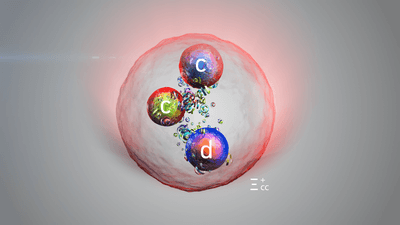


Researchers at CERN have announced a new particle that is like a slightly heavier version of the proton. This new particle, reported by the LHCb experiment, has two charm quarks and one down quark, making it four times heavier than a regular proton.
There are six types of quarks in the universe: up, down, charm, strange, top, and bottom. Mostly, regular matter is made of just up and down quarks in a triplet combination. Two down and one up make a neutron, and two up and one down make a proton. The charm quark is like a heavier version of the up quark, so it can be assembled in a similar setup.
The new particle is known as Ξcc⁺ , pronounced "double-charmed Xi". It is similar to a particle discovered by LHCb in 2017, another Xi double-charm baryon, which also contained two charm quarks and one up quark. Theory predicted the existence of both, but the new one has a half-life six times shorter, making it that much more difficult to observe.
“This is the first new particle identified after the upgrades to the LHCb detector that were completed in 2023, and only the second time a baryon with two heavy quarks has been observed, the first having being observed by LHCb almost 10 years ago,” the LHCb Spokesperson Vincenzo Vagnoni said in a statement. “The result will help theorists test models of quantum chromodynamics, the theory of the strong force that binds quarks into not only conventional baryons and mesons but also more exotic hadrons such as tetraquarks and pentaquarks.”
LHCb is one of the four experiments of the Large Hadron Collider. Particles made of quarks are known as hadrons, and the number of new ones discovered with the LHC is now up to 80. The team has observed the double-charmed Xi with a statistical significance of 7 sigma, well beyond the gold standard of 5 sigma for particle physics.
“This major result is a fantastic example of how LHCb’s unique capabilities play a vital role in the success of the LHC,” added Mark Thomson, CERN Director-General. “It highlights how experimental upgrades at CERN directly lead to new discoveries, setting the stage for the transformative science we expect from the High-Luminosity LHC. These achievements are only possible thanks to the exceptional performance of CERN’s accelerator complex and the teams who make it all work and to the commitment of the scientists on the LHCb experiment.”
The discovery was announced at the Rencontres de Moriond Electroweak conference.