


 Space and Physics
 PUBLISHED
 3
3


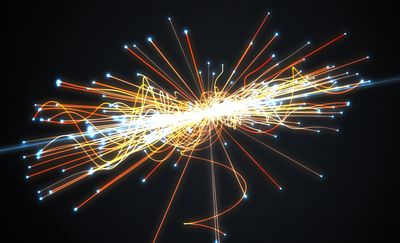


The Large Hadron Collider at CERN is synonymous with cutting-edge research in particle physics. In 2012, two of its four experiments discovered the Higgs Boson, the particle that gives all particles a mass. There was a time, though, when a small group of loud people got it into their heads – and then into the newspapers – that the LHC was going to end the world.
The LHC, located underground across the border between France and Switzerland, and the Relativistic Heavy Ion Collider (RHIC) were the focus of these conspiracy theories. Both colliders accelerate particles to a speed close to that of light before letting them smash into each other. The collision creates new particles as well as showing force interactions, similar to what the universe was like the instant after the Big Bang.
Bold claims...
The claim, which continues to exist in some form or another today, is that the LHC and RHIC would create something. The most popular idea was that the particle colliders would produce a black hole that would devour the Earth. Another, that they would start false vacuum decay, leading to the end of the universe itself. A third one involves the creation of stable strangelets, peculiar particles containing a strange quark and, for some unspecified reason, a problem for us.
Let’s debunk the black hole stuff first. The LHC gives a lot of energy to particles, but nowhere close to producing a black hole. A black hole is an object with an incredibly high density, so you need to pack a lot of matter (or energy) into a very small space. The LHC simply can’t do that.
Some extensions/alternatives to the Standard Model of Particle Physics (our current best understanding) suggest that an accelerator like the LHC could produce one micro black hole a second. Let’s assume that this is indeed the case: the smaller the black hole, the faster it evaporates due to the loss of Hawking radiation. Basically, these hypothetical black holes would be gone faster than they appeared.
The false vacuum decay theory is more interesting. It is a fascinating hypothesis that the universe is not in its lowest possible energy state. This means that the universe as it is today is only metastable, and there is a more stable version possible. If any portion of the universe were to reach that true stable configuration (the true vacuum), the whole universe would be condemned to the change, ending the existence of the entire cosmos.
…meet real physics!
Both the RHIC and CERN looked into the claims, and they took them very seriously. CERN commissioned two reports about its safety, both finding that there were literally zero concerns about the particle accelerators. This did not stop the promoters of the “danger claims” from issuing legal challenges and staging protests against the activation of the LHC.
We could get into the details of each claim for a bespoke rebuttal, but there is a simple truth that should convince you that the claims are nonsense. Nature is capable of producing much more energetic particles than we do, and it is consistently throwing them at Earth. Ultra-high-energy cosmic rays make the acceleration we are capable of at CERN look like child’s play.
Take KM3-230213A, the most energetic neutrino ever detected, believed to be linked to the most active supermassive black hole. It had an energy 100,000 times higher than the particles we collide in the LHC. If particle acceleration alone could cause the end of the world, our concerns should be directed towards the cosmos, not underground in Switzerland.
How does the Large Hadron Collider work?
“The Large Hadron Collider is a machine of 27 kilometers [16.8 miles]. It's about 100 meters [328 feet] underground, and it's filled with protons coming from the injector chain,” Rende Steerenberg, who is affectionately known around CERN as "the man who pushes the button to start the LHC", told IFLScience in an exclusive visit to the site.
Before getting to the LHC, those protons have to be accelerated by other smaller accelerators. Powerful magnets push the speed of these particles closer and closer to the speed of light, before entering the main ring of the LHC, where they will travel those 27 kilometers at 99.9999991 percent of the speed of light.
“There will be protons circulating in the two opposite directions of the ring, and then these protons are brought into collision at four points of the ring,” Fabiola Gianotti, former director-general of CERN, told IFLScience.
The locations of those four points are the four experiments. ATLAS and CMS are the multipurpose ones – they just want to see what particles are produced in the collisions. ALICE works similarly to the RHIC, and it has studied the collisions between lead ions that recreate the conditions close to the Big Bang (as well as producing the almost-alchemical conversion of lead into gold). Last but certainly not least is LHCb, which is trying to understand why the universe is made of matter and not antimatter by searching for anomalies between the two.
The LHC will soon undergo a sizable upgrade as it prepares for its Hi-Lumi phase, where it will be capable of producing a lot more collisions, expanding even more on what we know. These nonsensical claims are bound to come back around, but the LHC has operated for almost two decades and we are still here, so we should not lose any sleep over the "danger" of particle physics.


