Space and Physics
 PUBLISHED




What you'll discover in this article
- The Search for Extraterrestrial Intelligence has mostly focused on a narrow range of radio frequencies.
- A team has now used a completely different range of wavelengths to look for alien signals.
- They did not find any; but as PhD researcher Louisa Mason told IFLScience, "My work at the moment is less about looking if aliens are sending messages and more about thinking about how we use these radio telescopes and even maximising the data, thinking about how we could search for it."
Where are the aliens hiding? Maybe talking to each other on the wrong frequency, one we have not yet looked at. Imagine if the solution to the Fermi Paradox, the famous quip about not being able to find these beings, came down to a simple change in where we're looking. New research investigates.
Most of the Search for Extraterrestrial Intelligence (SETI) in radio waves specifically focuses on the frequencies between 1.42 and 1.66 GHz, with plenty of reasons why. To begin with, this range is among the parts where the Earth’s atmosphere is transparent to radio waves, so we can use observatories on the ground.
The two frequencies also sit between two famous lines: on one hand is the emission from hydrogen (the notorious 21-centimeter line), and on the other is the hydroxyl molecule, or more simply, OH. Combined together, hydrogen and hydroxyl make water.
Both hydrogen and hydroxyl are common and bright in the universe, but the frequencies in between are wonderfully quiet. The water connection has led researchers to call this the "water hole." If you were trying to send signals across the stars, picking a frequency between these two would be a smart choice.
Lots of signals we use on Earth, from TV to radar, can fall into this particular water hole. Earth could already be discoverable by nearby star systems due to telephone communication signals and even airport radars.
It's just really about understanding whether we're alone or not; that's the biggest question. I hope not!
Louisa Mason
Still, there is no reason why aliens might not be communicating or accidentally emitting signals in other wavelengths.
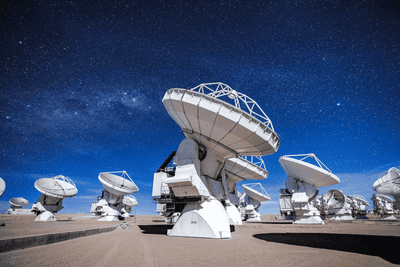
For this reason, Louisa Mason, a PhD researcher at the University of Manchester, used archival data from the Atacama Large Millimeter/submillimeter Array (ALMA) to expand this search.
“In SETI, the first best guess was looking at a specific wavelength about 1.4 to 1.6 gigahertz, partly because the galaxy goes quiet,” Mason told IFLScience.
“So, we thought that maybe if intelligent life wanted to send a signal, they've got a better chance of getting over the noise from the galaxy, from the universe.”
The logic of that choice is undeniably solid. It’s a great range of frequencies, and any species that is water-based would be familiar with that signature. There’s one snag though… which is the usual snag.
Where is everyone?
“We haven't detected a signal yet at that frequency,” Mason told IFLScience. “So maybe we've got the frequency wrong.”
“My work has been looking at expanding the search to higher frequencies. ALMA is one of the most sensitive instruments at millimeter and submillimeter wavelengths, so it seemed like a great choice.”
Mason’s work focused on archival data from two small frequency windows in ALMA. Currently, the work focuses on four archived ALMA observations – a start, showing that there is something worth looking into it.
And no, the team has not found any candidate technosignatures above their thresholds.
“My work at the moment is less about looking if aliens are sending messages and more about thinking about how we use these radio telescopes and even maximising the data, thinking about how we could search for it,” Mason explained.
SETI might have been more efficient than thought
A second aspect of Mason’s work focused on a more accurate census of how many stars have been sampled. The idea is that a radio telescope might be pointing at a specific star, but other objects might be in the field of view.
Previous work used stellar catalogs like the incredible map of the Milky Way made by the now defunct Gaia observatory and showed that you could jump from a thousand stars to hundreds of thousands.
Mason shows that by using galaxy simulations, you can take into account stars that are too faint to be seen by those surveys or couldn’t be resolved as individual objects. A previous SETI survey of 1,327 systems covered 288,000 stars according to Gai, but 6.1 million objects following Mason’ approach.
“Any time you point your telescope, you capture a certain extent of the sky. Using a simulation gives you a better picture of what you've actually captured,” Mason told IFLScience.
The shift from the water hole is a shift in perspective about what aliens might be like and how they might be using radio-wave-producing technology.
“SETI, at first, was thinking about those water-loving, human-like, Earth-2.0-kind of systems,” Mason explains. “Now, what we're looking at is something much less human-centered.”
“It's just really about understanding whether we're alone or not; that's the biggest question. I hope not!”
The study was presented this week at the Royal Astronomical Society's National Astronomy Meeting 2026 in Birmingham, UK.