Space and Physics
 PUBLISHED
 3
3


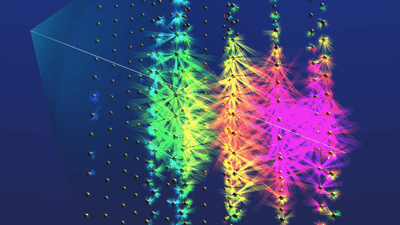


Neutrinos are often known as "ghostly particles", and for good reason. There are trillions literally going through each of us right now. They occasionally slam into matter, producing flashes of light or secondary particles. These events are rare enough that you need big detectors to catch them, one of which even uses the bottom of the Mediterranean Sea. A few years back, it detected the most energetic neutrino ever.
The observatory, called KM3NeT, is still under construction across multiple sites, and at the time of discovery, only 10 percent of it was operational. Still, it captured neutrino KM3-230213A. This event has no equal in our observation history. It was 35 times more energetic than the previous record holder, and 100,000 times more energetic than the particles we collide in the Large Hadron Collider.
Whatever event produced it must have been of epochal energy. New work has tried to answer the question of what its source might be. It needs to be something powerful and rare, otherwise we would have seen these types of events in other detectors. A previous suggestion was the death of a primordial black hole. A new alternative centers an extremely active supermassive black hole: a blazar.
"There are several possible explanations for the origin of this particle," Meriem Bendahman, a researcher at INFN Naples and a member of the KM3NeT collaboration, among the authors of the study, which counts hundreds of contributors, said in a statement.
"For example, it has been proposed that such neutrinos are generated when ultra-high-energy cosmic rays interact with the cosmic microwave background radiation, the residual light from the early universe. But there is also the possibility that the neutrino originates from a diffuse flux produced by a population of extreme accelerators, such as blazars."
The authors had to simulate what could have possibly produced such an event. It doesn’t seem likely that the source is a transient event like a flare or explosion, as no counterpart has been discovered using light. The team can’t exclude a point source, but it seems a lot more likely that it could come from a diffuse neutrino emission from a population of blazars. The event was just too extreme.
“For a neutrino it’s almost unbelievable,” Professor Miroslav Filipovic of the University of Western Sydney told IFLScience when the detection was announced. “And this is even though the instrument that detected it is only at one 10th of its final power.”
"We have never observed such a high-energy neutrino before, and if it turns out to come from cosmic accelerators like blazars," Bendahman explained, "it would give us new insight into how these objects can emit particles at energies beyond what we previously expected."
Ultimately, to understand this extreme event, we will need to find more events like this. As KM3NeT continues to be built, we hope more cosmic neutrino interactions will be spotted deep under the Mediterranean.
"We need more observational data," added Bendahman. "KM3NeT is still under construction, and we detected this ultra-high-energy neutrino with only a partial configuration. With the full detector and more data, we will be able to perform more powerful statistical analyses and open a new window on the ultra-high-energy neutrino universe."
The study is due to be published in the Journal of Cosmology and Astroparticle Physics and is available on the arXiv.