Space and Physics
 PUBLISHED





What you'll discover in this article
- Astronomers have found a new exoplanet with one of the longest orbital periods of any yet discovered.
- It follows a peculiar oval path and is much cooler than many other exoplanets but still hotter than Earth.
- The research team has shared with IFLScience what this means for the search for Earth-like planets.
Most exoplanets discovered in the past three decades look nothing like the planets in our own solar system. That's partly because there's more variety than we expected. At the same time, it's also been easier to find objects that are very un-Earth-like.
One common way to find exoplanets is called the transit method. Astronomers look at stars and wait for possible planets to pass in front of them, creating a dip in the recorded starlight. One dip doesn’t cut it, so you need repeated regular dips. On top of that, bigger worlds make bigger dips, making them easier to spot.
This combination makes our observations biased towards large planets orbiting small stars in very tight orbits. Spotting something like Earth requires many years of observations and high-precision telescopes. But new work shows we are getting there.
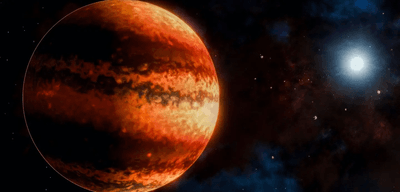
Researchers report on the discovery of a new gas giant that is 8 percent larger than Jupiter with almost five times the mass. It is certainly not Earth-sized, but the exciting result is to do with its orbit.
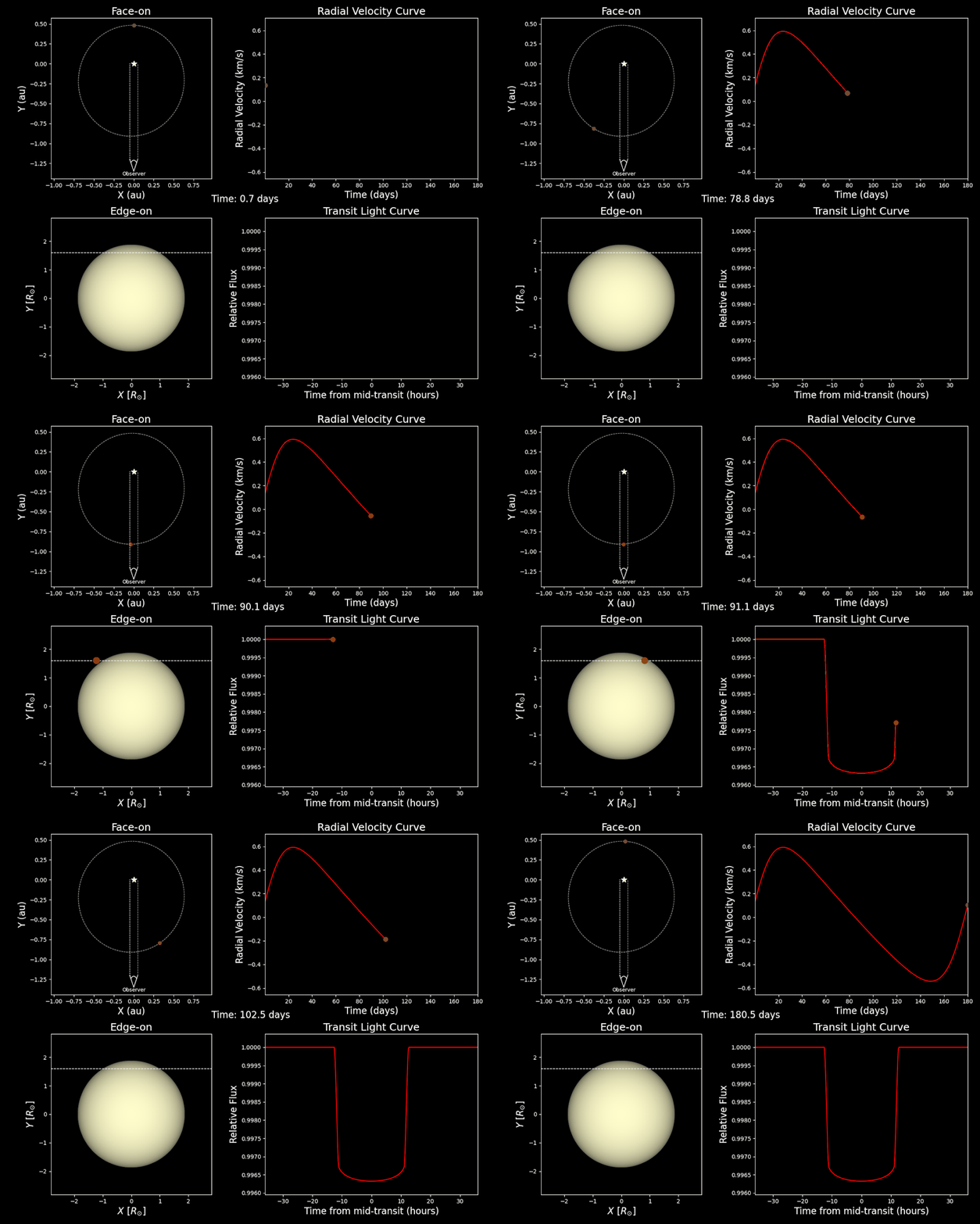
The planet goes around its star, which is larger and brighter than our Sun, every 180 days. Obviously that's shorter than an Earth year, but it's longer than most exoplanets we've spotted so far.
“The planet is called NGTS-38 b; that comes from the facility we used to find it, the Next Generation Transit Survey,” lead researcher Toby Rodel at Queen’s University Belfast told IFLScience.
“It's the longest-period planet that we've ever detected with NGTS, and it's one of the longest-period transiting planets ever found.”
How are things changing for exoplanet research?
Rodel and their supervisor Christopher Watson sat with IFLScience at the Royal Astronomical Society's National Astronomy Meeting in Birmingham to discuss this discovery and what it means for exoplanet research.
“We're entering a very exciting space where we're finding more and more of these planets,” Rodel explained. “You know, in a week there might be a half dozen more that have even longer periods."
The long period of this planet is certainly exciting, but there is a lot more about this planet that makes it special.
While the planets of the solar system have roughly circular orbits, this world goes around its star on quite an elliptical orbit. At its closest approach, the planet is closer to its star than Mercury is to the Sun. At its most distant, it’s roughly as far out as Earth.
We still don't know of a planetary system that resembles remotely our own solar system
Chris Watson
The star it orbits is just under twice as big as the Sun with about 1.5 times the mass, making it a lot brighter. So while this planet is cooler than most similar-sized worlds discovered with the transit method, it is much hotter than Earth due to its bright star.
Still, that brightness is an opportunity. Astronomers can use the light to better constrain the properties of the planet. Understanding the formation and evolution of giant planets around stars matters a lot to understanding our solar system.
A Christmas gift and years of follow-up
The planet was first spotted by NASA’s TESS (Transiting Exoplanet Survey Satellite) on Christmas Day 2020. Hoping to see it again, Rodel's team then pointed the NGTS instrument in Chile at that star for over 200 nights.
This secured a second dip, and the team was also able to measure a tiny wobble in the star due to the planet’s gravity, another method that allowed them to infer the presence of a planet. The work took years, but that's necessary when you're looking for planets that orbit far away from their stars.
“Pushing things out to those longer periods is crucial if we're going to find an earth analogue,” Watson told IFLScience. “For me it's exciting that we're able to do that, and we're doing that with a combination of space and ground observatories.”
“We still don't know of a planetary system that resembles remotely our own solar system. We still have not found that despite all these efforts, but there are a number of things that are coming up in the next few years.”
An observational revolution
First and foremost, the European Space Agency (ESA) PLATO mission is expected to launch early in 2027 and will be a game-changer in the search for Earth-analogue worlds.
“Plato is a groundbreaking mission that is not only going to find us new exoplanets, especially Earth-sized, Earth-mass exoplanets on one-year orbits, but also tell us about the ages of stars and those worlds,” Maximilian Günther at ESA told IFLScience previously. “We're really going to have a bit of a paradigm shift in terms of our understanding of other worlds… that is extremely exciting!”
In space, following PLATO, ESA will launch ARIEL. Blasting off in 2031, ARIEL will study atmospheres of known exoplanets in more detail.
Down on the ground, and on a similar timeframe, the next-generation of telescopes will come online, first ESO’s Extremely Large Telescope (ELT) and then the Giant Magellan Telescope, which should be capable of directly imaging rocky worlds.
Despite the excitement for new space observatories and extremely advanced and large ground-based telescopes, we shouldn't dismiss older facilities such as the NGTS, which was crucial in this work.
As Watson joked with us, telescopes here on Earth are much easier to repair than those in orbit: “If something goes wrong, we can take a trip out with a screwdriver and a wee mallet and give it a fix,” added Watson with a laugh.
This world was also discovered independently by a team led by Felipe Rojas and Rafael Brahm from Adolfo Ibáñez University in Santiago, Chile.
The research has been published in the Monthly Notices of the Royal Astronomical Society.