Space and Physics
 PUBLISHED


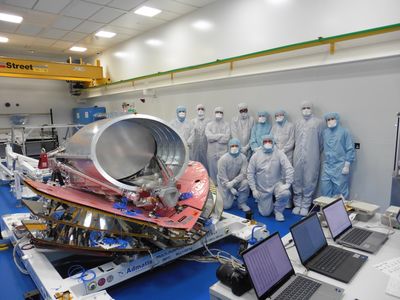


If we want to know how an exoplanet forms, we need to study its composition. The way to do that for very distant worlds is to study their atmospheres. In particular, if we are to find an Earth twin, we need to look for planets that have a similar size and similar atmospheric composition. A mission will fly into deep space in a few years to do just that. IFLScience was offered an exclusive behind-the-scenes look at how it is being tested.
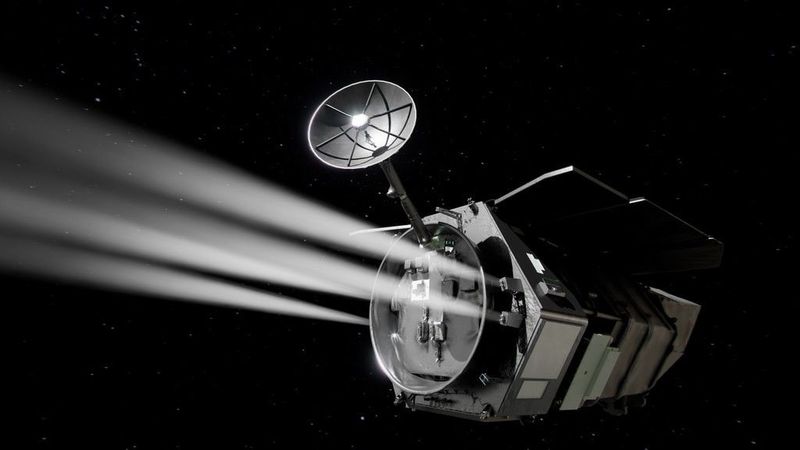
The telescope is called ARIEL. It is a project from the European Space Agency (ESA) that aims to produce a detailed understanding of the atmospheres of about 1,000 known exoplanets. It will travel 1.5 million kilometers (almost a million miles) from Earth to the second Lagrange point, where it will look at what the air is made of on those distant worlds.
“ARIEL is an ESA M4 mission that is going to look at the atmosphere of exoplanets. We are not hunting for exoplanets, we are basing ourselves on previous mission who’ve already found the exoplanets,” Dr Rachael Drummond, ARIEL UK National Project Manager at STFC RAL Space, told IFLScience during our tour. “We are going to study up to 1,000 in detail as they pass in front of their stars.”
As a planet passes in front of its host star, some of the starlight is filtered through its atmosphere. ARIEL will be capable of determining the composition in greater detail than ever before.
ESA is very serious about understanding exoplanets. The agency has a stake in JWST, which has performed many exoplanet studies and will do even more in the coming years. It also launched CHEOPS in 2019, which studies the size of known exoplanets and confirms candidate worlds. It was supposed to be working for three-and-a-half years, and it is now in its sixth year. Later this year, ESA will also launch PLATO, which will aim to look for exoplanets around 1 million stars.
ARIEL was scheduled to launch in 2029, but 2031 is now a more likely date. The spacecraft is currently being tested to make sure everything works as it should.
“We need to be sure it's going to survive launch. We need to be sure it’s going to survive the cold vacuum of space,” Dr Drummond explained. “Also, with ESA missions, the payload comes from numerous countries, so each person has built their parts and this is the first time that we put them all together, and make sure all the bolts go through the holes and it hold together.”
There is a big missing piece from the current setup, which is looking at the structural integrity of the craft, and it is the finished mirror. The spacecraft will have a one-of-a-kind aluminum mirror. It will be 1.1 meters (3.61 feet) across and is the largest ever attempted.
“This is the first time we are building the entire telescope out of aluminium. So this mirror isn’t glass, it’s a block of aluminium that has been machined down and then coated in silver,” Dr Drummond explained. “The reason why we are doing this is so that the entire telescope has the same coefficient of thermal expansion and it all shrinks and keeps in focus when we get into space.”
Aluminum is also a light material, and every gram counts when it comes to space. It is not an easy task getting a mirror as perfect as astronomy requires out of aluminum, but ESA is already looking at future possibilities, using segmented approaches to make an even more effective and lighter object.
The telescope will continue to be shaken, frozen, and messed with by the team to make sure all is well. The next phase will be integrating all the components and the mirror, and making sure everything continues to look as it should before we send it far away from Earth.