Space and Physics
 PUBLISHED



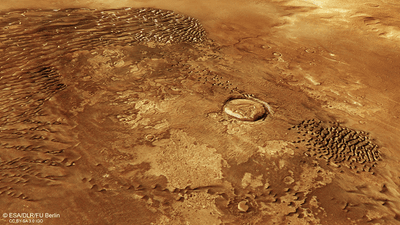


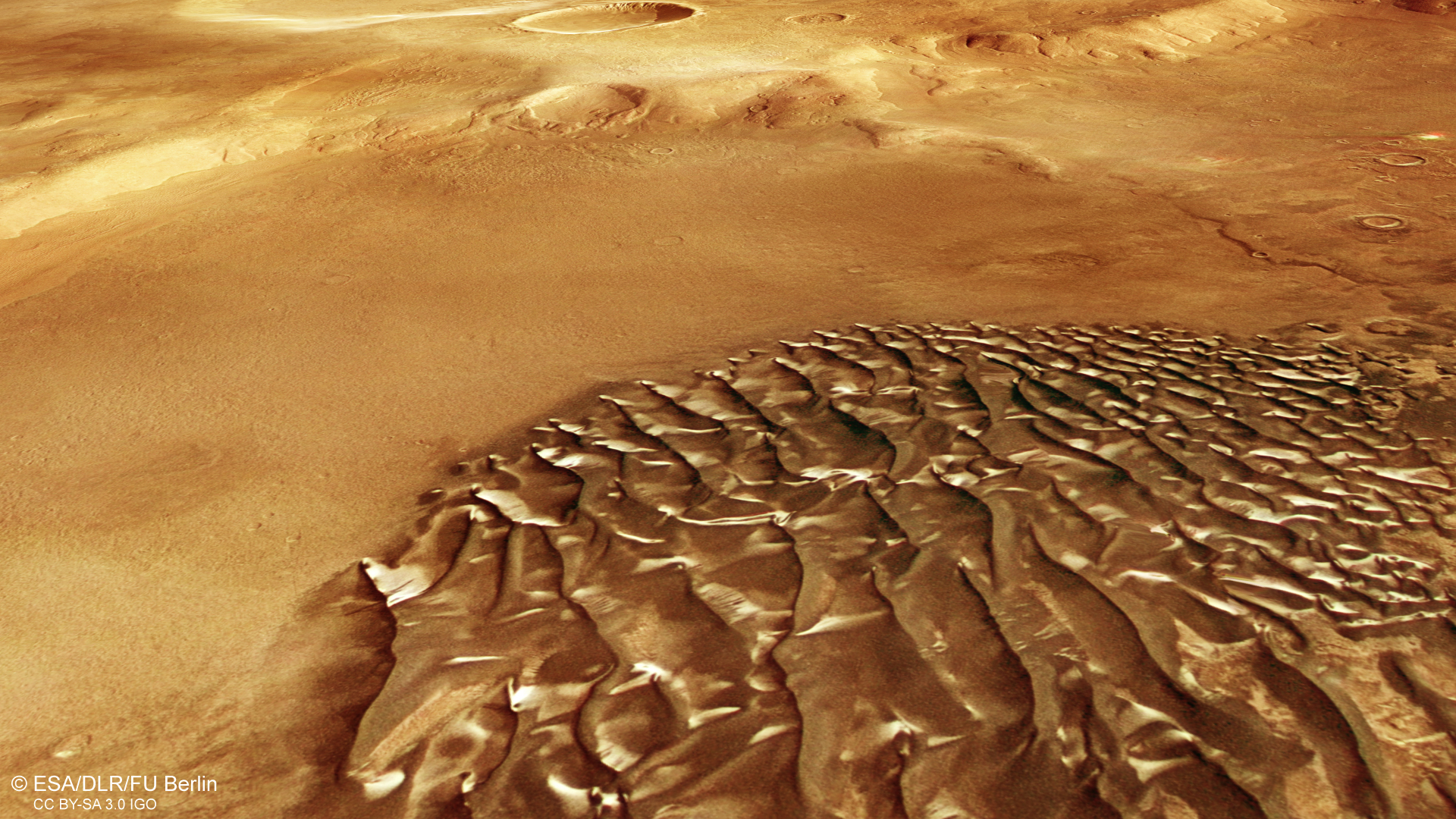
The European Space Agency's Mars Express orbiter has sent back stunning images of "metallic" waves inside an ancient Martian crater.
Here on Earth, our atmosphere protects us from smaller space rocks by burning them up, while the oceans happily gulp down evidence of the rest. Even if a large space rock does leave a crater, we've got plate tectonics on clean-up duty.
But on Mars, with a pathetic atmosphere and little geological activity, craters large and small remain visible and strewn all about the landscape.
Kaiser Crater, in the highlands of the southern hemisphere, is on the larger side, measuring around 207 kilometers (129 miles) in diameter.
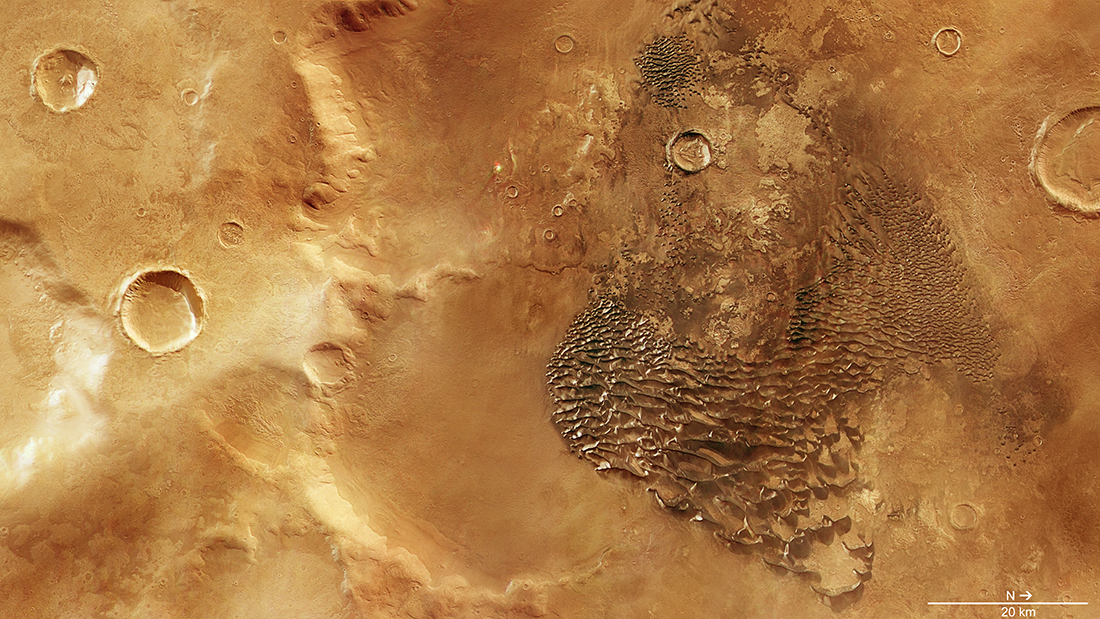
That's about the distance from Washington D.C. to Philadelphia, and it's room enough to contain several dunes, which are located in the southeastern part of the crater.
"Most of the individual dunes in Kaiser Crater are barchan dunes. Barchan dunes are crescent shaped with the points of the crescent pointing downwind," NASA explains.
"The sand is blown up the low angle side of the dune and then tumbles down the steep slip face. This dune type forms on hard surfaces where there is limited amounts of sand."
The area has seen a pretty heavy bombardment over the past 4 billion years, with craters within craters being a relatively common sight.
But the dunes of Kaiser Crater are a little bit special. Shaped by the Martian winds, they form a wavelike structure, towering 100 meters (328 feet) above the surrounding landscape.
"Much of the floor of Kaiser Crater is covered by distinctive, dark, almost shiny waves that look almost as if they’re carved out of metal," the European Space Agency (ESA) explains in a statement.
"Some are more solitary and isolated, while others merge to form a continuous dune field that extends for several kilometres. Their shiny, slightly metallic appearance is caused by bright frost deposits on their south-facing slopes."
The area is interesting scientifically. In places where wind has stripped away the top layers of the surface, orbiters have seen patches of light-toned clay rock, which scientists believe was formed in a more watery environment, long in the planet's past.
"There are also little gullies and narrow channels lining the steeper walls of some of the craters here," ESA adds. "While these were likely formed by dry landslides slipping down unstable slopes, some of the older gullies may have formed as ice reserves melted, or buried groundwater reservoirs caused the ground above to shift."
But the main appeal on this one, if we're honest, is how pretty those waves look on a lifeless planet millions of miles away. Feels like some life form should enjoy them, even if there are no Martians.