Space and Physics
 PUBLISHED


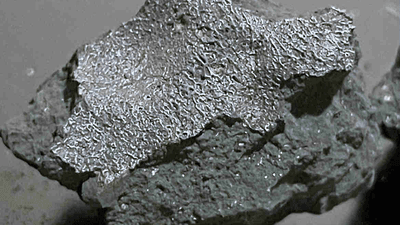


On July 16, 2024, at 15:17:27 UTC, residents of New York witnessed a "daylight fireball" reportedly passing over the city and iconic Statue of Liberty. In a new study, a team of scientists describe the trajectory of the object, and found features not previously seen on this kind of "protoplanet world".
When the meteorite first fell over New York, witnesses in the area soon began reporting the fireball and an associated boom to the American Meteor Society.
"As I was driving down on Rte 100, I suddenly saw this bright, white and kind of burning at one end, bundle streak through the sky from left to right – going down very rapidly," one report explains. "I have never seen anything like this before."
Using this information, NASA was able to put together a rough trajectory for the object.
"More eyewitness reports have been posted – we have double what we had before and the adds have made a big difference in the trajectory," NASA's Meteor Watch explained at the time. "We now have the meteor originating over New York City and moving west into New Jersey. Speed has bumped up a bit to 38,000 miles [61,155 kilometers] per hour."
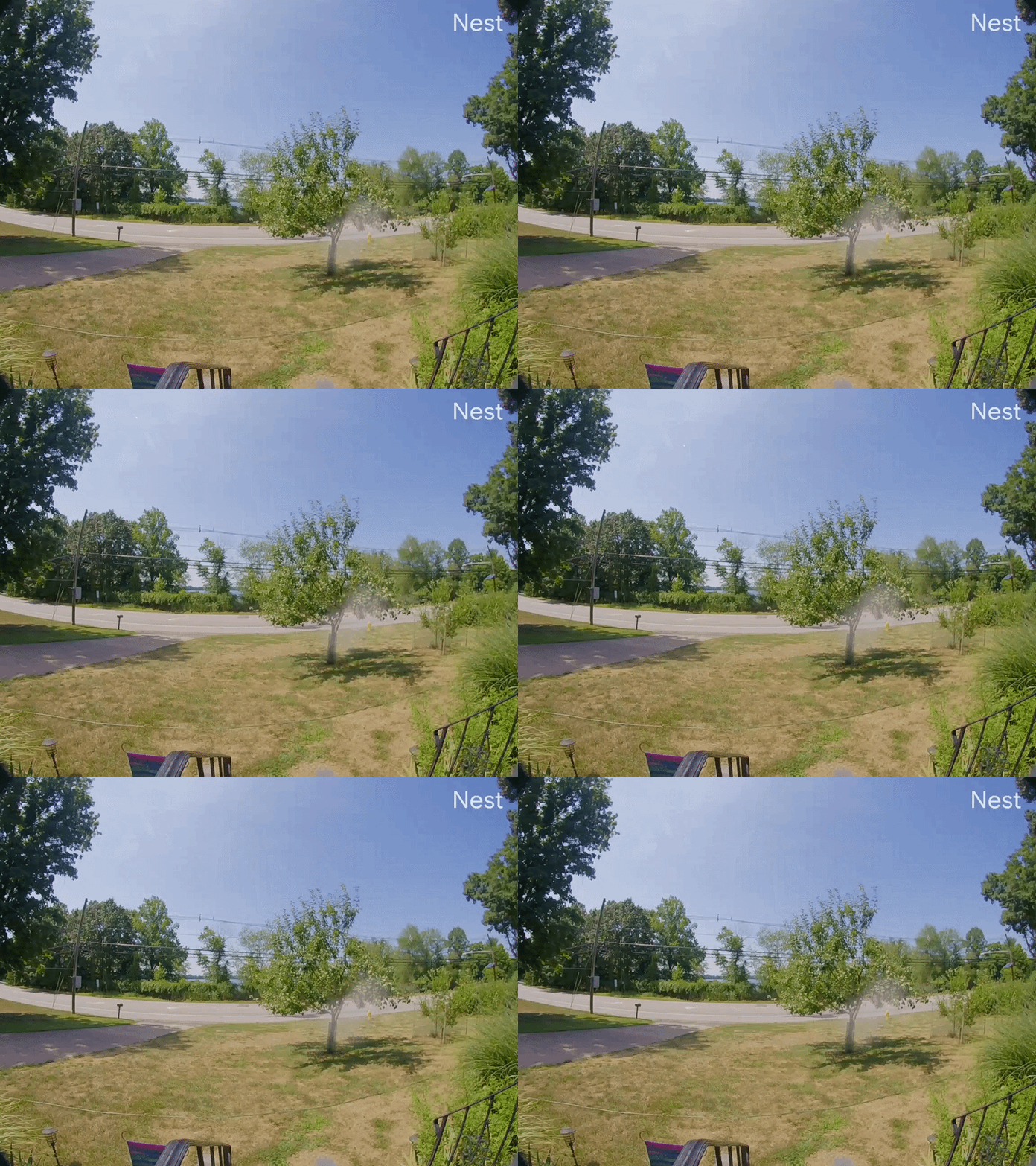
While that was a pretty good estimate, the new team was able to characterize the trajectory more accurately, using, amongst other footage, video collected by a New Jersey resident's doorbell.
"The meteor was filmed by two stations of the Allsky7 camera network, as well as by a doorbell camera in Wayne, NJ," the team explains in their paper. "Triangulation of those records show that the meteor moved in a 256° direction (East to West) over Staten Island toward New Jersey, from 44.4- to 34.9-km [27.6-21.7-mile] altitude at an angle of 29° to the horizontal."
"Each flare left a wake of dust. A surviving mass caused a final flare at 28.2 km [17.5 miles]. From 2 to 16 min later, the Newark Airport Doppler weather radar detected falling meteorites of 10 to 0.1 g, respectively, but none of these were found," they added.
Using the footage, the team was able to trace back the object to its previous home, between the orbits of Mars and gas giant Jupiter.
“Our cameras in Northford, Connecticut, and Douglassville, Pennsylvania, as well as a doorbell camera in Wayne, New Jersey, captured the meteor, and from that we measured its trajectory,” American Meteor Society operations manager Mike Hankey explained in a statement. “The path traced back to low in the asteroid belt.”
While the smaller pieces of debris proved elusive, a surviving, larger chunk very much made itself known, smashing into the roof of a house in Hillsborough, New Jersey.
The owner, hearing a loud bang, went into their bedroom to find a hole in the ceiling, and dark matter (we're talking dust here, not the elusive substance that makes galaxy rotation curves flat) covering the bed and carpet, and making everything smell of sulfur.
Carefully collecting the debris, the team found that around 1.35 kilograms (2.9 pounds) of space material had redecorated the master bedroom.
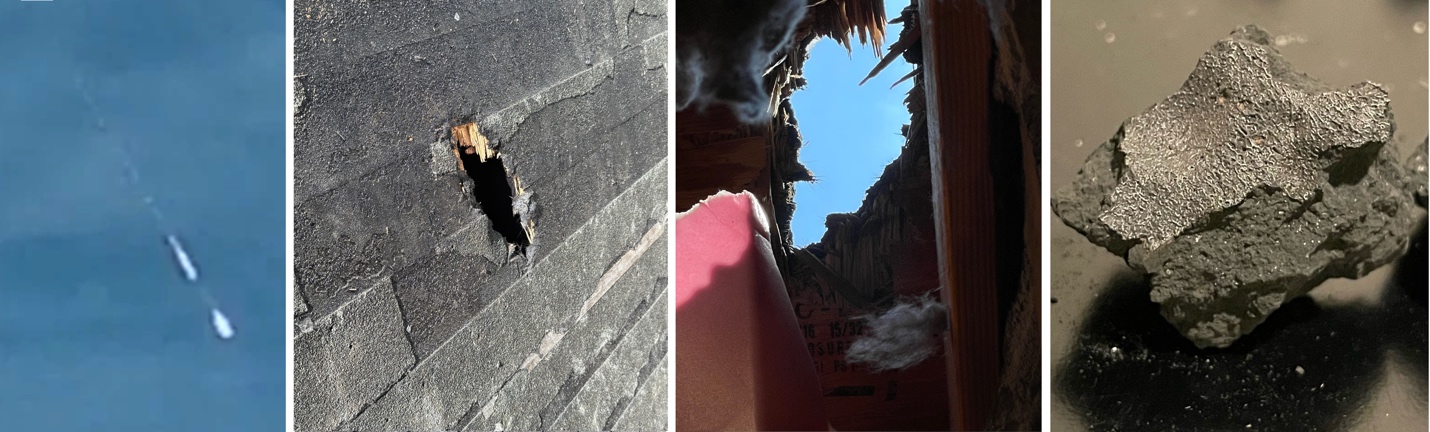
Examining the material available, the team found that it was a CM-type carbonaceous chondrite, a primitive type of water-rich meteorite believed to be important probes of planetesimals earlier in the Solar System's history.
“Isotope studies of carbon and nitrogen suggest that primitive carbonaceous chondrites, including CM-types, delivered organic matter to the early Earth,” cosmochemist Queenie Chan of Royal Holloway University of London, England, and biogeochemist Nana Ogawa of the Biogeochemistry Research Center at the Japan Agency for Marine-Earth Science and Technology, added.
“The Hillsborough meteorite contained 1.8 percent by weight of carbon and 0.07 percent of nitrogen, and had carbon and nitrogen isotopes typical for CM-type meteorites.”
We have only found around 22 of this type of meteorite, and this is only the second time that one has been witnessed falling to the Earth.
“A forensic study of the fragments revealed that they contained preserved bits from near the surface of a primitive asteroid where it experienced concentrated salty fluids – a process not previously known from this type of proto planet world,” said lead author and meteor astronomer Peter Jenniskens of the SETI Institute and NASA’s Ames Research Center in California’s Silicon Valley.
These briny fluids could play a role in creating molecules that are crucial, in turn, to creating life. According to the team, the meteorite came from the object's surface, and the meteor was altered more than previously-seen CM-type carbonaceous chondrites.
As well as this, the team found organic matter and prebiotic compounds within the samples.
"The exogenous delivery of amino acids, carboxylic acids, and other soluble organic molecules by CM-type bodies and their fragments could have been an important source of the prebiotic organic inventory that led to the emergence of life on Earth," the team explains.
While it would be cool to be able to trace the meteor back to its parent body, the team identified 27 near-Earth asteroids which it potentially could have come from, with no firm conclusions.
Nevertheless, we learned plenty about the meteor, and potentially about how water and life were delivered to (and developed on) Earth. All thanks to the hard work of the team, a doorbell, and a man whose bedroom was unexpectedly redecorated one July morning.
“Thanks to the homeowner’s quick reaction, these are the most pristine CM1/2 meteorites we know of,” Jenniskens added.
The study is published in Science Advances.
Correction (July 15, 2026): An earlier version of this article mistakenly stated that the house affected by the meteorite strike was in New York, rather than New Jersey. This has been corrected.