Nature
 PUBLISHED


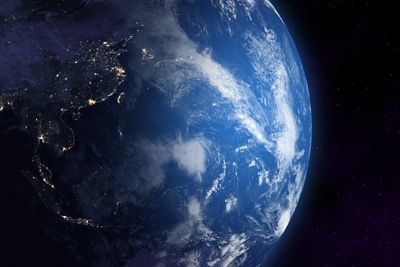


It’s easy to forget, from the safety of our dry, inland homes, just how much of this planet is ocean. But we are, clearly and easily, outnumbered. Water far exceeds land as a percentage of the Earth’s surface; up to 80 percent of all life is found in the ocean, and practically all of the habitable space here is under the waves. The Earth is, without a doubt, the blue planet.
But it wasn’t always. For the first billion years or so of our planet’s life, in fact, there were no oceans at all on Earth – there couldn’t have been, because it was simply too hot for water to stay in its liquid state. But around 3.8 billion years ago, the world started to transform. Slowly, the surface disappeared under a growing, green mega-ocean, increasingly ready to harbor the beginnings of life.
But exactly how and why that happened? Well, that’s all a bit of a mystery. Ask NASA, and you may be told the answer is in the stars; ask the National Ocean Service, and you’ll learn they came from below.
“Where all [our] water came from is a very good question,” wrote Malcolm Walter, Professor of Astrobiology at UNSW Sydney, in a 2018 article for The Conversation. “Scientists have been wondering about it for a long time.”
“We are still not exactly sure,” he said, “but it is probably a combination of two places.”
Raining down from above
So, hypothesis one: the Earth’s water came from someplace outside of our world. It’s a reasonable proposal: comets are, after all, just giant space icebergs that occasionally smash into planets. The timing of the oceans’ appearance also lines up kind of suspiciously well with the end of the Late Heavy Bombardment, a hypothesized period of around 400 million years during which Earth, the other rocky planets, and all our satellites were pummeled by a disproportionately high number of asteroids and comets.
What’s more, there’s a fair bit of evidence to support it. Last year, for example, researchers investigating the asteroid Ryugu confirmed that liquid water was flowing on the rock for more than a billion years – “far later than we expected,” said Tsuyoshi Iizuka, an Associate Professor in the University of Tokyo’s Department of Earth and Planetary Science and coauthor of a subsequent paper describing the find.
“The idea that Ryugu-like objects held on to ice for so long is remarkable,” he said. “It suggests that the building blocks of Earth were far wetter than we imagined. This forces us to rethink the starting conditions for our planet’s water system.”
Comets are a trickier prospect. The first spots of direct evidence, collected in the 1990s by the Giotto spacecraft and later in the 2010s by Rosetta, seemed to completely rule out comets as the source of Earth’s water; analyses found comet water to have a completely different “flavor” – real term – from the stuff we have here.
“[The] ratio between heavy and light water is very characteristic,” Kathrin Altwegg, principal investigator on the project, told the BBC at the time. “You cannot easily change it and it stays for a long time.”
And this ratio was “more than three times higher [on the asteroid] than on the Earth,” she explained, “which means that this kind of comet could not have brought water to the Earth.”
It seemed pretty slam-dunk – until 2024, when a new team took a closer look at the samples and realized something major: the impact of space dust. “Rosetta observations […] previously reported one of the highest [ratio] values for a comet,” the researchers explained. “However, reanalysis of more than 4000 water isotope measurements over the full mission shows that dust markedly increases [the] local [ratio].”
In other words: the comet hypothesis was still possible. And there are other extraterrestrial suspects for our water, too. It might have been that time our sister planet, Theia, smashed into us, birthing the Moon and imparting some of the building blocks of life at the same time. Perhaps it was meteorites that delivered Earth’s water – although the most recent research seems to point against that latter hypothesis (for now).
Overall, there are a whole bunch of potential ways water could have been delivered to our planet from elsewhere. So… how come so many people think the exact opposite happened?
An ocean under our feet
Could Earth have had water from day one? For a long time, this idea was dismissed by scientists – while it’s far from controversial to say that the rocks in the Earth’s mantle have always contained water, it was never thought to be enough to form the vast oceans that now cover the planet.
But more recently, the idea that Earth’s oceans were homegrown has gained traction. Just last year, for example, scientists at the University of Oxford deduced that the building block materials of the early Earth contained much more hydrogen than previously thought – a conclusion that “provides vital evidence to support the theory that water on Earth is native,” explained DPhil student and project lead Tom Barrett at the time; “that it is a natural outcome of what our planet is made of.”
It's an image echoed by NOAA’s National Ocean Service, which explains the oceans as a result of millions of years’ worth of continuous “degassing” of the Earth. “According to this theory, the ocean formed from the escape of water vapor and other gases from the molten rocks of the Earth to the atmosphere surrounding the cooling planet,” the organization says.
“After the Earth's surface had cooled to a temperature below the boiling point of water, rain began to fall – and continued to fall for centuries,” it explains. Then, “as the water drained into the great hollows in the Earth's surface, the primeval ocean came into existence.”
But perhaps most evocative of all the proposed models is that of the vast underground ocean hiding more than 660 kilometers (410 miles) below the Earth’s surface. First discovered in 2014, there’s potentially as much as three times the amount of water there as in all of the oceans combined – but if you’re imagining waves and currents, think again.
Instead, all this water is stored within striking blue rocks called ringwoodite – and according to Steven Jacobsen, a mineralogist and materials scientist at Northwestern University who was on the team that discovered it, “it’s good evidence the Earth’s water came from within,” he told New Scientist at the time.
Down in the mantle’s transition zone, the water would be squeezed out of the rocks – “almost as if they’re sweating,” Jacobsen said. From there, the water might reach the surface by various tectonic mechanisms – perhaps they were spewed out by a volcano; maybe they oozed out through subduction.
However the water reached the surface, though, we “should be grateful,” Jacobsen said, that so much stayed where it was. After all, “if it wasn’t there, it would be on the surface of the Earth, and mountain tops would be the only land poking out,” he pointed out.