Space and Physics
 PUBLISHED





For the first time, astronauts have had their bodies X-rayed while in space. This was not because there was anything wrong, but as a proof-of-principle for future missions.
For more than a century, X-rays have been a key tool for diagnosis, saving many lives and hastening recovery from serious injuries.
However, as Dr Sheyna Gifford of the Mayo Clinic noted in a statement, “Traditional X-ray machines are very large, produce a lot of radiation, and have a tendency to produce a blurred image if there’s movement. Because everything in space is constantly moving, the conceit has been that obtaining a diagnostic image in orbit was too technically challenging.”
The increasing use of X-ray telescopes in orbit has been a scientific goldmine, but they’re not what an injured astronaut needs.
Without suitable diagnostic tools, astronauts may need to be evacuated from Low Earth Orbit for conditions that would be treatable in space if they only knew what was wrong. On long missions, such as one to Mars, such a scenario would be much worse.
Ultrasound has been used in space for decades, but requires extensive training to operate properly. In the absence of a radiographer on board, ultrasound training is seldom top priority in pre-flight training.
As missions get longer, Gifford and others consider ultrasound increasingly inadequate. “It’s been a dream for aerospace medicine to have more than one imaging modality for diagnosing illnesses and injuries in space,” Gifford said. “X-rays are fast, easy and diagnostically valuable.”
But as X-ray machines have become more miniaturized, particularly with digital imaging, Gifford saw an opportunity.
“Portable X-ray machines are in use everywhere — at the Kentucky Derby, on the sidelines of the Super Bowl, and around the globe in low-resource areas — because they can run on solar power and can be operated by individuals with no medical expertise,” Gifford said.
“We believed an off-the-shelf portable system would stand a very good chance of surviving prelaunch testing and be operational in space by crew members with minimal training.”
To test the practicality of taking X-rays in microgravity, the Fram2 mission, launched in March 2025, spent three and a half days in a low orbit.
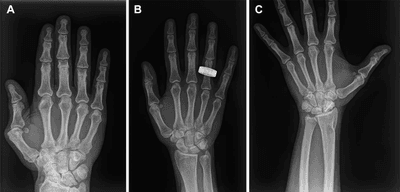
Some aspects of the mission did not go smoothly, but using the battery-powered IMPACT portable X-ray generator, three crew members succeeded in taking sharp images of each other’s bodies after just four hours of training.
All the images were good enough to have been used for medical diagnosis, had the astronauts been sick or injured.
Indeed, radiologists who compared the images taken in space with those collected by the crew before and after the mission using the same equipment found no differences in quality or resolution, although positioning was worse than preflight for abdomen images.
The crew also reported favorably on the usability of the system in space.
“By acquiring the first human and equipment X-rays in space, our study demonstrates the feasibility of in-orbit radiography and expanded diagnostic capabilities for crew health and hardware evaluation,” Dr. Gifford said.
“Acquiring a diagnostically useful X-rays in space is something that anyone can do. Three very talented nonmedical people with four hours of training in one of the harshest environments did it right and did it well.”

On longer missions, such facilities could track the decline of bone density in microgravity.
When the Fram2 mission took off to test this tech, those onboard could not know how relevant it would become. Less than a year later, four astronauts would be evacuated from the International Space Station (ISS) because one of them was sick.
Earlier that month, astronaut Michael Fincke suffered a medical episode and briefly lost the capacity to speak. Under instruction from NASA flight surgeons, Fincke’s crewmates were able to stabilize him.
But it was decided that medical imaging unavailable on the ISS might help diagnose the cause, although so far that hasn't been achieved.
There are other reasons to want to send portable X-ray machines into space, even if modifications would sometimes be required.
Gifford suggested they could diagnose malfunctioning satellites as well as people, with equipment imaged to the submillimeter scale. In addition, there is considerable interest in using microgravity to enhance the production of pharmaceuticals, and X-ray diffraction is a key tool in determining crystal size and purity for medications.
On-site quality control could mean better treatment even for those of us on Earth that never leave the planet.
“By acquiring the first human and equipment X-rays in space, our study demonstrates the feasibility of in-orbit radiography and expanded diagnostic capabilities for crew health and hardware evaluation,” Gifford added.
“Acquiring a diagnostically useful X-rays in space is something that anyone can do. Three very talented nonmedical people with four hours of training in one of the harshest environments did it right and did it well.”
The paper is open access in Radiology