Space and Physics
 PUBLISHED
 1
1




Just when we are starting to figure things out, the cosmos has a habit of throwing a new curveball our way.
Whether it was humans of the 1600s, having sorted out that we are living on a rock, finding that the rock we are living on may not be at the center of the universe, or the awkward and slightly irritating discovery that space between galaxies is (or maybe isn't) expanding at an accelerating rate, the universe sure does like to say "no lol" whenever we start to get a handle on things.
This has been going on for a while now, and from a certain perspective the prank may have begun with the universe's first light.
In 1964, physicist Arno Allan Penzias and radio astronomer Robert Woodrow Wilson noticed an unusual noise, like static on a radio, always present in the background of their radio telescope observations. The two thought at first, perfectly reasonably, that the interference must have been coming from the telescope itself, given that it was always there, no matter what direction they pointed the telescope in.
After eliminating all possible sources of terrestrial interference, and pigeons who had nested within the telescope's antenna, the noise remained. As you might already have guessed what they were looking at was not pigeons ruining their astronomy, but a Nobel Prize-winning discovery.
The noise had been heard and dismissed by other radio astronomers, but Penzias and Wilson realized that they were observing the cosmic microwave background (CMB), a signal that had been proposed by Ralph Alpher as potential evidence for the Big Bang model; the leftover radiation that is faintly detectable and permeates all of the observable universe.
The discovery of the CMB heavily supports the Big Big theory, with no alternative able to explain it and predict its very precisely observed features. But, like with most other progress in science, it also comes with some juicy mysteries in tow.
One of the odder, and lesser-studied, mysteries is often referred to as the "Axis of Evil" because astronomers can sometimes be dramatic too.
The problem is that when we look at the universe, given our current models and understanding, we would expect it to be isotropic and homogenous. That is, an area of space can differ slightly in mass etc due to slight variations during inflation, but if you zoom out far enough the universe should look pretty much the same in whatever direction you look.
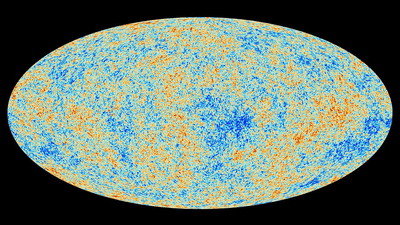
Looking at the CMB that is almost true, but not quite. For a start, there's that pesky cold spot. Then there is the axis of evil, which doesn't look quite as threatening when it isn't capitalized. The name was coined in a 2005 paper, after researchers noticed something odd when they broke down the cosmic microwave background into its largest patterns.
If the cosmological principle holds, the tiny temperature fluctuations imprinted on the CMB around 380,000 years after the Big Bang should be randomly distributed. No specific direction should be different than any other.
NASA's COBE and WMAP missions measured the CMB to be 2.726 Kelvin (around -270°C) almost everywhere in the sky, with minute variations in temperature representing the seeds from which galaxies would eventually grow.
Astronomers analyze these variations by dividing the sky into patterns known as multipoles. The simplest, the dipole, splits the sky into two hemispheres, while the quadrupole divides it into four regions, and the octupole into eight. Comparing these smaller segments, if the cosmological principle holds, the temperatures should appear random. But that is not what they find.
"[I]n recent years, there have been claims of anomalies detected in the CMB temperature map with considerable significance, which seem to break statistical isotropy of the temperature fluctuations and thus to question the cosmological principle," a paper on the topic explains. "Several groups claim to have found a strong alignment between the preferred axes of the quadrupole and the octopole, which is commonly referred to as the axis of evil."
More headache-inducing still, the axis appears to line up with our Solar System, with the temperatures "above" the axis appearing slightly higher, and the temperatures "below" slightly lower. This is true even after correcting for the motion of the Solar System and our own galaxy, a step taken before the CMB is split into multipoles.
As far as we can tell, there is no reason why this would be the case. It would be especially surprising to find that the universe somehow aligns with our own humble little Solar System, and so for the most part scientists believe that it will be a problem with the way our data is collected, or possibly a local problem, caused by massive structures in our vicinity. Separating local sources of microwave radiation from cosmological signals is notoriously difficult, as Penzias and Wilson made clear.
The problem has, so far, not gone away. We don't know whether the axis is truly there, or is a quirk of how our data is collected, or whether there is a local source messing around with our cosmology.
In the future, assuming the problem remains, it could challenge our cosmological models. For now though, the Axis of Evil is more of a Puzzle of Irritation than anything to stress about.