Space and Physics
 PUBLISHED
 3
3




The cosmological principle states that, on the largest scales, the universe is uniform and isotropic. In other words, it should look broadly the same no matter where you are or which direction you look. You would not expect to find a single enormous structure in one particular region of the sky.
Finding two in relatively close proximity is even more surprising.
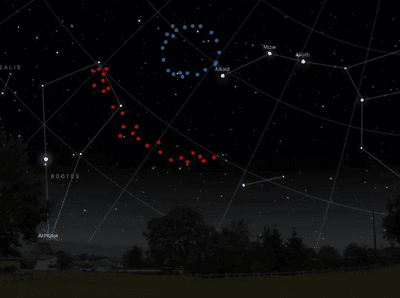
Five years ago, researchers discovered the Giant Arc, a vast crescent of galaxies stretching 3.3 billion light years across and located around 9.2 billion light years from Earth.
Then, in 2024, the same team announced an even more surprising discovery: a second enormous structure they named the Big Ring. Measuring 1.3 billion light years across and sitting at roughly the same distance, the Big Ring lies just 12 degrees away from the Giant Arc in the night sky.
“We could expect maybe one exceedingly large structure in all our observable universe. Yet, the Big Ring and the Giant Arc are two huge structures and are even cosmological neighbours, which is extraordinarily fascinating,” discoverer Alexia Lopez, a graduate researcher from the University of Central Lancashire, said in a statement.
“Neither of these two ultra-large structures is easy to explain in our current understanding of the universe. And their ultra-large sizes, distinctive shapes, and cosmological proximity must surely be telling us something important – but what exactly?”
An exact explanation for this is yet to be provided. According to the cosmological principle, galaxies should be evenly distributed, and despite the presence of galaxy clusters and the so-called cosmic web, these structures tend to average out. So structures cannot grow beyond a certain limit.
“Cosmologists calculate the current theoretical size limit of structures to be 1.2 billion light-years, yet both of these structures are much larger – the Giant Arc is almost three times bigger and the Big Ring’s circumference is comparable to the Giant Arc’s length,” Lopez continued.
“From current cosmological theories we didn't think structures on this scale were possible. We could expect maybe one exceedingly large structure in all our observable universe. Yet, the Big Ring and the Giant Arc are two huge structures and are even cosmological neighbours, which is extraordinarily fascinating.”
Further observations will be needed to confirm these claims and provide insight that the theory can use to understand what the presence of these structures means for our understanding of the Universe.
Lopez presented her findings on the Big Ring at the 243rd meeting of the American Astronomical Society. The research was later published in the Journal of Cosmology and Astroparticle Physics.
An earlier version of this article appeared in 2024.