Space and Physics
 PUBLISHED


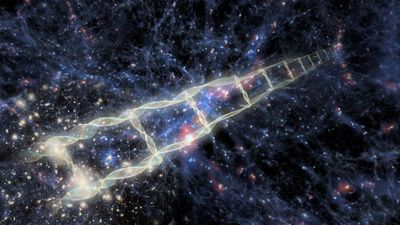


For the last several years, cosmology – the study of the universe as a whole – has been facing a major tension. The two main approaches to measure the expansion of the universe today should give us the same value. Unfortunately, they do not. This problem, known as the Hubble tension, continues to persist. A new approach actually made it “worse”.
Using the cosmic microwave background, the light echo of the Big Bang, and the standard model of cosmology, you get the value for the expansion rate today (AKA the Hubble constant) of about 67-68 kilometers per second per megaparsec. This means that if a galaxy is one megaparsec away (roughly 3.2 million light-years), it would appear to recede from us due to the expansion of the universe with a speed of 67 kilometers (41.6 miles) per second.
There's been this fascinating tension between the local measurement of the Hubble constant and what you expect it to be based on the cosmic microwave background.
Professor Adam Riess
An alternative to this is the distance ladder method. Basically, if we can measure the receding velocity and the distance of galaxies pretty accurately, we can work out the expansion rate. To get accurate distances, we need to look for celestial objects of known luminosity, known as standard candles. They act as milestones across the universe.
One of the limitations of the method has been our general uncertainty on the properties of the standard candles, even if we understand the true luminosities of these objects well enough. A new approach called the Local Distance Network has combined a variety of these measurements to strengthen the final value.
Using this approach, researchers found that the Hubble constant is 73.50 kilometers per second per megaparsec, with an uncertainty of ± 0.81. That’s a precision of just over 1 percent.
“There's been this fascinating tension between the local measurement of the Hubble constant and what you expect it to be based on the cosmic microwave background,” study coauthor and Nobel laureate Professor Adam Riess, from Johns Hopkins University, told IFLScience. “There are many independent ways locally that we can measure distances in order to arrive at an answer.”
What we concluded was that the Hubble tension is now at least seven sigmas. That's a lot… seven times the error bar. And that it's not dependent on any one source, telescope, team, or tool like that.
Professor Adam Riess
“Ordinarily, when you have a lot of data, you want to average things to get a better error, a smaller error. And also you want to be able to get a measurement that is less dependent on any one single element. The way to do that is to combine these things, but you have to be aware of a technical concept called 'covariance,' or some might call it 'correlation,' which is just simply to say that sometimes two measurements depend on the same underlying quantity.”
Several dozen experts in those different estimates worked together to combine the different measurements, making sure to never double-count any piece of information. The result is that the Local Distance Network has the lowest uncertainty for this estimate of the Hubble constant, well beyond the gold standard of the five sigmas.
On top of that, the network approach means that measurements can be removed without affecting the overall analysis. Let’s assume one is skeptical on how well we understand a particular stellar process; that can be removed without affecting the overall analysis.
“What we concluded was that the Hubble tension is now at least seven sigmas. That's a lot… seven times the error bar,” Professor Riess continued. “And that it's not dependent on any one source, telescope, team, or tool like that.”
The Hubble tension continues to appear as a real feature in the sky, not an issue with our measurements. In some camps, the idea is that either one or both camps are underestimating their errors and that the tension is not there. This work will certainly challenge that opinion. If the Hubble tension is real, then we might be missing something fundamental about the universe, and we need to continue observing to work out what that is.
The study is published in the journal Astronomy & Astrophysics.