Space and Physics
 PUBLISHED




Last week, the Royal Astronomical Society hosted its annual National Astronomy Meeting. The conference was exhilarating, revealing new discoveries, upcoming results, and even proposals for missions that won’t happen for decades to come.
There was a lot to learn. For example, the dust storm that killed fan favorite Mars rover Opportunity might have had a little help from a solar storm. Also, our galaxy’s stellar disk (where the spiral arms and we are located) might have flipped like a pancake due to a galaxy collision.
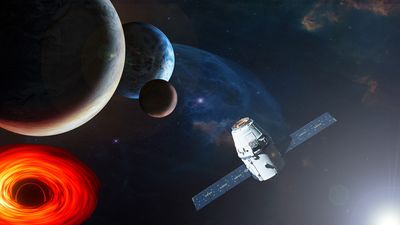
Unleashed onto the conference like every year, I learned a lot, but I also had the opportunity to subject brilliant people to silly questions. And one of them this year was this: If you could have an uncrewed spacecraft move faster than light, which celestial object or event would you travel to and why?
Basically, let’s ignore physics, feasibility, and money and see where these brilliant astronomers would want to explore.
Defy physics and defiant physicists
I need to immediately caveat that I've learned that one should not suggest to any kind of physicist, especially astrophysicists, a thought experiment where the limits of their subject can be ignored.
Being an astrophysicist myself, I should have known better. We are people who approximate grazing cows as perfect spheres in a vacuum and without friction.
The first answer, in fact, immediately blows up in my face when Dr Izzy Garland, from Masaryk University, told me that they’d send the spacecraft in the very opposite direction I was expecting.
“I’d send my spacecraft to the very center of Earth and see what’s happening there,” Dr Garland told IFLScience.
Understanding what happens in the core of rocky planets is a crucial mission of planetary science, and I did say physics be damned. There is a lot to learn under our feet about what's in the universe.
Let’s explore the solar system… but faster!
In general, there was a surprising amount of interest in just studying the Solar System, but a lot more quickly.
"I'd choose Europa. A direct investigation of a potentially habitable ocean on one of Jupiter’s moons would be incredibly exciting,” Professor Jim Wild, president of the Royal Astronomical Society, told IFLScience.
Before I could reply, pointing out that we have not one but two missions reaching Europa in a few years (JUICE and Europa Clipper), Professor Wild schooled me on the reason for his choice.
“Although it’s not so far away, a faster-than-light probe might facilitate rapid sample returns for comprehensive analysis in labs here on Earth.”
Basically, we want to know if these worlds can host life, and we want to know it yesterday. This is very much a shared sentiment among the scientists I encountered.
The Solar System remains mysterious and poorly explored. Many are keen to look at the places more promising for alien life: the icy moons.
“I would actually just like to go to the moons around Jupiter, and I think actually just doing a little tour of the Solar System,” Louisa Mason from the University of Manchester told IFLScience.
Mason works on SETI, and at the conference she presented exciting new work on looking for intelligent life signatures in previously untapped frequencies.
I would like to go to one of the interstellar objects. Maybe just sort of hitch a ride and see where it goes.
Phoebe Ryder
Unlike Europa, which will soon be explored again, another major target – not getting visited until the 2050s – is Saturn’s icy moon Enceladus.
Lana Williams, who presented her findings on the possible links between solar storms and a Martian dust storm, wants to go there. But with a twist.
“As part of my bachelor's degree, I did a study on Enceladus looking at the subsurface ocean. I'd absolutely love if we could send a probe to Enceladus and somehow have a look through its history,” Williams, a PhD researcher at Lancaster University, told IFLScience.
Beyond the quest to find alien life, there has been a very intriguing mystery in the Solar System. Well, three to be exact: ‘Oumuamua, Comet Borisov, and Comet 3I/ATLAS.
“I think I would like to go to one of the interstellar objects. Maybe just sort of hitch a ride and see where it goes,” Phoebe Ryder, also from the University of Manchester, told IFLScience.
I hear you like exoplanets...
There were a fair few exoplanet experts at the conference, and while it might be possible to reach the closest star to the Sun, Proxima Centauri, in a human lifetime with the proposed Project Starshot, a fictional faster-than-light craft might be preferable.
“I would love to go to the Alpha Centauri system. I'm going to say the whole thing because that's our nearest star system. We already know it hosts at least two planets,” Toby Rodel, from Queen’s University Belfast, told IFLScience.
Rodel and supervisor Professor Christopher Watson have recently discovered a planet going around its star in 180 days, a very long period and an unusual discovery given the method used. But they do not want to go and check out that particular world.
“If I was going to go somewhere else, I would probably head to TRAPPIST-1 because you've got lots of planets in that system you can look at.”
“And then there's this whole debate around, are planets around M-dwarfs actually habitable?”
TRAPPIST-1 has seven Earth-sized planets, orbiting in resonance in a very tight space, around a much smaller and dimmer star than the Sun, an M-dwarf. At about 40 light-years away, it remains one of the most fascinating known planetary systems.
“I would send a faster-than-light spacecraft to the TRAPPIST-1 system because I want all the details about all of those planets,” Professor Brooke Simmons, from Lancaster University, told IFLScience.
“How does such a compact planetary system exist? What are exoplanets actually like? Are any of them possibly capable of supporting life?”
Questions that we hope to solve with our current telescopes, but it would be much easier to do it right there.
Black holes near and far
Finding out about distant worlds and their potential for life is clearly on a lot of astronomers’ minds. The other thread we have spotted is using the physics-defying properties of our craft to go where physics struggles: black holes.
If I've got faster-than-light spacecraft, I'm going inside the event horizon, and I'm coming back out again so that we can actually probe what's inside a black hole and really test gravity to the extreme.
Dr Becky Smethurst
“I would send the spacecraft to the middle of the galaxy. We want to explore an environment we've never seen before,” Professor Chris Lintott, from the University of Oxford, told IFLScience.
“We've got the black hole, an amazing accretion disk, and it's the densest mass of stars. The night sky will look spectacular!”
This is echoed by John Mills, from the University of Warwick, who would like to see a special moment in a black hole’s life.
“I think it'd be quite cool to see a tidal disruption event, where a star is ripped apart by a black hole,” Mills, who presented work on the one-of-a-kind helium nova V445 Puppis, told IFLScience. “That must be spectacular!”
I also managed to catch up with Dr Becky Smethurst, our guest for IFLScience's The Big Questions podcast episode about black holes' impact on the universe. Unsurprisingly, she also picked a black hole to visit, but not just any one, the biggest known, TON 618.
“I would go to TON 618, which is the most massive supermassive black hole that we know of. It's 60 billion times heavier than the Sun. It's an absolute gargantuan thing,” Dr Smethurst told IFLScience.
“If I've got faster-than-light spacecraft, I'm going inside the event horizon, and I'm coming back out again so that we can actually probe what's inside a black hole and really test gravity to the extreme.”
The limit is just our imagination
Journalists should not become involved in a story, but my last interviewee, Professor Catherine Heymans, Astronomer Royal for Scotland, challenged me to answer my very question first.
Putting my astrophysicist hat back on, I said that I would visit a little red dot. This is a new class of objects that is related to the first galaxy in the universe, but we do not know what they are. Building blocks of galaxies, supermassive black holes, the first generation of stars?
Professor Heymans told me that I need to think bigger and that we will solve the little red dot mystery, even without my spacecraft. We should be using its capabilities to the limit: going faster than light means we have a time machine.
“I’d clearly go back in time to find out what kickstarted inflation,” Heymans told me. Cosmic inflation is a mysterious but fundamental period in our understanding of the universe when the cosmos swelled at an incredible rate a fraction of a second after the Big Bang.
She was just getting started.
“Or I could get an answer to the question I always get asked: what happened before the Big Bang? Could we even consider a before?”
This is not just a million-dollar question, it's a priceless question, because you’ll need a spacecraft that can say physics be damned to be solved.