Space and Physics
 PUBLISHED




What you'll discover in this article
- Meet V445 Puppis, a nova like no other known in the universe.
- It was shrouded in dust for decades, making it difficult to study – but astronomers are finally peering through it.
- Lead research John Mills told IFLScience about the several currently unexplained features in this system.
A nova is a special event that can happen in a tight binary star system between a companion and a white dwarf, the end product of a star like our Sun after it has run out of nuclear fuel.
White dwarfs are small and dense and can steal material from these companions, and this very material ignites, making the system suddenly much brighter. Nova comes from the Latin "stella nova," or new star. But of all the known novae, there are none like V445 Puppis.
It’s just such a weird system. It really reminds you that there's so much stuff going on out there.
John Mills
V445 Puppis is the only known helium nova. There are a few other candidates, but none of them have been confirmed.
It is extremely unusual to have a helium nova, as the vast majority of stars have plenty of hydrogen even in their evolved states. But researchers see no hydrogen here, and that's not even the only unusual thing.
“We didn't know an awful lot about this object, even though it erupted about 25 years ago, because this eruption also produced a lot of dust, obscured our view of this central binary,” lead researcher John Mills, from the University of Warwick, told IFLScience.
What can we see now?
The dust is now coming off, and with that, new insights and new mysteries around this event.
The team was able to confirm the nature of the white dwarf companion as a helium star. The observations suggest that the two stars orbit each other every 3.7 days, almost twice as long as previously thought. Also, the white dwarf is stealing material once again.
If this were not enough, there is also a lot going on with the surrounding material.
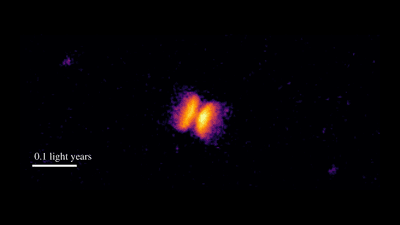
“You've got all this material coming off, and it produced this very lobed outflow, which came off in two different directions,” Mills told IFLScience. “This is also quite unusual for a nova.”
“Additionally, there were these bullets, these blobs of gas, probably produced after the eruption in some other related event… they were shot off much faster.”
The bullets are rich in oxygen, and they are moving at well over 30 million kilometers (20 million miles) per hour. No other known nova has produced such bullets, and the team believes that their ejection might be connected with some other unexplained phenomena.
“If you backtrack the motion of the bullets, when we think they come out roughly coincides with a radio flare of some sort, which I don't think we really know what that is either, but it's possible the two are related in some way,” Mills told IFLScience.
This unique system with never-before-seen events is truly an enigma wrapped in a puzzle. A different team is planning JWST observations to try and see through the dust, and Mills and his team plan follow-up observations too, especially at ultraviolet and X-ray wavelengths, to better understand the accretion.
“Novae are very cool, but no one knows about them because they get upstaged by their cooler cousins, the supernovae,” Mills continued.
Well, based on this research, we doubt anyone will be able to put V445 Puppis in a corner!
“It’s just such a weird system. It really reminds you that there's so much stuff going on out there.”
The study was presented at the Royal Astronomical Society's National Astronomy Meeting 2026 in Birmingham, UK.