Space and Physics
 PUBLISHED


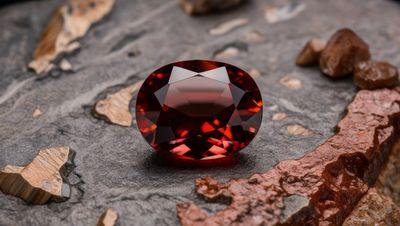


Anyone fancy a Martian gemstone tiara? While that would certainly be a conversation starter, it is unlikely that anyone's head would be adorned with such a jewelry piece any time soon. That’s not for the lack of minerals on the Red Planet. Over the last decade or so, it has become clear that Mars has plenty of “chemical” gemstones – rubies, opals, sapphires, garnets – though they might not be quite like our gemstones on Earth.
The precious minerals found on Mars are often small, many of them microscopic. While their elemental building blocks seem to be pretty common, they are pretty rare in general and probably formed in wildly different conditions than on Earth.
So don't expect to stumble on a massive sapphire. Still, in the precious stones, and maybe inside the precious stones, we might find something even more valuable: evidence of ancient life.
Precious stones as measuring tools
Just recently, researchers reported the first discovery of garnets in a Martian meteorite. This is cool because garnets are very pretty stones, but there's a reason why geologists in particular love them
Garnets are great geobarometers and geothermometers. This means that they record the pressure and temperature of the process that forms them. This is very important to understand where these particular rocks come from and the conditions on Mars.
One possibility is that this garnet was not from Mars. Martian meteorites are rocks from Mars, but to be lifted and thrown into space, they need an impact. It would be disappointing but interesting for other reasons if this garnet formed from outer space and got stuck into a Martian meteorite as it took flight.
The other two options are a lot more exciting. One is that the Martian garnet formed from rocks that were melted in a high-pressure and high-temperature environment. Garnets are a type of metamorphic rock.
On Earth, we have plenty of metamorphic rocks thanks to plate tectonics. There's no evidence of plate tectonics on Mars, but maybe a different process could create such rocks.
The other option is that the garnet formed in the asteroid impact. The high pressure and temperature of the impact create the right conditions for the garnet to come together. The research team is investigating the possibility.
As co-author James Darling at the University of Portsmouth explained at the time: “The findings add a striking new dimension to our understanding of the geology of Mars and open an exciting new window into the evolution of our planetary neighbour.”
Not quite a ruby, but maybe plenty of opals…
At the recent Lunar and Planetary Science Conference, researchers presented evidence from NASA’s Perseverance rover that suggested corundum might be present on Mars. Corundum is the mineral aluminum oxide or alumina, the second hardest known natural substance on Earth after diamonds. Both rubies and sapphires are types of corundum.
The findings, currently awaiting peer review, show a small pebble-sized corundum. It certainly does not look like any ruby or sapphire that we know of, but it's an extremely interesting hint at Mars geology. Similarly to garnets, rubies and sapphires need those high energies and pressures.
Jewelers might have better luck when it comes to opals. These have been found both by NASA’s Curiosity rover and by Perseverance. So two different locations on Mars. On top of that, in 2015, they were also found in the Martian Nakhla meteorite.
Those were actually very similar to fire opals. Given that opals form in the presence of water underground, they could be an excellent target to look for evidence of ancient life.
“The slice of Nakhla that we have is small, and the amount of fire opal we’ve found in it is even smaller, but our discovery of opal is significant," Professor Martin Lee, lead author of the meteorite study, said at the time.
"If Martian microbes existed, it’s possible they may be preserved in opal deposits on the surface of Mars."
The most precious rock of all
When it comes to Mars, the most precious rock is not a gemstone at all. It's the Cheyava Falls sample. This is the most compelling evidence we have that some biological processes might have happened on Mars.
To make sure of it, we should test the sample collected by Perseverance on Earth. Unfortunately, the Trump administration has canceled the Mars Sample Return mission that was supposed to bring it back, and the future of all Perseverance's Mars samples is now unclear.
We can’t really hop in a car and go get it, no matter how important it is (also, it would take at least 130 years to drive there and back), but at least we know where it is: safe and priceless at the edge of Jezero Crater.