Space and Physics
 PUBLISHED



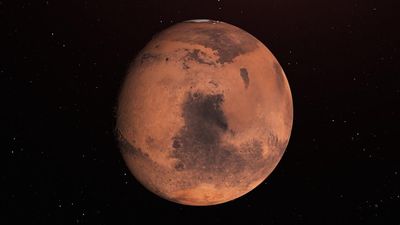


An international team of researchers reports the first discovery of a garnet in a Martian meteorite. Found in the NWA 8171 meteorite fragment, part of the Royal Ontario Museum (ROM) collection, this precious mineral could deliver a brand new understanding of the geological history of Mars.
Garnets have been appreciated since antiquity in jewelry, but there’s another reason geologists love them. They act as geobaromethers and geothermometers: they record the pressure and temperature of the metamorphic processes that form them.
Garnets form in metamorphic rocks. Such rocks form when pre-existing rocks are altered by intense heat and pressure deep within the planet's crust without melting into magma. At least, that’s on Earth. Finding one on a sample from Mars is very exciting.
“This discovery is going to expand our knowledge of the geologic processes that are possible on this planet. This new garnet-bearing rock type could give us clues to how Mars has changed throughout its history and new insights into the ancient environments that could have formed the garnet and related minerals,” lead author Tanya Kizovski at Brock University in Canada said in a statement.
Co-author James Darling at the University of Portsmouth added: “The findings add a striking new dimension to our understanding of the geology of Mars and open an exciting new window into the evolution of our planetary neighbour.”
While the fragment is definitely a Martian meteorite, the team is still cautious about the origin of the garnet. It is possible that this is a garnet from outer space that landed on Mars in a meteorite, became incorporated into the rock, and then was sent flying back into space by a separate collision until it reached Earth.
The team will now be measuring the isotopic signature (the specific versions of certain elements present in the garnet) to be absolutely certain that it was produced on Mars.
“Measuring oxygen isotopes from the garnet-bearing rock type itself would help to confirm if it is Martian in origin or from an exotic meteorite impactor,” Kizovski continued. “Isotopes are a collection of atoms with equal numbers of protons and electrons, but different numbers of neutrons.”
If it is Martian, then the team has a few scenarios for its formation. Mars has no plate tectonics, which is one of the ways metamorphic rocks form on Earth, so something different must be happening.
“On Mars, the heat and pressure needed to produce garnet through metamorphism could have come from the impact of a meteorite hitting the surface of Mars, magma rising up into the Martian crust or both.”
In the past, directly on Mars, researchers have reported the discovery of opals. More recently, there were hints of corundum, the mineral form of rubies and sapphires. These discoveries aren't really about the gems themselves or even the possibility of an interplanetary gem trade, but they provide insight into the geological past of Mars and, possibly, if it once had the right conditions for life.
A paper discussing these results was published in the journal Geochemical Perspectives Letters.