Space and Physics
 PUBLISHED




Here's a fun little thing to make you feel even fancier than you already are; there's a good chance you are wearing something far older than the Sun itself.
We are, of course, talking elements here. There is no object you own which has been in its current form (e.g. a Shrek plush toy) for over 4.5 billion years. But if you have an object (say a gold ring) containing any element heavier than iron, you can bet your squidgy carbon ass that its constituent parts formed before our star.
Heavy metal
In the beginning, there was hydrogen and helium, and small amounts of lithium. When the universe's first stars came together, they began to fuse hydrogen into helium, helium to carbon, and carbon into heavier elements including oxygen, magnesium, and neon.
"For the largest stars, this chain continues until silicon fuses into iron. These processes produce energy that keeps the core from collapsing, but each new fuel buys it less and less time," NASA explains.
"The whole process takes just a few million years. By the time silicon fuses into iron, the star runs out of fuel in a matter of days. The next step would be fusing iron into some heavier element, but doing so requires energy instead of releasing it."
Elements heavier than iron are thought to be produced in much higher-energy environments, such as those found when a massive star goes supernova. As well as this, our own star is on its main sequence, fusing hydrogen into helium, meaning that all the carbon that makes up you comes from a different star system, as well as the iron that makes up your (for example) swingball set.
Where is all the gold?
Where exactly all these heavier elements, like gold, come from remains a bit of a puzzle, at least in the abundance and distribution that we see them.
“It’s a pretty fundamental question in terms of the origin of complex matter in the universe,” Anirudh Patel, a doctoral student at Columbia University in New York, said in a statement following a recent study which aimed to address this. “It’s a fun puzzle that hasn’t actually been solved.”
To be clear, scientists aren't completely baffled. We have a pretty good idea of how a lot of the heavier elements are produced through rapid neutron capture. But we don't exactly know where.
"Roughly half of the elements in our universe heavier than iron are synthesized through the rapid neutron capture process (r-process). Despite this recognition, identifying the astrophysical sites that give rise to the necessary conditions for an r-process has remained challenging," that team explained in their 2025 paper.
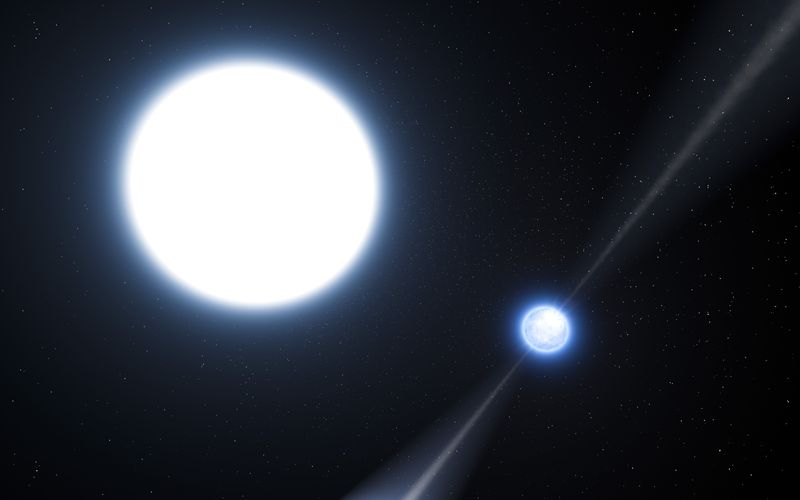
"Possibilities include neutron star mergers, proto-neutron star winds during core-collapse supernovae, and black hole accretion disk outflows in collapsars, among other sources."
An extreme explosion?
A particular puzzle is how the earliest elements were created and distributed throughout the universe before enough time had passed for supernovae, etc to produce them. Neutron stars are thought to have formed too late to account for early heavy elements, for example.
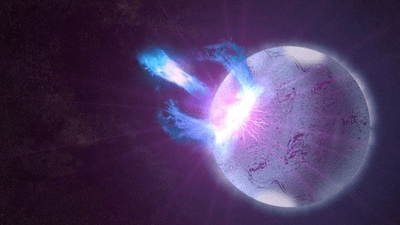
Looking at archival data, that team found support for another potential source: magnetar flares. Theoretical work described heavy elements being forged as magnetar flares heat up and eject the crust of neutron stars, sending the material across the universe at impressive speeds.
Looking at archival data from a giant flare observed in December 2004 and analyzing it, they found that it closely matched the predicted signature of a magnetar producing and ejecting heavy elements during a gigantic flare.
“It's very cool to think about how some of the stuff in my phone or my laptop was forged in this extreme explosion of the course of our galaxy’s history,” Patel added (evidently jewelry-less).
Though we will have to wait to observe more of these events, it is tantalizing evidence in favor of the idea, which the team believes can account for 1-10 percent of the galaxy's heavier elements.
Nevertheless, the material that makes up whatever gold jewelry you are wearing right now was forged in a high-energy event, long before our star and planets coalesced together and formed our Solar System. So give it a polish every now and then.