Space and Physics
 PUBLISHED



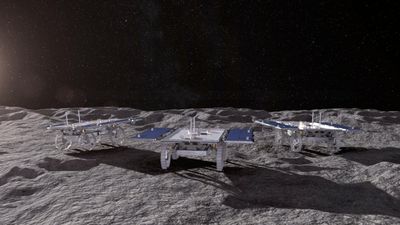


The moon will soon have three new residents who are smart, free-wheeling, and self-reliant: a trio of autonomous rovers that will cruise around the lunar surface and map the land in three dimensions without a meatbag human calling the shots.
The rovers are the stars of NASA's upcoming CADRE (Cooperative Autonomous Distributed Robotic Exploration) mission, set to launch later in 2026.
They consist of four wheels and a cat-crate-sized body containing solar panels, imaging equipment, and novel computer software that allows them to act autonomously.
What will the CADRE rovers get up to?
Once the rovers land on the Reiner Gamma region of the Moon, they will use cameras and ground-penetrating radar to send back imagery of the lunar surface and subsurface.
This work will be coordinated with little direct input from human mission controllers back on Earth. The three rovers will communicate with each other and a base station aboard a lunar lander, using that information to traverse the landscape and make decisions about how to tackle the many steps of their mission.
“The only instruction is, for example, ‘Go explore this region,’ and the rovers figure out everything else: when they’ll do the driving, what path they’ll take, how they’ll maneuver around local hazards,” Jean-Pierre de la Croix, CADRE’s principal investigator from NASA JPL, said in a statement.
“You only tell them the high-level goal, and they have to determine how to accomplish it,” he added.
For instance, mission command might instruct the system to explore a specific patch of the lunar surface. One of the rovers will take the lead, cooking up a strategic plan that will decide how the terrain should be split, taking into account the available resources to each rover and the conditions it faces.
Each rover then gets its own custom briefing and, on its own, uses its sensors to chart a safe route to its target point and carry out the imaging that’s requested. The information will then be relayed back, providing a holistic view of the task at hand.
Workplace hazards on the moon
The level of technology is impressive but not Earth-shaking by the standard of the recent AI boom. Nevertheless, it is a huge challenge to execute this kind of thing on the Moon.
Since the Moon has no atmosphere, the rovers will face the full force of solar radiation and will endure midday temperatures of up to 114°C (237°F). Like an overheating laptop, the extra computing power will pump out even more heat, which would prove fatal for the machines if they weren't properly prepared.
To solve this problem, the CADRE rovers will work in 30-minute wake-sleep cycles that will allow them to periodically shut down, cool off, and recharge their batteries using sunlight. Once they awaken, the rovers will check in with each other, then get back to work.
The legacy of Perseverance
The CADRE are standing on the shoulders of giants. NASA’s Perseverance rover has been exploring the surface of Mars for the past five years, traveling the length of a marathon over its lifetime.
While its course is ultimately guided by humans, a huge amount of that distance has been covered using autonomous self-driving technology.
Speaking to IFLScience in June, NASA rover driver Mark Maimone said: “Rovers have been actively exploring Mars during most of the past 29 years. But it's only recently with Perseverance's self-driving software and hardware that a rover has been able to drive autonomously at nearly its full mechanical top speed.”
“It's a great engineering achievement to have our latest Mars rover able to drive itself quickly enough that self-driving is now the primary way we accomplish long drives. In fact, over 90% of all driving on Perseverance is now being done autonomously,” explained Maimone.
CADRE's rovers will build on this legacy over their 14-day mission, running a variety of experiments to test their capabilities.
Make no mistake: the era of autonomous space exploration is already upon us.