Space and Physics
 PUBLISHED



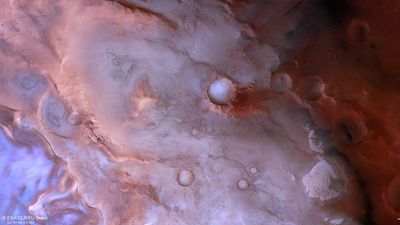


ESA, the European Space Agency, has released a beautiful image of Mars unlike any you've seen before. While on one side the crimson hue of the planet's characteristic soil is visible, the photo shows the whites, pinks, and purples of the frosty extents of the Martian Southern Pole.
It is almost a winter wonderland scene, but it was taken while the southern hemisphere of Mars was experiencing spring. On some of the southern highlands, frost is something that remains all year round, no matter the season.
ESA’s Mars Express used its High Resolution Stereo Camera to take the shot. In the bottom left corner, you can see a stunning glacier with colorful swirls that have an almost iridescent hue. More on that in a minute.
Just next to it, there’s the focus of the observations, Thyles Rupes, a sinuous ridgeline that bisects a half-moon crater just a short distance away from the glacier. "Rupes" is the Latin word for cliff, and "Thyle" is a reference to Thule – a legendary location found in many ancient maps.
Unfortunately, Thule is now associated with an occult German society that helped the Nazis come to power. A celestial object originally named Ultima Thule was later renamed Arrokoth by NASA once the connection became known.
The two craters on the cliffs tell us something about how the ridgeline formed. The large half-moon crater predates the formation of the ridge. The smaller round one instead formed after the cliff was raised from the surrounding highland.
Another location of note is the edge between the red sand and the white ice. The black deposits there (and elsewhere in the image) are volcanic material from a time when Mars still had powerful volcanoes. Olympus Mons, now extinct, was once volcanically active and remains the tallest mountain in the Solar System.
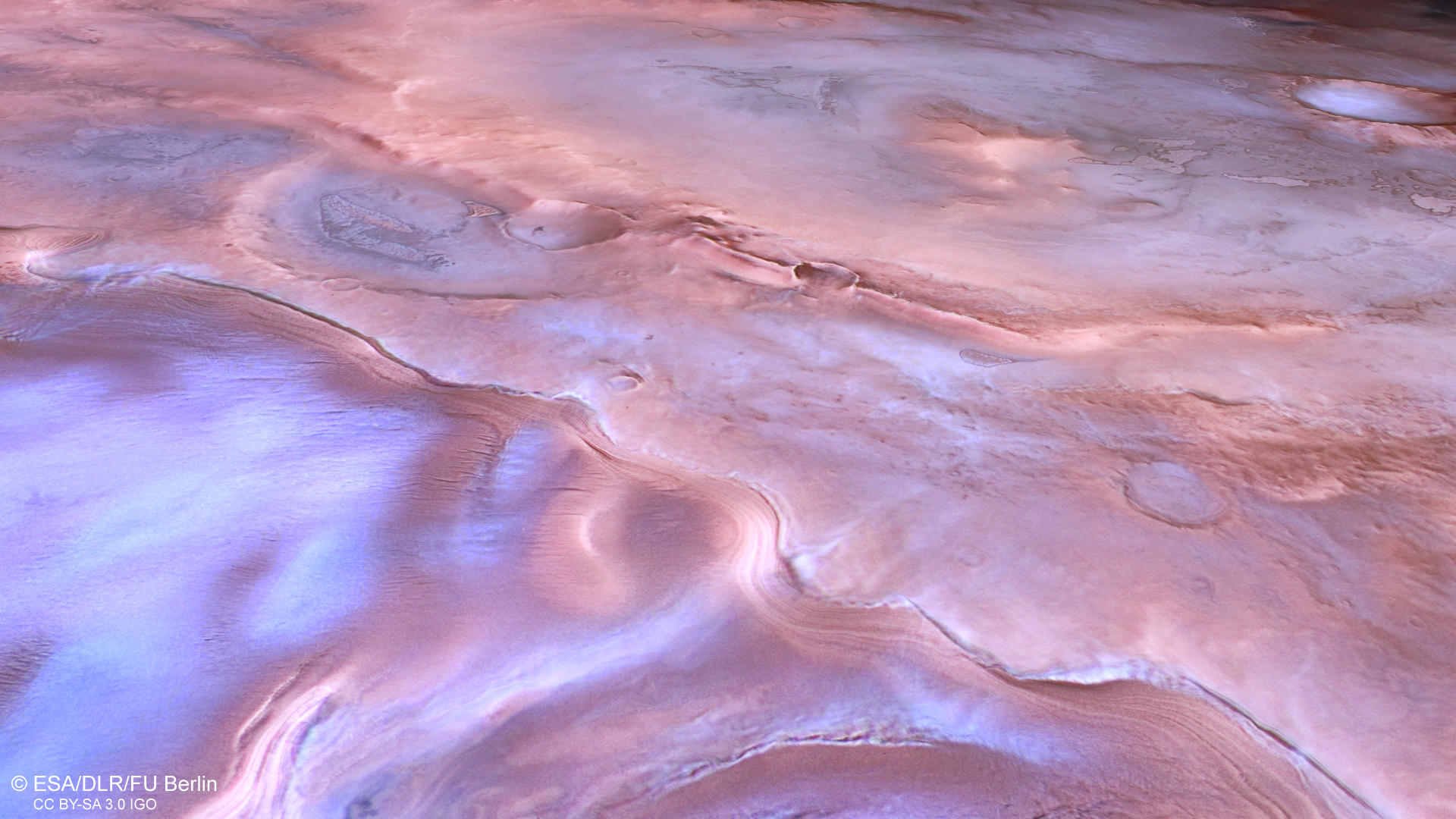
One further point of interest is the very white patch that looks almost rough towards the bottom right of the image. Those are frost-covered dunes (most likely carbon-dioxide frost).
So why does the whole region look like berry-flavored ice cream? It's down to a mixture of light effects, dust, and frost. It's also partly because the image was taken in the morning. The soft early light, when combined with the dusty air of Mars and overlaid on the ice-covered ground, produces these peculiar purple swirls.
These make the glacier particularly enchanting. This glacier is actually a part of the vast South Polar Cap, a broad frozen region that can even be spotted by amateur telescopes on Earth when conditions are right. It isn't really purple, but from orbit at that particular time, it did look like it was.