Space and Physics
 PUBLISHED


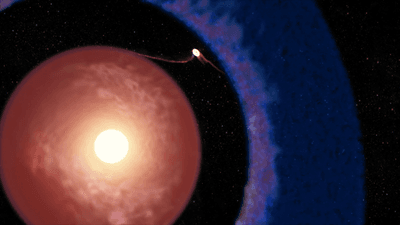


Meet the new kid on the block, literally! Exoplanet Elias 2-24 b is officially the youngest known planet. It is less than 1 million years old, and thanks to its young age, it is providing a truly unique look at how gas giant planets form.
It orbits a star located 450 light-years from Earth, and it is about as massive as Jupiter. Young stars are surrounded by disks of material and, as planets form, gaps appear within them – just like grooves on a record. Elias 2-24b is located right in the middle of one of these gaps.
“What makes Elias 2-24 b so remarkable is its age,” lead author Andrea Bernardi, a doctoral student at Diego Portales University, said in a statement.
“This is the youngest planet detected so far, and because it is still actively accreting material from its surroundings, we’re able to observe a stage of planet formation that is rarely seen directly.”
There are two leading theories for the formation of gas giant planets. They could form from the clumps collapsing in on themselves or via so-called ‘core accretion.’ The latter suggests that dust grains become pebbles, pebbles become stone, and eventually planets, pulling in as much gas as they can before the stars push it away.
Elias 2-24b shows that core accretion is the way to go, and in particular, this baby planet is undergoing a phase of the core accretion process that we struggle to model.
“Our planet-formation models already struggled to explain the previous record holders for the youngest known planet – a four-way tie between two planets orbiting the star PDS 70 and two planets orbiting the star WISPIT 2 – which are all more than 5 million years old,” co-author Professor Lucas Cieza, a professor at the Instituto de Estudios Astrofísicos in Chile, explained in another statement.
“Elias 2-24 b shows us that even our best planet-formation models are still missing some important processes.”
“This system will therefore provide key insights once we are able to further constrain its dynamical mass, helping us refine and recalibrate evolutionary models for young planets,” added Professor Alice Zurlo from Diego Portales University.
Zurlo was one of the researchers who studied the system with the Keck Observatory back in 2018. She and her team found a hint of the planet back then, though unfortunately it was not enough to claim a discovery.
A new analysis of that data with modern techniques, combined with more archival Keck observations obtained in 2020, as well as observations from the Very Large Telescope and ALMA, finally revealed what was sort-of-hiding in this system.
“Astronomical data can have a remarkably long shelf life,” said Keck Observatory Chief Scientist John O’Meara. “The observations existed for years, but new techniques, improved models, and a fresh look at the data revealed something extraordinary.”
The team now plans more detailed observations to measure a variety of properties on the baby planet: accurate mass, size, temperature, and rate of growth.
“This system has become a laboratory for understanding how planets form,” Cieza said. “Every new observation helps us piece together one of the most complex puzzles in modern astrophysics, the origin of planetary systems like our own.”
The study is published in The Astrophysical Journal Letters.